The Role of Early Maladaptive Schemas, Resilience, and Coping Styles in Predicting Intolerance of Uncertainty among Female Nurses
DOI:
https://doi.org/10.61838/kman.pwj.4390Keywords:
intolerance of uncertainty, early maladaptive schemas, resilience, coping styles, female nursesAbstract
Objective: This study aimed to examine the predictive role of early maladaptive schemas, resilience, and coping styles in explaining intolerance of uncertainty among female nurses in Tehran.
Methods and Materials: The research employed a correlational descriptive design. The study population consisted of female nurses working in hospitals across Tehran, from which 410 participants were selected using the Morgan and Krejcie sample size table. Data were collected using the Intolerance of Uncertainty Scale, the Young Schema Questionnaire–Short Form, the Connor–Davidson Resilience Scale, and the Coping Inventory for Stressful Situations. Data analysis was performed using SPSS version 27. Descriptive statistics were reported, Pearson correlations were conducted to examine bivariate relationships, and multivariate linear regression was used to identify predictors of intolerance of uncertainty. Assumptions of regression analysis were tested and confirmed.
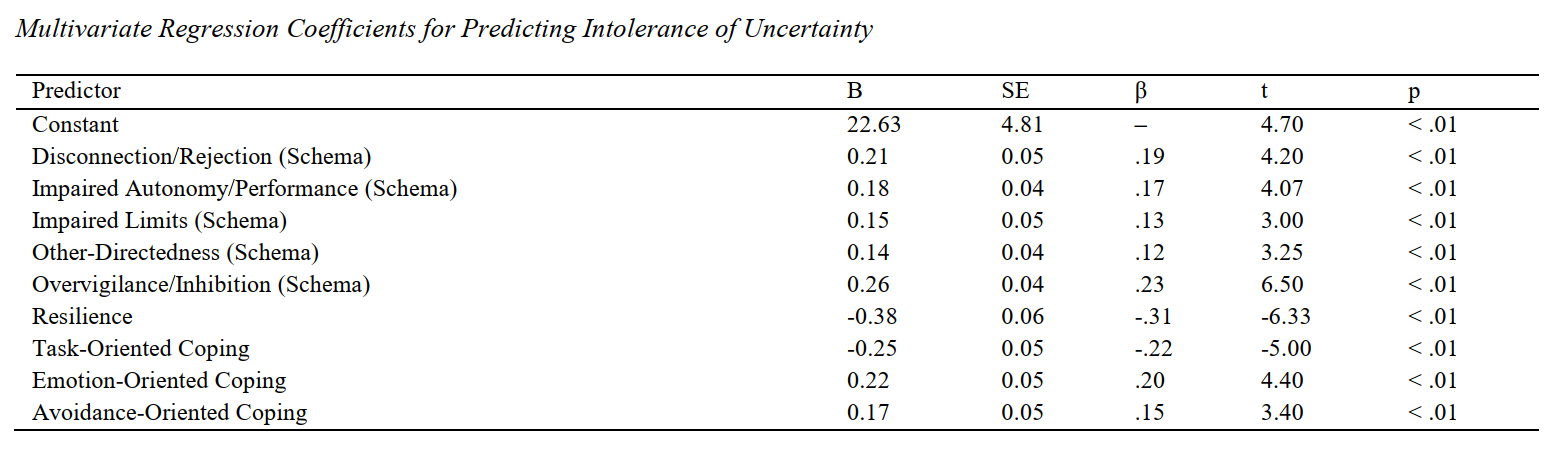
Findings: Results indicated that all schema domains were significantly and positively correlated with intolerance of uncertainty (r values ranging from .39 to .56, all p < .01). Resilience (r = –.48, p < .01) and task-oriented coping (r = –.44, p < .01) were negatively correlated with intolerance of uncertainty, whereas emotion-oriented coping (r = .41, p < .01) and avoidance-oriented coping (r = .37, p < .01) were positive correlates. The regression model was statistically significant, F(9, 400) = 78.62, p < .01, with R² = .41, indicating that the predictors explained 41% of the variance in intolerance of uncertainty. Overvigilance/inhibition (β = .23, p < .01) and disconnection/rejection (β = .19, p < .01) emerged as the strongest schema-related predictors, while resilience (β = –.31, p < .01) and task-oriented coping (β = –.22, p < .01) were protective factors.
Conclusion: The findings demonstrate that maladaptive schemas and maladaptive coping styles increase intolerance of uncertainty, whereas resilience and task-oriented coping reduce it. These results underscore the need for schema-focused interventions, resilience-building programs, and coping-skills training to enhance psychological well-being among nurses.
Downloads
References
Aftab, R., & Shams, A. (2020). Relationship Between Integrated Self-Knowledge and Resilience with Anxiety of Being Infected by COVID-19: The Mediating Role of Intolerance of Ambiguity, Worry, and Physical Activity. Sport Psychology Studies, 9(32), 201-226. https://doi.org/10.22089/spsyj.2020.9010.1975
Ahmadi, G., & Siyahi, A. (2017). Investigating the predictive role of psychological toughness and ambiguity tolerance in the resilience of military forces. Military Psychology, 8(30), 91-90. https://jmp.ihu.ac.ir/article_201252_c76f5ad941197568d1a850193bc7dd26.pdf
Carnahan, N. D., Carter, M. M., & Sbrocco, T. (2022). Intolerance of uncertainty, looming cognitive style, and avoidant coping as predictors of anxiety and depression during COVID-19: a longitudinal study. International Journal of Cognitive Therapy, 15(1), 1-19. https://doi.org/10.1007/s41811-021-00125-7
Chesnokova, O., Churbanova, S., Molchanov, S., & Markish, O. (2022). The role of social intelligence and creativity as personal resources for coping with uncertainty during primary career self-determination in late adolescence. European Psychiatry, 65(S1), S335-S335. https://doi.org/10.1192/j.eurpsy.2022.852
Durna, N. B., Durna, D., & Seçer, İ. (2022). The Mediating Role of Psychological Resilience in the Relationship Between Emotional Reactivity, Intolerance of Uncertainty and Psychological Maladjustment in Children Receiving Orthodontic Treatment. Healthcare, 10(8), 1505. https://doi.org/10.3390/healthcare10081505
Golavari, M., & Khayatan, F. (2022). The Effectiveness of Schema Therapy on The Ambiguity Tolerance and Resilience in Mothers of Children with Attention Deficit Hyperactivity Disorder. Journal of Clinical Psychology and Personality, 20(1). https://cpap.shahed.ac.ir/article_3864.html
Hashemi Saraj, R., Toozandehjani, H., & Zendehdel, A. (2022). Comparison of the effectiveness of short-term solution-oriented psychotherapy and schema therapy on perturbation tolerance and unbearable intolerance in women with mental disorders. frooyesh, 11(3), 207-218. http://frooyesh.ir/article-1-3534-en.html
Ke, T., & Barlas, J. (2020). Thinking about feeling: Using trait emotional intelligence in understanding the associations between early maladaptive schemas and coping styles. Psychology and Psychotherapy: Theory, Research and Practice, 93(1), 1-20. https://doi.org/10.1111/papt.12202
Khoshnevis, E., Ahmadzadeh, S., & Zomorodi, S. (2018). The Effectiveness of Schema Therapy-based Training on Generalized Anxiety, Intolerance of Uncertainty and Cognitive Distortion in University Students. Health and Development Journal, 7(3), 250-261. https://doi.org/10.22062/jhad.2018.91292
Makhdoumi, M., Abolghasemi, S., & Khane Kashi, A. (2024). The Effectiveness of Schema Therapy on Worry States and Intolerance of Uncertainty in Individuals with Generalized Anxiety Disorder. Journal of Psychological Sciences, 23(144), 95-79. https://doi.org/10.61186/jps.23.144.5
Moharrami, S., Nasab, D. H., & Vafa, M. A. (2024). Comparison of the Effectiveness of Schema Therapy and Acceptance and Commitment Therapy on Ambiguity Tolerance in Male High School Students. Jayps, 5(5), 41-49. https://doi.org/10.61838/kman.jayps.5.5.6
Narimani, M., Malekshahifar, M., & Mahmoudi, N. (2009). Coping skills and Ambiguity Tolerance in Withdrawal Girls. https://www.sid.ir/paper/96323/en
Penyavskaya, A. V. (2023). Coping Behavior in Young People With Different Levels of Ambiguity Tolerance. Sibscript, 25(5), 665-676. https://doi.org/10.21603/sibscript-2023-25-5-665-676
Vafadar, A., Mirzamani Bafghi, S. M., & Jafari Roshan, M. (2021). Comparing the effectiveness of acceptance and commitment-based training and emotional schema therapy on attentional bias, intolerance of uncertainty, and cognitive avoidance in women with generalized anxiety disorder. Journal of Disability Studies, 11(194), 3-17. https://jdisabilstud.org/article-1-2176-fa.html
Yeganeh Rad, N., Tozandehjani, H., & Bagherzadeh Golmakani, Z. (2020). Comparison of the effectiveness of schema therapy and compassion-based therapy on resilience and tolerance of ambiguity in women seeking divorce. Scientific Quarterly of Psychological Methods and Models, 11(41), 89-112.
Yu, M., Wang, H., & Xia, G. (2022). The review on the role of ambiguity of tolerance and resilience on students' engagement. Frontiers in psychology, 12. https://doi.org/10.3389/fpsyg.2021.828894
Zamani, S., & Zolfaghari, M. (2022). The Relationship Between Mindfulness and Tolerance of Ambiguity with Death Anxiety and Improving Sleep Quality in the Elderly. Aging Psychology, 8(3), 299-310. https://doi.org/10.22126/jap.2023.8258.1649
Zhang, Z., Meng, Y., Ma, T., & Zhang, Y. (2022). Childhood Trauma and Anxiety: The Chain Mediating Effects of Intolerance of Uncertainty and Proactive Coping. Asian Journal of Social Science Studies, 7(6), 89. https://doi.org/10.20849/ajsss.v7i6.1213
Zlomke, K. R., & Jeter, K. M. (2014). Stress and worry: examining intolerance of uncertainty's moderating effect. Anxiety, Stress, & Coping, 27(2), 202-215. https://doi.org/10.1080/10615806.2013.835400
Downloads
Additional Files
Publication Timeline
- Submitted
- Revised
- Accepted
Issue
Section
License
Copyright (c) 2025 Mohammad Najafi Aliehkolaei, Nazgol Malek Mohammadi , Fatemeh Momeni (Author); Shaghayegh Abedi (Corresponding Author); Elham Mostafavi , Zohreh Zadhasan (Author)

This work is licensed under a Creative Commons Attribution-NonCommercial 4.0 International License.