Can Self-Repair Training Help Women with Symptoms of Borderline Personality Disorder? A Quasi-Experimental Study
DOI:
https://doi.org/10.61838/Keywords:
self-repair training, self-regulation, neurotic defense mechanisms, women with symptoms of borderline personality disorderAbstract
Objective: The present study was conducted to determine the capacity of self-repair training to help women with symptoms of borderline personality disorder improve self-regulation and weaken neurotic defense mechanisms.
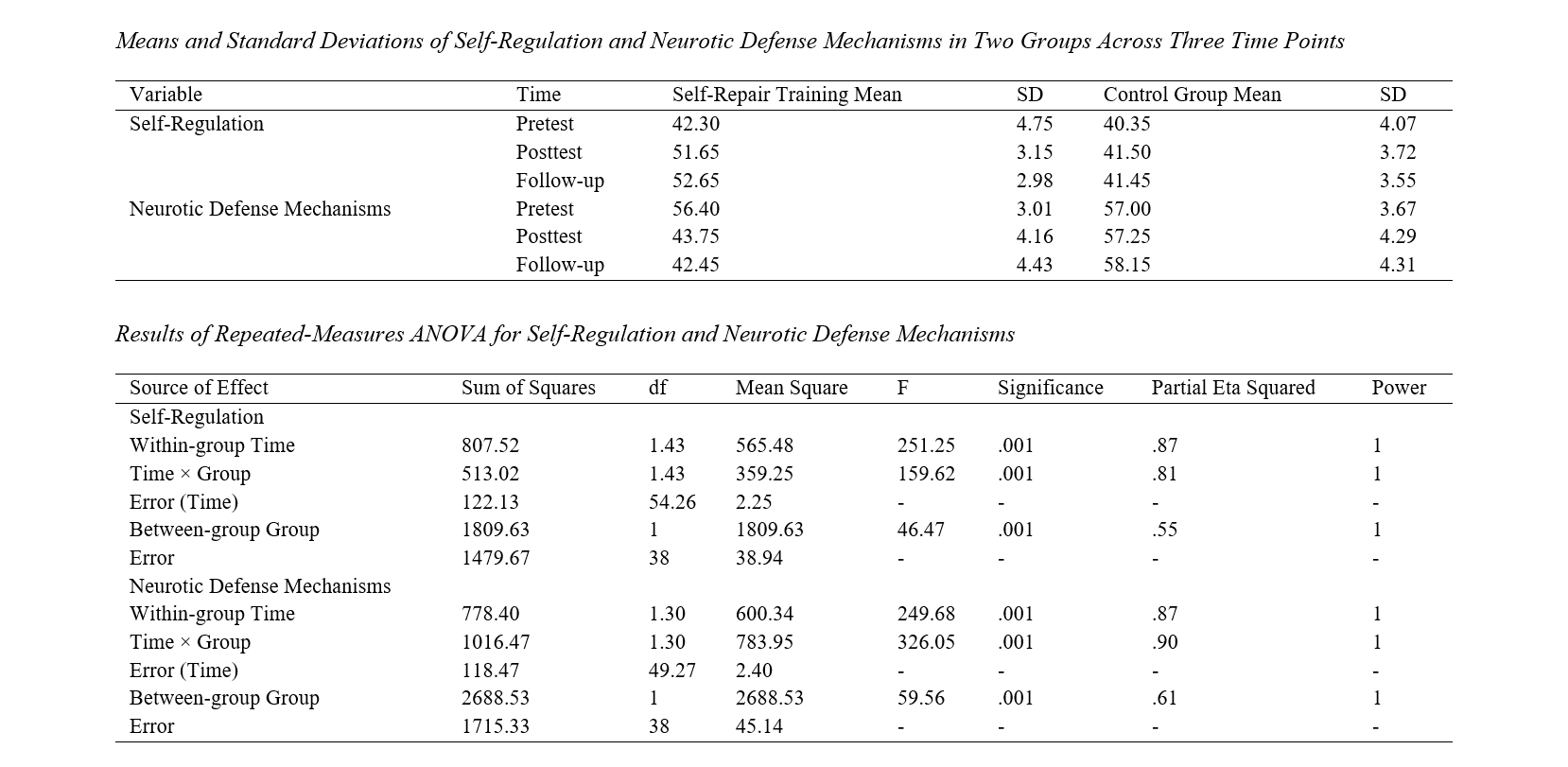
Methods and Materials: This study employed a quasi-experimental design with three stages: pretest, posttest, and follow-up, along with a control group. The statistical population consisted of women with symptoms of borderline personality disorder in the city of Isfahan during the summer of 2025 who were referred to four centers active in this field. Among them, 40 women were purposively selected and assigned to an experimental group and a control group (20 participants in each group). The Self-Regulation Questionnaire (Gratz & Roemer, 2004) and the Neurotic Defense Mechanisms Questionnaire (Andrews et al., 1993) were used to assess the dependent variables at the three stages. The self-repair training group received training over 10 sessions, whereas the control group received no training. Data were analyzed using repeated-measures analysis of variance and Bonferroni post hoc test in SPSS version 26.
Findings: The results showed that there was a significant difference between the self-repair training group and the control group in the variables of self-regulation and neurotic defense mechanisms (p < .05). This means that self-repair training helped women with symptoms of borderline personality disorder improve their level of self-regulation and, in contrast, reduce their use of neurotic defense mechanisms.
Conclusion: Therefore, self-repair training can be used in treatment centers to help women struggling with symptoms of borderline personality disorder.
Downloads
Downloads
Additional Files
Publication Timeline
- Submitted
- Revised
- Accepted