Artificial Neural Network Prediction of Psychological Well-Being Among Women Using Emotional, Cognitive, and Social Features
Keywords:
Psychological Well-Being, Artificial Neural Network, Self-Efficacy, Loneliness, Cognitive Flexibility, Social Support, Women, Machine LearningAbstract
Objective: This study aimed to develop and evaluate an artificial neural network model for predicting psychological well-being among women in Canada based on emotional, cognitive, and social features.
Methods and Materials: This cross-sectional predictive study was conducted among 428 adult women residing in Canada. Participants were recruited through community, academic, workplace, and online networks. Psychological well-being was assessed using Ryff’s Psychological Well-Being Scale. Emotional predictors included cognitive reappraisal, expressive suppression, and emotional intelligence; cognitive predictors included cognitive flexibility, self-efficacy, and mindfulness; and social predictors included perceived social support, social connectedness, and loneliness. Pearson correlations were used to examine bivariate relationships among variables. A multilayer perceptron artificial neural network with two hidden layers was developed using nine standardized input features. The dataset was randomly divided into training, validation, and testing subsets of approximately 70%, 15%, and 15%, respectively. Model performance was evaluated using mean squared error, root mean squared error, mean absolute error, coefficient of determination, and correlations between observed and predicted scores.
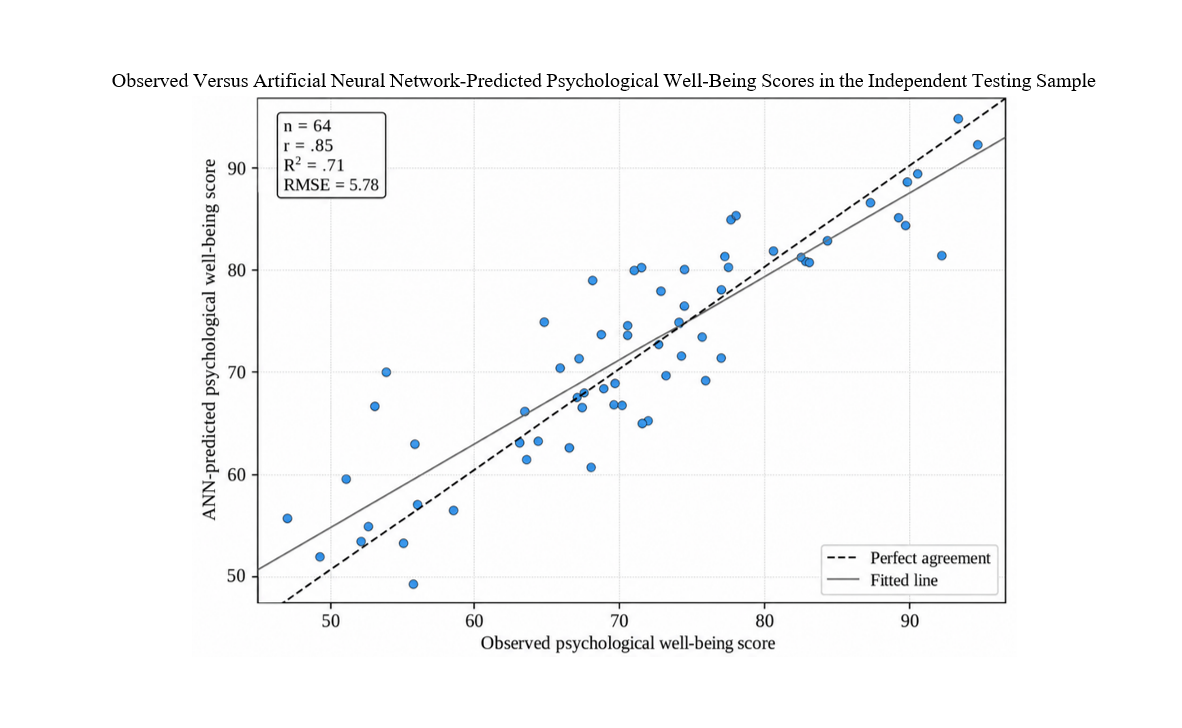
Findings: Psychological well-being was positively associated with self-efficacy, cognitive flexibility, perceived social support, emotional intelligence, social connectedness, mindfulness, and cognitive reappraisal, and negatively associated with loneliness and expressive suppression (all p < .001). The ANN demonstrated strong predictive performance, explaining 78% of variance in the training set, 73% in the validation set, and 71% in the independent testing set. In the test sample, RMSE was 5.78, MAE was 4.61, and the correlation between observed and predicted scores was .85. Self-efficacy showed the highest normalized importance, followed by loneliness, cognitive flexibility, perceived social support, and emotional intelligence. Cognitive and social domains contributed 40.20% and 40.60% of total predictive importance, respectively.
Conclusion: Psychological well-being among women can be predicted with substantial accuracy using an integrated set of emotional, cognitive, and social features, with self-efficacy, loneliness, cognitive flexibility, and social support emerging as particularly influential predictors.
Downloads
References
Ao, L., & Xia, Y. (2026). How Pre-Travel Mood and Personality Predict Destination Preferences: Insights From Social Media Data. https://doi.org/10.21203/rs.3.rs-8854510/v1
Atagün, M. İ. (2025). Longitudinal Trajectories of Major Depressive Disorder Provide Further Clinical Perspectives for Precision Psychiatry. Psychiatry and Clinical Neurosciences Reports, 4(4). https://doi.org/10.1002/pcn5.70221
Burback, L., Brémault‐Phillips, S., Nijdam, M. J., McFarlane, A. C., & Vermetten, E. (2024). Treatment of Posttraumatic Stress Disorder: A State-of-the-Art Review. Current Neuropharmacology, 22(4), 557-635. https://doi.org/10.2174/1570159x21666230428091433
Carbone, E., Piras, F., Pellegrini, F. F., Caffarra, P., & Borella, E. (2022). Individual Differences Among Older Adults With Mild and Moderate Dementia in Social and Emotional Loneliness and Their Associations With Cognitive and Psychological Functioning. BMC Geriatrics, 22(1). https://doi.org/10.1186/s12877-022-03517-2
Chatterjee, D., & Rai, R. (2023). Behind the Screens: Proposing a Mentalization-Based Theoretical Model of Problematic Internet Use. Cyberpsychology Journal of Psychosocial Research on Cyberspace, 17(5). https://doi.org/10.5817/cp2023-5-6
Chen, S., Vermol, V. V., Yu, J., & Jiang, H. (2026). Immersive Metaverse Art as a Psychological Intervention for Depression and Anxiety: A Narrative Review and Multilevel Model Integrating Engagement, Cultural Identity, and Neurocognitive Mechanisms. Frontiers in psychology, 17. https://doi.org/10.3389/fpsyg.2026.1829947
Crespo, D. P., Carrasco, P. M., Mardomingo, C. D., Villalba‐Mora, E., & Montenegro-Peña, M. (2024). Social Loneliness in Older Adults With Mild Cognitive Impairment: Predictive Factors and Associated Clinical Characteristics. Journal of Alzheimer’s Disease, 97(2), 697-714. https://doi.org/10.3233/jad-230901
Cundiff, J. M., Cribbet, M. R., & Birmingham, W. C. (2025). Introduction to the Special Issue Social Influences on Physical Health: Patterns, Mechanisms, and Solutions. Health Psychology, 44(5), 409-412. https://doi.org/10.1037/hea0001510
Darwesh, A. A. A., Batarfi, R. M., Abdelmohsen, A. M., & Hegazy, R. M. (2026). “Investigating Predictive Associations Among Postural Balance, Functional Mobility, Cognitive Function and Psychological Well‐Being in Patients With Multiple Sclerosis: A Cross‐Sectional Study”. Physiotherapy Research International, 31(2). https://doi.org/10.1002/pri.70213
Elbayomy, D. R. M., & Metwally, A. H. (2023). The Impact of Social Comparison on Consumer Well-Beingliterature Review. المجلة العملیة التجارة والتمویل, 43(3), 185-234. https://doi.org/10.21608/caf.2023.317362
Fabrizio, C., Picerni, E., Laricchiuta, D., Decandia, D., Piras, F., Termine, A., Spalletta, G., Petrosini, L., & Cutuli, D. (2024). The Psychological and Neuro-Morphological Predictors of Resilience in Healthy Adults: The Whole Is More Than the Sum of Its Parts. https://doi.org/10.21203/rs.3.rs-4485591/v1
Fabrizio, C., Picerni, E., Laricchiuta, D., Decandia, D., Piras, F., Termine, A., Spalletta, G., Petrosini, L., & Cutuli, D. (2025). Psychological and Neuro-Morphological Predictors of Resilience in Healthy Adults: The Whole Is More Than the Sum of Its Parts. Frontiers in Neuroscience, 19. https://doi.org/10.3389/fnins.2025.1597835
Fu, W., Li, R., & Liang, Y. (2023). The Relationship Between Stress Perception and Problematic Social Network Use Among Chinese College Students: The Mediating Role of the Fear of Missing Out. Behavioral Sciences, 13(6), 497. https://doi.org/10.3390/bs13060497
Garzón‐Partida, A. P., Padilla-Gómez, C. B., Fernández, D., Garcı́a‐Estrada, J. n., Luquı́n, S., & Fernández-Quezada, D. (2025). The Implementation of Digital Biomarkers in the Diagnosis, Treatment and Monitoring of Mood Disorders: A Narrative Review. Frontiers in Digital Health, 7. https://doi.org/10.3389/fdgth.2025.1595243
Grecucci, A., Dadomo, H., Salvato, G., Lapomarda, G., Sorella, S., & Messina, I. (2023). Abnormal Brain Circuits Characterize Borderline Personality and Mediate the Relationship Between Childhood Traumas and Symptoms: A mCCA+jICA and Random Forest Approach. Sensors, 23(5), 2862. https://doi.org/10.3390/s23052862
Hossain, S. B., Rahman, M. M., Giash, K. B., Ali, M. H., Akter, M. R., & Chowdhury, A. B. M. A. (2025). Prediction and Feature Selection of Mastectomy-Related Post Traumatic Stress Disorder (PTSD) Using Machine Learning Among Breast Cancer Patients in Bangladesh. Cancer Informatics, 24. https://doi.org/10.1177/11769351251401330
Jowf, G. I. A., Ahmed, Z. T., Reijnders, R. A., Nijs, L. d., & Eijssen, L. (2023). To Predict, Prevent, and Manage Post-Traumatic Stress Disorder (PTSD): A Review of Pathophysiology, Treatment, and Biomarkers. International Journal of Molecular Sciences, 24(6), 5238. https://doi.org/10.3390/ijms24065238
Krause-Utz, A., Saygin, M., Podbylska, M., Chatzaki, E., Rosa, B. A., & Lis, S. (2025). Interpersonal Emotion Regulation, Borderline Personality Disorder Symptoms, and Working Memory During Social-Affective Distraction. Personality Disorders Theory Research and Treatment, 16(3), 210-222. https://doi.org/10.1037/per0000722
Liu, Y. (2024). Multilayer Perceptron-Based Literature Reading Preferences Predict Anxiety and Depression in University Students. Frontiers in psychology, 15. https://doi.org/10.3389/fpsyg.2024.1425471
Liu, Y., Yu, H., Shi, Y., & Ma, C. (2023). The Effect of Perceived Stress on Depression in College Students: The Role of Emotion Regulation and Positive Psychological Capital. Frontiers in psychology, 14. https://doi.org/10.3389/fpsyg.2023.1110798
Mavroudis, I., Petridis, F., Karantali, E., Ciobîcă, A., Papagiannopoulos, S., & Kazis, D. (2025). Post-Concussion Syndrome and Functional Neurological Disorder: Diagnostic Interfaces, Risk Mechanisms, and the Functional Overlay Model. Brain Sciences, 15(7), 755. https://doi.org/10.3390/brainsci15070755
Mejía-Suazo, C. J., Landa–Blanco, M., Mejía-Suazo, G. A., & Martínez‐Martínez, C. A. (2025). Personality Traits and Digital Challenges in Honduran Adults: Exploring the Dark and Light Triads’ Influence on Internet Gaming Disorder and Technology-Related Conflicts. Frontiers in Public Health, 13. https://doi.org/10.3389/fpubh.2025.1485264
Memarzia, J., Lofthouse, K., Dalgleish, T., Boyle, A., McKinnon, A., Dixon, C., Smith, P., & Meiser‐Stedman, R. (2024). Predictive Models of Post-Traumatic Stress Disorder, Complex Post-Traumatic Stress Disorder, Depression, and Anxiety in Children and Adolescents Following a Single-Event Trauma. Psychological medicine, 54(12), 3407-3416. https://doi.org/10.1017/s0033291724001648
Nogueira, M. J. (2023). Positive and Negative Predictors of Mental Health in College Students. A Cross-Sectional Predictive Study. https://doi.org/10.21203/rs.3.rs-2535420/v1
Rapelli, G., Spatola, C. A. M., Landi, G., Tossani, E., Grandi, S., Martino, G., Castelnuovo, G., Pietrabissa, G., & Cattivelli, R. (2025). Applying Ecological Momentary Assessment (EMA) to Understand Overweight and Obesity: A Systematic Review. Journal of Personalized Medicine, 15(11), 526. https://doi.org/10.3390/jpm15110526
Shi, H., Yang, L., Fang, Y., Lu, H., Huang, Y., Xiao, Z., Long, Y., Li, P., Shi, F., Liao, H., & Yin, X. (2026). External Factors Show Reproducible Local Symptom-Biomarker Associations in Middle-Aged and Older Adults With Heart Disease. Frontiers in Psychiatry, 17. https://doi.org/10.3389/fpsyt.2026.1870992
Sun, F. (2025). The Relationship of Physical Exercise and Suicidal Ideation Among College Students: A Moderated Chain Mediation Model. Frontiers in psychology, 16. https://doi.org/10.3389/fpsyg.2025.1624998
Tecuta, L., Gardini, V., Schumann, R., Ballardini, D., & Tomba, E. (2021). Irrational Beliefs and Their Role in Specific and Non-Specific Eating Disorder Symptomatology and Cognitive Reappraisal in Eating Disorders. Journal of clinical medicine, 10(16), 3525. https://doi.org/10.3390/jcm10163525
Wang, F., Xu, P., Huang, Y., Liu, L., & Yang, F. (2025). Social Anxiety Prediction Model for Nursing Students Based on Machine Learning: A Cross-Sectional Survey. Frontiers in Psychiatry, 16. https://doi.org/10.3389/fpsyt.2025.1721618
Yeo, J. J., Chew, Q. H., & Sim, K. (2021). Resilience and Its Inter‐relationship With Symptomatology, Illness Course, Psychosocial Functioning, and Mediational Roles in Schizophrenia: A Systematic Review. Asia-Pacific Psychiatry, 14(2). https://doi.org/10.1111/appy.12486
Zhang, X., Hulvershorn, L. A., Constable, R. T., Zhao, Y., & Wang, S. (2025). Cost Efficiency of fMRI Studies Using Resting‐State vs. Task‐Based Functional Connectivity. Human Brain Mapping, 46(9). https://doi.org/10.1002/hbm.70260
Downloads
Additional Files
Publication Timeline
- Submitted
- Revised
- Accepted