The Effectiveness of Schema Therapy on Self-Esteem, Self-Compassion, and Loneliness in Divorced Women with Depressive Symptoms: A Case Study
Keywords:
Schema therapy, self-esteem, self-compassion, loneliness, depressive symptoms, case studyAbstract
Objective: This study aimed to investigate the effectiveness of schema therapy in improving self-esteem and self-compassion and reducing loneliness among divorced women with depressive symptoms.
Methods and Materials: This applied study was conducted using a single-case experimental design with a multiple-baseline structure. The statistical population consisted of divorced women with depressive symptoms who referred to counseling and treatment centers in Khoy, Iran, in 2025. Three participants were selected through purposive sampling based on the inclusion criteria, including elevated depression scores on the Beck Depression Inventory. The participants received a 10-session schema therapy protocol based on Young’s model. Data were collected using the Rosenberg Self-Esteem Scale, Neff Self-Compassion Scale, and Russell Loneliness Scale. The data were analyzed through visual analysis, including level, trend, stability, immediate change, and overlap indices, as well as quantitative indices including reliable change index, effect size, and mean percentage of improvement.
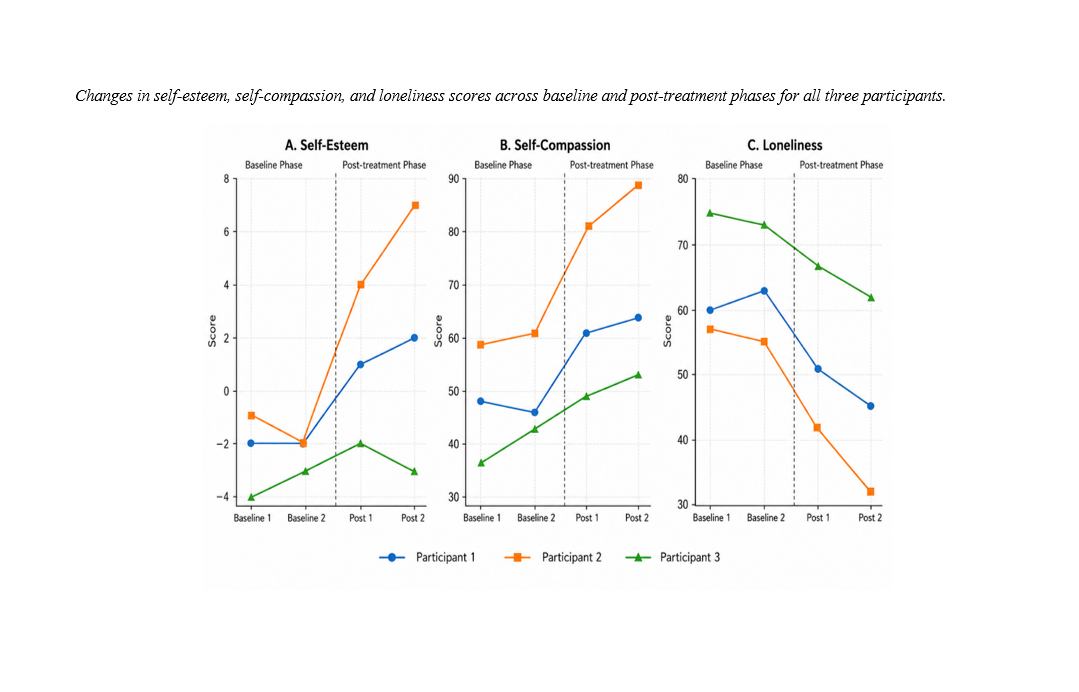
Findings: The results of visual and quantitative analyses indicated that schema therapy produced clinically meaningful and stable improvements in all target variables. The intervention had a large effect on self-esteem, with an effect size of 3.71, indicating a substantial increase after treatment. Self-compassion also improved significantly, with a large effect size of 1.84. In addition, loneliness showed a meaningful reduction, with a large negative effect size of -1.68. All components of self-compassion, including self-kindness, self-judgment, common humanity, isolation, mindfulness, and over-identification, demonstrated statistically meaningful improvement patterns. The reliable change indices and improvement percentages confirmed the stability and clinical significance of the therapeutic changes across participants.
Conclusion: Schema therapy appears to be an effective psychological intervention for enhancing self-esteem and self-compassion and reducing loneliness in divorced women with depressive symptoms.
Downloads