Comparing the Effectiveness of Compassion-Focused Therapy and Logotherapy in Reducing Feelings of Emptiness Among Patients with Multiple Sclerosis
Keywords:
Compassion-Focused Therapy, Feelings of Emptiness, Logotherapy, Multiple Sclerosis, Psychological InterventionAbstract
Objective: This study aimed to compare the effectiveness of compassion-focused therapy and logotherapy in reducing feelings of emptiness among women diagnosed with multiple sclerosis.
Methods and Materials: This quasi-experimental study employed a pretest–posttest control-group design with a six-month follow-up. The statistical population comprised all female patients with multiple sclerosis who attended hospitals affiliated with Islamic Azad University in Tehran between September 2025 and March 2026. Using purposive sampling, 45 eligible patients were selected and randomly assigned to compassion-focused therapy, logotherapy, and control groups, with 15 participants in each group. Data were collected using Reker’s Life Attitude Profile (1992). The intervention groups received compassion-focused therapy based on Gilbert’s protocol and logotherapy based on Frankl’s approach and the protocol developed by Bahaeloo Horeh and Khosh Akhlagh, whereas the control group received no psychological intervention during the study period. Assessments were conducted at the pretest, posttest, and six-month follow-up stages. The data were analyzed using the chi-square test and mixed-design analysis of variance in SPSS version 26.
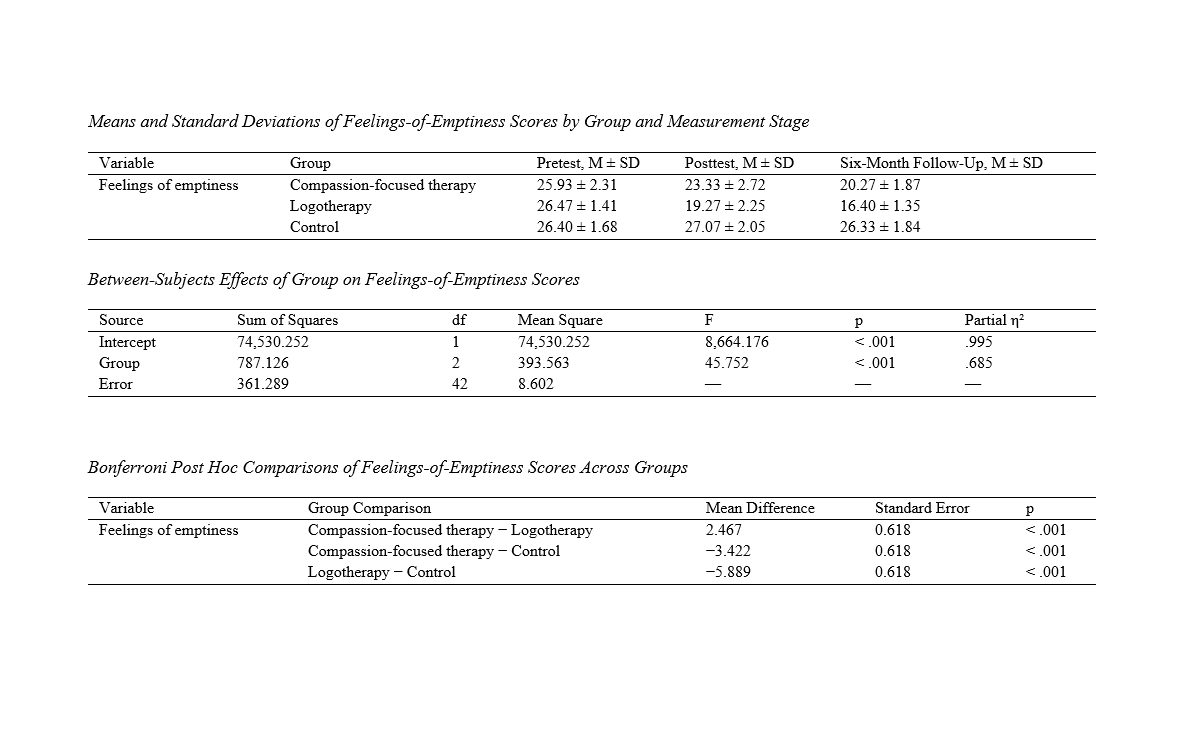
Findings: Mixed-design analysis of variance indicated significant effects of time, group, and the time-by-group interaction on feelings of emptiness (p < .05). Both compassion-focused therapy and logotherapy produced significant reductions in feelings of emptiness from pretest to posttest compared with the control group. Pairwise comparisons further demonstrated that logotherapy resulted in a significantly greater reduction in feelings of emptiness than compassion-focused therapy (p < .05).
Conclusion: Both compassion-focused therapy and logotherapy are effective psychological interventions for reducing feelings of emptiness among women with multiple sclerosis, although logotherapy appears to produce stronger and more persistent therapeutic effects. Logotherapy may therefore be prioritized in psychological rehabilitation programs designed to improve existential well-being in this clinical population.
Downloads
References
Asadollahzadeh, E., Ebadi, Z., Owji, M., Rezaeimanesh, N., Sahraian, M., & Moghadasi, A. (2025). Exploring the Relationship between Disability Status, Depression, and Quality of Life in Individuals with Multiple Sclerosis. Multiple Sclerosis and Related Disorders, 87, 105629. https://doi.org/10.1016/j.msard.2024.105629
Bahaalou Houreh, A., & Khosh Akhlagh, H. (2023). Comparison of the Effectiveness of Compassion-Focused Therapy and Logotherapy on Hope for Life and Time Perspective among Families Bereaved by COVID-19 in Shahrekord: A Quasi-Experimental Study. Journal of Rafsanjan University of Medical Sciences, 22(9), 979-998.
Ebrahimpour Azizi, M., Hajloo, N., & Baghbanian, M. (2024). Effectiveness of Compassion-Focused Acceptance and Commitment Therapy on Pain Self-Efficacy and Pain Catastrophizing in Patients with Multiple Sclerosis. Iranian Journal of Psychiatry and Clinical Psychology, 30(1), 2-16.
Frankl, V. E. (2023). Man's Search for Meaning: The Classic Tribute to Hope from the Holocaust. Beacon Press.
Frederiksen, J., Massacesi, L., Nielsen, H., Rini, A., & Exel, J. (2025). Effect of Alemtuzumab on Fatigue, Quality of Life, and Patient/Caregiver-Reported Outcomes in Relapsing-Remitting Multiple Sclerosis: A Real-World Evidence Study. Multiple Sclerosis and Related Disorders, 93, 106214. https://doi.org/10.1016/j.msard.2024.106214
Ghasemi, S., Kavyani, M., Kavyani, A., & Abdoli, B. (2025). A Controlled Study on the Effect of Online Pilates Suspension with Self-Awareness on Fear of Falling and Quality of Life in Women with Multiple Sclerosis. Journal of bodywork and movement therapies, 42, 352-359. https://doi.org/10.1016/j.jbmt.2024.12.005
Gilbert, P. (2023). The Compassionate Mind: A New Approach to Life's Challenges. New Harbinger Publications.
Gobin, K. C., McComb, S. E., & Mills, J. S. (2021). Testing a Self-Compassion Microintervention before Appearance-Based Social Media Use: Implications for Body Image. Body Image, 40, 200-206. https://doi.org/10.1016/j.bodyim.2021.12.011
Hein, K., Glass, I., Frankenburg, F., Fitzmaurice, G., & Zanarini, M. (2025). Emptiness in Patients with Borderline Personality Disorder: Severity and Predictors of Outcome over 24 Years of Prospective Follow-Up. Journal of affective disorders, 372(1), 234-240. https://doi.org/10.1016/j.jad.2024.11.075
Hoffmann, O., Paul, F., Haase, R., Kern, R., & Ziemssen, T. (2024). Preferences, Adherence, and Satisfaction: Three Years of Treatment Experiences of People with Multiple Sclerosis. Patient Preference and Adherence, 455-466. https://doi.org/10.2147/PPA.S452849
Jacob, A., Shatila, A., Inshasi, J., Massouh, J., Mir, R., Noori, S., & Yamout, B. (2024). Disease-Modifying Treatment Guidelines for Multiple Sclerosis in the United Arab Emirates. Multiple Sclerosis and Related Disorders, 88, 105703. https://doi.org/10.1016/j.msard.2024.105703
Kim, C., & Choi, H. (2021). The Efficacy of Group Logotherapy on Community-Dwelling Older Adults with Depressive Symptoms: A Mixed Methods Study. Perspectives in psychiatric care, 57(2), 920-928. https://doi.org/10.1111/ppc.12635
O'Boyle-Finnegan, U., Graham, C. D., Doherty, N., & Adair, P. (2022). Exploring the Contribution of Psychological Flexibility Processes and Self-Compassion to Depression, Anxiety and Adjustment in Parents of Preterm Infants. Journal of Contextual Behavioral Science, 24, 149-159. https://doi.org/10.1016/j.jcbs.2022.05.002
Peyman, S. (2024). Effectiveness of Group Logotherapy Training on Hope for Life in Patients with Colorectal Cancer. Applied Psychology Quarterly, 18(1), 63-83. https://doi.org/10.48308/apsy.2024.233946.1582
Rostamnejad, M., Tayyebi, A., Abolghasemi, S., & Ebrahimirad, R. (2021). Presenting a Structural Model Explaining Quality of Life in People with Multiple Sclerosis Based on Lifestyle with the Mediating Role of Psychological Capital. Family and Research Quarterly, 18(1), 87-104.
Sandi, D., Kokas, Z., Kincses, Z., Tamas, J., Fricska-Nagy, Z., & Bencsik, K. (2024). NEDA-State, Psychological Symptoms and Quality of Life Are Stable in Natalizumab-Treated Multiple Sclerosis Patients: An Up to 6-Years-Long Follow-Up Study. Heliyon, 10(20), e39536. https://doi.org/10.1016/j.heliyon.2024.e39536
Sherwell, C. S., Varley, D., & Kinnane, C. (2025). Examining the Impact of a Brief Compassion-Focused Intervention on Everyday Experiences of Compassion in Autistic Adults through Psychophysiology and Experience Sampling. Applied Psychophysiology and Biofeedback, 50, 247-260. https://doi.org/10.1007/s10484-024-09681-y
Shojaei, F. (2024). Assessing the Attitudes of Patients with Multiple Sclerosis toward Hope for Life with Regard to Dysfunctional Attitudes and Psychological Hardiness National Conference on Applied Psychology and Human Development, Tehran. https://civilica.com/doc/2017133
Sun, F. K., Chiu, N. M., Yao, Y., Wu, M. K., Hung, C. F., Chen, C. C., Lee, Y. H., & Chiang, C. Y. (2022). The Effects of Logotherapy on Meaning in Life, Depression, Hopelessness, and Suicidal Ideation in Patients with Depression: An Intervention Study. Perspectives in psychiatric care, 58, 1891-1899. https://doi.org/10.1111/ppc.13003
Vidal, J., & Soldevilla, J. M. (2023). Effect of Compassion-Focused Therapy on Self-Criticism and Self-Soothing: A Meta-Analysis. British Journal of Clinical Psychology, 62(1), 70-81. https://doi.org/10.1111/bjc.12394
Walz, L., Brooks, J. C., Shavelle, R. M., Robertson, N., & Harding, K. E. (2022). Life Expectancy in Multiple Sclerosis by EDSS Score. Multiple Sclerosis and Related Disorders, 68, 104219. https://doi.org/10.1016/j.msard.2022.104219
Yalom, I. D., & Leszcz, M. (2023). The Theory and Practice of Group Psychotherapy (6th ed.). Basic Books.
Ziadeh, T., Mjaess, G., Helou, J., Zalaket, J., Mouawad, C., Azar, C., & Helou, E. (2022). Impact on Quality of Life in Multiple Sclerosis Patients: Which Urinary Symptoms Are to Blame? [Impact sur la qualité de vie des patients atteints de sclérose en plaques: symptômes urinaires à incriminer]. Progres en Urologie, 32(10), 711-716. https://doi.org/10.1016/j.purol.2022.05.003
Downloads
Additional Files
Publication Timeline
- Submitted
- Revised
- Accepted