Comparison of the Effectiveness of Cognitive-Behavioral Couple Therapy and Intensive Solution-Focused Couple Therapy on Intolerance of Uncertainty and Generalized Anxiety in Infertile Women
Keywords:
generalized anxiety, intolerance of uncertainty, solution-focused therapy, cognitive-behavioral therapy, infertile womenAbstract
Objective: The present study aimed to compare the effectiveness of cognitive-behavioral couple therapy and intensive solution-focused couple therapy in reducing intolerance of uncertainty and generalized anxiety among infertile women.
Methods and Materials: This experimental study employed a pretest–posttest–follow-up design with a control group. The study sample consisted of 45 infertile couples attending Milad Center in Mashhad in the spring of 2025. Participants were selected using convenience sampling and were randomly assigned to the experimental and control groups using a lottery method. Cognitive-behavioral couple therapy was administered in ten 2-hour sessions, whereas intensive solution-focused couple therapy was delivered in six 90-minute sessions. The research instruments included the Generalized Anxiety Disorder Scale developed by Spitzer et al. (2006) and the Intolerance of Uncertainty Scale developed by Carleton et al. (2007). Data were analyzed using repeated-measures analysis of variance (ANOVA).
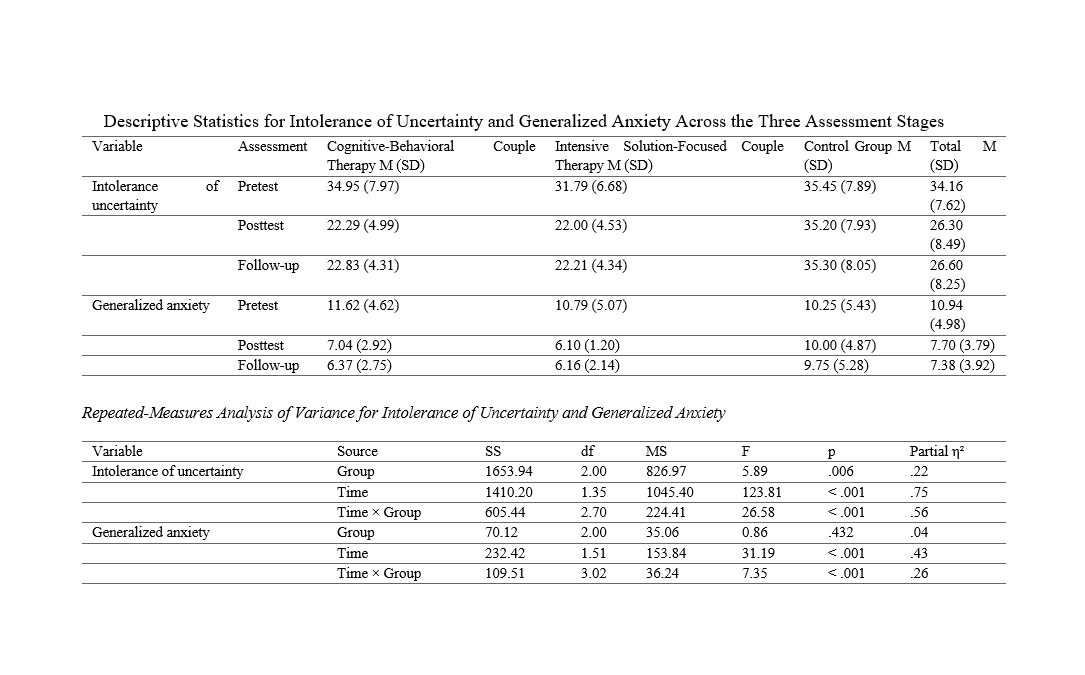
Findings: The results indicated that both cognitive-behavioral couple therapy and intensive solution-focused couple therapy were effective in reducing intolerance of uncertainty; however, no significant difference was found between the two therapeutic approaches. Regarding generalized anxiety, participants in the intensive solution-focused couple therapy group demonstrated a significant improvement at posttest compared with the control group; however, this effect was not maintained at follow-up (p > .05). Therefore, the findings indicated that intensive solution-focused couple therapy was effective in reducing generalized anxiety among infertile women, although its effectiveness was not sustained over time. Cognitive-behavioral couple therapy, however, did not demonstrate a significant effect on generalized anxiety.
Conclusion: Based on the findings, both cognitive-behavioral couple therapy and intensive solution-focused couple therapy had positive effects on reducing intolerance of uncertainty. Intensive solution-focused couple therapy was effective in reducing generalized anxiety, whereas cognitive-behavioral couple therapy had no significant effect on generalized anxiety.
Downloads
References
Abdollahpour, S., Taghipour, A., Mousavi Vahed, S. H., & Latifnejad Roudsari, R. (2022). The Efficacy of Cognitive Behavioural Therapy on Stress, Anxiety and Depression of Infertile Couples: A Systematic Review and Meta-Analysis. Journal of Obstetrics and Gynaecology, 42(2), 188-197. https://doi.org/10.1080/01443615.2021.1904217
Aghili, M., & Tanzadeh, B. (2022). The Effectiveness of Mindfulness-Based Cognitive-Behavioral Therapy on Perfectionism and Self-Focused Attention in Infertile Couples in Isfahan. Journal of Assessment and Research in Applied Counseling (JARAC), 4(2), 1-13.
Altıntaş, M., & Korkut, S. (2023). Investigation of Coronavirus Anxiety, Health Anxiety, and Anxiety Symptom Levels in Vertigo Patients During COVID-19 Pandemic. Brazilian Journal of Otorhinolaryngology, 89(2), 313-320. https://doi.org/10.1016/j.bjorl.2022.11.003
Bahrami Moghadam, M., Afsharinia, K., & Kakabraee, K. (2023). Comparison of the Effectiveness of Emotion-Focused Couple Therapy and Cognitive-Behavioral Couple Therapy in Reducing Marital Burnout and Depression in Couples. Modern psychological research, 18(71), 59-69.
Bakhtiarzadeh, M., Goudarzi, M., Sabah, A., & Niazi Mirak, Z. (2022). The Effectiveness of Rational-Emotive Behavior Therapy on Impulsivity, Intolerance of Uncertainty, and Emotion Regulation in Women Attending Family Counseling Centers with Marital Problems. Rooyesh-e-Ravanshenasi, 11(5), 135-146. https://dor.isc.ac/dor/20.1001.1.2383353.1401.11.5.4.9
Bal, Z., & Uçar, T. (2024). The Effect of Cognitive Behavioural Therapy and Eye Movement Desensitization and Reprocessing Techniques on Infertile Women: A Randomized Controlled Trial. Reproductive BioMedicine Online, 48(2), 103612. https://doi.org/10.1016/j.rbmo.2023.103612
Bavolar, J., Kacmar, P., Hricova, M., Schrötter, J., Kovacova-Holevova, B., Köverova, M., & Raczova, B. (2023). Intolerance of Uncertainty and Reactions to the COVID-19 Pandemic. The Journal of General Psychology, 150(2), 143-170. https://doi.org/10.1080/00221309.2021.1922346
Behbahani, M., & Zolfaghari, M. (2021). The Effectiveness of Solution-Focused Couple Therapy on Cognitive Flexibility of Couples Seeking Divorce. Assessment and Research in Applied Counseling, 3(1), 17-27.
Donegan, E., Frey, B. N., McCabe, R. E., Streiner, D. L., & Green, S. M. (2022). Intolerance of Uncertainty and Perfectionistic Beliefs About Parenting as Cognitive Mechanisms of Symptom Change During Cognitive Behavior Therapy for Perinatal Anxiety. Behavior therapy, 53(4), 738-750. https://doi.org/10.1016/j.beth.2022.02.005
Franklin, C., Ding, X., Kim, J., Zhang, A., Hai, A. H., Jones, K., Nachbaur, M., & O’Connor, A. (2024). Solution-Focused Brief Therapy in Community-Based Services: A Meta-Analysis of Randomized Controlled Studies. Research on Social Work Practice, 34(3), 251-268. https://doi.org/10.1177/10497315231162611
Franklin, C., & Hai, A. H. (2021). Solution-Focused Brief Therapy for Substance Use: A Review of the Literature. Health & Social Work, 46(2), 103-114. https://doi.org/10.1093/hsw/hlab002
Franklin, C., Riley, M., & Kim, J. S. (2025). Introduction to Solution-Focused Brief Therapy (SFBT). In Solution-Focused Brief Therapy with Families: A Training Manual (pp. 3-21). American Psychological Association. https://doi.org/10.1037/0000447-001
Greenberg, T., Bertocci, M. A., Versace, A., Lima Santos, J. P., Chase, H. W., Siffler, R., Aslam, H. A., Graur, S., Bebko, G., Lockovich, J. C., & Phillips, M. L. (2021). Depression and Anxiety Mediate the Relationship Between Frontotemporal White Matter Integrity and Quality of Life in Distressed Young Adults. Journal of psychiatric research, 132, 55-59. https://doi.org/10.1016/j.jpsychires.2020.10.001
Hajloo, N., Pourabdol, S., Saravani, S., Sobhi Gharamaleki, N., & Mousavi, B. (2021). The Effectiveness of Cognitive-Behavioral Couple Therapy on Components of Social Well-Being in Couples with Marital Conflict. Clinical Psychology Studies, 12(45), 113-137. https://doi.org/10.22054/jcps.2022.60508.2568
Huang, A., Liu, L., Wang, X., Chen, J., Liang, S., Peng, X., Li, J., Luo, C., Fan, F., & Zhao, J. (2023). Intolerance of Uncertainty and Anxiety Among College Students During the Re-Emergence of COVID-19: Mediation Effects of Cognitive Emotion Regulation and Moderation Effects of Family Function. Journal of affective disorders, 327, 378-384. https://doi.org/10.1016/j.jad.2023.01.110
Irvani, F., Bolghan-Abadi, M., & Mansouri, A. (2026). Comparison of the Effectiveness of Cognitive-Behavioral Therapy and Short-Term Solution-Focused Therapy on Intolerance of Uncertainty in Pregnant Women. Psychology of Woman Journal, 7(2), 1-14. https://doi.org/10.61838/kman.pwj.5940
Jackson, P. L., Saunders, P., Mizzi, S., & Hallam, K. T. (2025). The Efficacy of Psychological Interventions for Infertile Women: A Systematic Review and Meta-Analysis. BMC Women’s Health, 25(1), 506. https://doi.org/10.1186/s12905-025-04054-x
Kemerer, B. M., Zdaniuk, B., Higano, C. S., Bossio, J. A., Camara Bicalho Santos, R., Flannigan, R., & Brotto, L. A. (2023). A Randomized Comparison of Group Mindfulness and Group Cognitive Behavioral Therapy vs Control for Couples After Prostate Cancer with Sexual Dysfunction. The Journal of Sexual Medicine, 20(3), 346-366. https://doi.org/10.1093/jsxmed/qdac038
Kuo, J. R., Fitzpatrick, S., & Ip, J. (2022). The Who and What of Validation: An Experimental Examination of Validation and Invalidation of Specific Emotions and the Moderating Effect of Emotion Dysregulation. Borderline personality disorder and emotion dysregulation, 9(15) 1-17. https://doi.org/10.1186/s40479-022-00185-x
Langari, M. R., Mofakhari, A., & Bakhshipour, A. (2023). Comparison of the Effectiveness of Health-Based Schema Therapy and Solution-Focused Therapy in Reducing Aggression in Couples Seeking Divorce. Quran and Medicine, 7(4), 171-180. https://www.quraniimed.com/article_189878.html
Li, A., Scalise, A. L., Mayette, E., McGeorge, N., James, K., & Mahalingaiah, S. (2025). Considerations on Optimizing the Patient Experience During Assisted Reproductive Technology Treatment: A Qualitative Analysis. F&S Reports, 6(1), 25-30. https://doi.org/10.1016/j.xfre.2025.01.002
Magzoub, R., Kheirelseid, E. A. H., Perks, C., & Lewis, S. (2022). Does Metformin Improve Reproduction Outcomes for Non-Obese, Infertile Women with Polycystic Ovary Syndrome? Meta-Analysis and Systematic Review. European Journal of Obstetrics, Gynecology, and Reproductive Biology, 271, 38-62. https://doi.org/10.1016/j.ejogrb.2022.01.025
Mashak, R., Naderi, F., & Chinaveh, M. (2021). Comparison of the Effectiveness of Religious Cognitive-Behavioral Therapy and Positive Psychotherapy on Self-Criticism and Psychological Distress in Infertile Women in Ahvaz. Iranian Journal of Nursing Research, 16(3), 59-73. http://ijnr.ir/article-1-2532-fa.html
Mohammadyari, A. (2023). Identifying Dysfunctional Marital Relationship Beliefs in Conflicted Women and Comparing the Effectiveness of Solution-Focused Couple Therapy and Object Relations Therapy in Modifying the Beliefs of Women with Marital Conflict University of Mohaghegh Ardabili]. Ardabil.
Morriss, J., Butler, D., & Ellett, L. (2025). Intolerance of Uncertainty and Psychosis: A Systematic Review. British Journal of Clinical Psychology, 64(2), 344-354. https://doi.org/10.1111/bjc.12509
Naseh, M., Badiezadeh, S., Rafieifar, M., Taridashti, S., Reddy, S. M., & Panisch, L. S. (2025). Solution-Focused Brief Therapy for Improving Couple Dyadic Relationships in Iran: A Systematic Review. Journal of marital and family therapy, 51(1), e12758. https://doi.org/10.1111/jmft.12758
Nho, J. H., & Kim, E. J. (2022). Relationships Among Type-D Personality, Fatigue, and Quality of Life in Infertile Women. Asian Nursing Research, 16(4), 208-214. https://doi.org/10.1016/j.anr.2022.08.001
Rahsepar Monfared, F., Arvand, Z., & Shariatzadeh Jenidi, G. (2021). The Effectiveness of Solution-Focused Couple Therapy on Marital Conflicts. Assessment and Research in Applied Counseling, 4(10), 53-67.
Salehi, H., Jahangiri, A., & Bakhshipour, A. (2021). Comparison of the Effectiveness of Cognitive-Behavioral Couple Therapy and Acceptance and Commitment Couple Therapy in Reducing Marital Burnout. Community Health, 15(1), 19-29. https://doi.org/10.22123/chj.2021.246660.1573
Salimi, H., & Sodani, M. (2023). The Effectiveness of Short-Term Solution-Focused Couple Therapy on Increasing Marital Self-Regulation and Emotional Distress Tolerance in Couples. Clinical Psychology and Counseling Research, 13(1), 5-24. https://doi.org/10.22067/tpccp.2023.76695.1287
Salimi, L. (2023). The Effectiveness of Emotion-Focused Couple Therapy on Positive Feelings Toward the Spouse and Intolerance of Uncertainty in Infertile Couples Seeking Divorce. Rooyesh-e-Ravanshenasi, 12(8), 201-210. https://dor.isc.ac/dor/20.1001.1.2383353.1402.12.8.20.8
Schaumberg, K., Reilly, E. E., Gorrell, S., Levinson, C. A., Farrell, N. R., Brown, T. A., Smith, K. M., Schaefer, L. M., Essayli, J. H., Haynos, A. F., & Anderson, L. M. (2021). Conceptualizing Eating Disorder Psychopathology Using an Anxiety Disorders Framework: Evidence and Implications for Exposure-Based Clinical Research. Clinical psychology review, 83, 101952. https://doi.org/10.1016/j.cpr.2020.101952
Shafierizi, S., Basirat, Z., Nasiri-Amiri, F., Kheirkhah, F., Geraili, Z., Pasha, H., & Faramarzi, M. (2024). Predictors of Nonresponse to Treatment and Low Adherence to Internet-Based Cognitive Behavioral Therapy in Depressed/Anxious Women Facing the Couple's Fertility Problems: A Secondary Analysis of a Randomized Control Trial. BMC psychiatry, 24, 39. https://doi.org/10.1186/s12888-023-05484-3
Shayestehmehr, S., Asgaridoust, L., Torabi, A., Saqeb Tabrizi, M., & Aryafraz, A. (2021). Predicting Psychological Health Based on Loneliness and Perceived Social Support with the Mediating Role of Spirituality in Infertile Women. Islamic lifestyle with a focus on health, 5(2), 92-100. https://www.islamiilife.com/article_186801.html
Tang, N., Xie, L., Pei, M., Wang, J., Hu, J., & Gao, Y. (2025). Effect of Solution Focused Approach on Women Aged 35 or Over with In Vitro Fertilization-Embryo Transfer: A Quasi-Experimental Trial. PLoS One, 20(3), e0316771. https://doi.org/10.1371/journal.pone.0316771
Vermeulen-Oskam, E., Franklin, C., Van't Hof, L. P. M., Stams, G. J. J. M., van Vugt, E. S., Assink, M., Veltman, E. J., Froerer, A. S., Staaks, J. P. C., & Zhang, A. (2024). The Current Evidence of Solution-Focused Brief Therapy: A Meta-Analysis of Psychosocial Outcomes and Moderating Factors. Clinical psychology review, 114, 102512. https://doi.org/10.1016/j.cpr.2024.102512
Volodarsky-Perel, A., Badeghiesh, A., Shrem, G., Steinev, N., & Tulandi, T. (2020). Chronic Endometritis in Fertile and Infertile Women Who Underwent Hysteroscopic Polypectomy. Journal of Minimally Invasive Gynecology, 27(5), 1112-1118. https://doi.org/10.1016/j.jmig.2019.08.017
Yang, Y., Gorka, S. M., Pennell, M. L., Weinhold, K., & Orchard, T. (2023). Intolerance of Uncertainty and Cognition in Breast Cancer Survivors: The Mediating Role of Anxiety. Cancers (Basel), 15(12). https://doi.org/10.3390/cancers15123105
Zak, A. M., & Pękala, K. (2025). Effectiveness of Solution-Focused Brief Therapy: An Umbrella Review of Systematic Reviews and Meta-Analyses. Psychotherapy Research, 35(7), 1043-1055. https://doi.org/10.1080/10503307.2024.2406540
Zatloukal, L. (2025). Negotiating Preferred Futures in Solution-Focused Couple Therapy. International Journal of Systemic Therapy, 37(1), 1-18. https://doi.org/10.1080/2692398X.2025.2492816
Zhao, C. X., Lu, M. T., Zhong, X. P., Chen, J. W., & Chen, L. P. (2025). Coping Strategies and Influencing Factors Among Infertile Patients: A Qualitative Meta-Synthesis. BMC public health, 25, 3144. https://doi.org/10.1186/s12889-025-24031-1
Downloads
Additional Files
Publication Timeline
- Submitted
- Revised
- Accepted