Comparison of the Effectiveness of Mindfulness-Based Cognitive Therapy and Acceptance and Commitment Therapy on Ideas of Reference, Thought–Action Fusion, and Cognitive Avoidance in Women with Breast Cancer
Keywords:
mindfulness-based cognitive therapy, acceptance and commitment therapy, thought–action fusion, cognitive avoidance, ideas of referenceAbstract
Objective: The present study aimed to compare the effectiveness of mindfulness-based cognitive therapy (MBCT) and acceptance and commitment therapy (ACT) in reducing ideas of reference, thought–action fusion, and cognitive avoidance among women with breast cancer.
Methods and Materials: This study employed a quasi-experimental pretest–posttest design. The statistical population consisted of all women with breast cancer who attended a radiotherapy and oncology center in Tehran between September 23, 2025, and March 20, 2026. Accordingly, 45 participants were selected and randomly assigned to three groups. The first experimental group received the mindfulness-based cognitive therapy protocol developed by Segal, Williams, and Teasdale (2013) over eight sessions, while the second experimental group received eight sessions of acceptance and commitment therapy (ACT) based on the protocol developed by Dahl et al. (2014). The control group received no intervention. The research instruments included the Ideas of Reference Questionnaire (Ehring, 1990), the Thought–Action Fusion Questionnaire (Shafran, Thordarson, & Rachman, 1996), and the Cognitive Avoidance Questionnaire (Sexton & Dugas, 2009). The data were analyzed using multivariate analysis of variance (MANOVA).
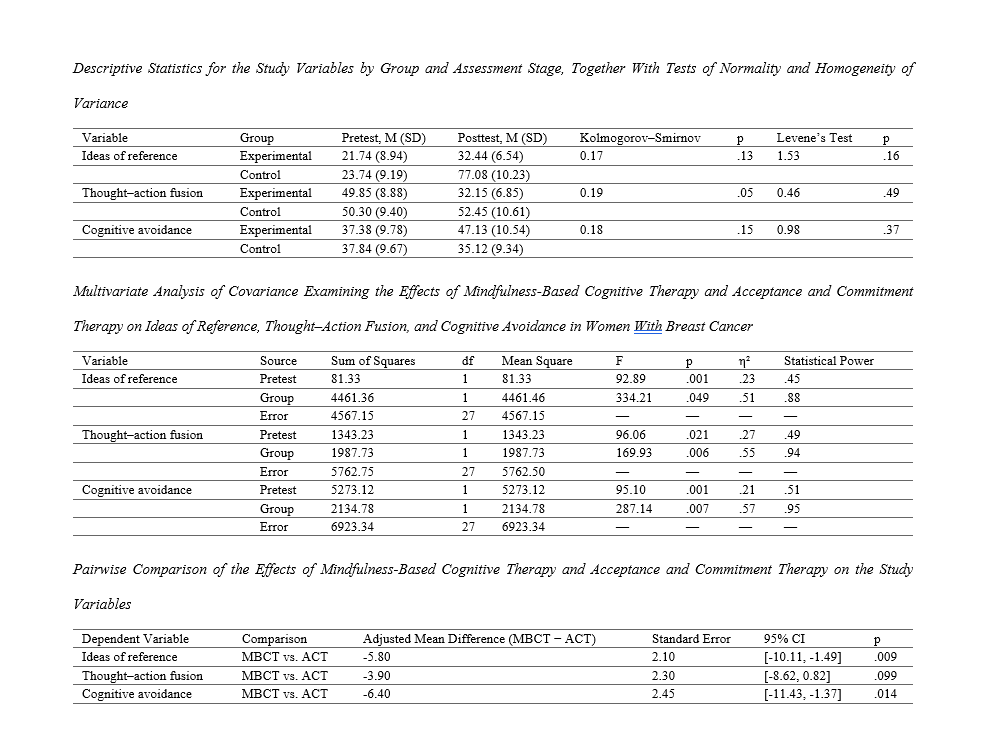
Findings: Based on the mean posttest scores of the experimental groups, the findings indicated that both mindfulness-based cognitive therapy and acceptance and commitment therapy were effective in reducing ideas of reference, thought–action fusion, and cognitive avoidance among women with breast cancer.
Conclusion: It can be concluded that both mindfulness-based cognitive therapy and acceptance and commitment therapy were effective in improving the dependent variables among women with breast cancer.
Downloads
References
Bakhtiari Zadeh, M. K., Ajeh Godari, M., Sabah, A., & Niazi Mirk, J. (2022). The Effect of Rational-Emotional Behavior Therapy on Impulsivity, Intolerance of Uncertainty, and Difficulty in Regulating Emotions in Women Referring to Family Counseling Centers with Marital Problems. Development of Psychology, 11(5), 135-146.
Bauer, E. A., MacNamara, A., Sandre, A., Lonsdorf, T. B., Weinberg, A., Morriss, J., & van Reekum, C. M. (2020). Intolerance of Uncertainty and Threat Generalization: A Replication and Extension. Psychophysiology, 57(5), e13546. https://doi.org/10.1111/psyp.13546
Bottesi, G., Noventa, S., Freeston, M. H., & Ghisi, M. (2019). Seeking Certainty About Intolerance of Uncertainty: Addressing Old and New Issues Through the Intolerance of Uncertainty Scale-Revised. PLoS One, 14(2), e0211929. https://doi.org/10.1371/journal.pone.0211929
Bredemeier, K., Church, L. D., Bounoua, N., Feler, B., & Spielberg, J. M. (2023). Intolerance of Uncertainty, Anxiety Sensitivity, and Health Anxiety During the COVID-19 Pandemic: Exploring Temporal Relationships Using Cross-Lag Analysis. Journal of anxiety disorders, 93, 102660. https://doi.org/10.1016/j.janxdis.2022.102660
Britt, K. L., Cuzick, J., & Phillips, K. A. (2020). Key Steps for Effective Breast Cancer Prevention. Nature Reviews Cancer, 20(8), 417-436.
Chen, J., Wang, Y., Zhang, H., Leng, T., Lin, X., Sun, Y., Wang, N., Wang, J., & Luo, F. (2022). The Mediating Effects of Coping Styles on the Relationship Between Trait Mindfulness and Romantic Relationship Satisfaction. Psychology, Health & Medicine, 1-8. https://doi.org/10.1080/13548506.2022.2094426
Corry, M., & Stella, J. (2018). Teacher Self-Efficacy in Online Education: A Review of the Literature.
Gielnik, M. M., Bledow, R., & Stark, M. S. (2020). A Dynamic Account of Self-Efficacy in Entrepreneurship. Journal of Applied Psychology, 105(5), 487.
Goldstein, P., Losin, E. A. R., Anderson, S. R., Schelkun, V. R., & Wager, T. D. (2020). Clinician-Patient Movement Synchrony Mediates Social Group Effects on Interpersonal Trust and Perceived Pain. The Journal of Pain, 21(11-12), 1160-1174.
Hasami, F., Timouri, Z., Ghafourian, G., Rezaei Zadeh, M., Kashafi, M., Abedi Naghandar, M., & Pour Mohammad Gouchani, K. (2025). A comparative study on the effectiveness of mindfulness-based cognitive therapy and acceptance and commitment therapy on self-efficacy and quality of life in patients with multiple sclerosis. Journal of Experimental and Cognitive Psychology, 2(1), 243-256. https://quarterlyecp.com/index.php/ecp/article/view/184
Hassami, F., Timouri, Z., Ghafourian, G., Razaei Zadeh, M., Kashfi, M., Abedi Noghandar, M., & Pourmohammad Ghouchani, K. (2025). Comparison of mindfulness-based cognitive therapy and acceptance and commitment therapy on self-efficacy and quality of life in patients with multiple sclerosis. Journal of Experimental and Cognitive Psychology, 2(1), 243-256. https://doi.org/https://www.quarterlyecp.com/index.php/ecp/article/view/184
Hebdon, M. C. T., Coombs, L. A., Reed, P., Crane, T. E., & Badger, T. A. (2021). Self-Efficacy in Caregivers of Adults Diagnosed with Cancer: An Integrative Review. European Journal of Oncology Nursing, 52, 101933.
Kelley, D. L., & Nichols, H. M. (2023). Relational Mindfulness Themes in Descriptions of Intimate Encounters Across Six Interpersonal Contexts. Journal of Social and Personal Relationships, 02654075231154286. https://doi.org/10.1177/02654075231154286
Kelting, K., Robinson, S., & Lutz, R. J. (2019). Would You Like to Round Up and Donate the Difference? Roundup Requests Reduce the Perceived Pain of Donating. Journal of Consumer Psychology, 29(1), 70-78.
Kissane, D. W., Lethborg, C., Brooker, J., Hempton, C., Burney, S., Michael, N., Staples, M., Osicka, T., Sulistio, M., Shapiro, J., & Hiscock, H. (2019). Meaning and Purpose (MaP) Therapy II: Feasibility and Acceptability from a Pilot Study in Advanced Cancer. Palliative & Supportive Care, 17(1), 21-28. https://doi.org/10.1017/S1478951518000883
Lawrence, E., Cohn, A. S., & Allen, S. H. (2022). Acceptance and Commitment Therapy for Couples. In Clinical Handbook of Couple Therapy (pp. 104).
Mohammadi, S., Azemoudeh, M., Shalchi, B., & Mesrabadi, J. (2024). Comparing the effects of mindfulness-based cognitive therapy and acceptance and commitment therapy on depression and anger in Iranian women affected by marital infidelity. Qom University of Medical Sciences Journal, 18(1), 29-45. https://doi.org/10.32598/qums.18.2945.1
Naseri, A., Rahmanian, M., & Rafiepoor, A. (2024). Comparing the Effectiveness of Acceptance and Commitment Therapy and Mindfulness-Based Cognitive Therapy on Life Expectancy and Quality of Life in Coronary Heart Disease Patients with Hypertension Referred to Shahid Rajaei Hospital. International Journal of Body, Mind and Culture, 11(6), 142-152. https://doi.org/10.61838/rmdn.ijbmc.11.6.17
Newman, A., Obschonka, M., Schwarz, S., Cohen, M., & Nielsen, I. (2019). Entrepreneurial Self-Efficacy: A Systematic Review of the Literature on Its Theoretical Foundations, Measurement, Antecedents, and Outcomes, and an Agenda for Future Research. Journal of Vocational Behavior, 110, 403-419.
Nowzari, A., Rezaei Jamalouei, H., Sobhani, A., & Nikyar, H. (2025). Comparing the Effectiveness of Group Therapy of Cognitive-Behavioral, Acceptance and Commitment and Mindfulness-Based Stress Reduction in the Treatment of Fibromyalgia Syndrome. Psychology of Motivation, Behavior, and Health, 3(2), 1-15.
Panchyshyn, V., Tekok-Kilic, A., Frijters, J. C., & Tardif-Williams, C. (2023). Sensory Sensitivity, Intolerance of Uncertainty and Sex Differences Predicting Anxiety in Emerging Adults. Heliyon, 9(3), 1-9. https://doi.org/10.1016/j.heliyon.2023.e14071
Pentzien, C. (2019). A Pilot Acceptance and Commitment Therapy Intervention to Reduce the Negative Effects of Sexual Objectification Among College Women Bowling Green State University]. http://rave.ohiolink.edu/etdc/view?acc_num=bgsu1560020773927712
Pour, M. M., Ahmadi, V., & Mami, S. (2024). Comparing The Efficacy Of Mindfulness-Based Cognitive Therapy And Acceptance And Commitment-Based Therapy On Adolescent Rumination And Cognitive Avoidance In Kermanshah City. Journal of Advanced Zoology, 45(2). https://frooyesh.ir/article-1-2937-fa.html
Segal, Z., Williams, M., & Teasdale, J. (2018). Mindfulness-Based Cognitive Therapy for Depression. Guilford Publications.
Senai, H., Mousavi, S. A. M., Moradi, A. R., Parhoon, H., & Sanai, S. (2017). The Effectiveness of Mindfulness-Based Stress Reduction Therapy on Self-Efficacy, Perceived Stress, and Life Orientation of Women with Breast Cancer. Journal of Thought and Behavior, 11(44), 57-90.
Vallee, C. A. (2022). Pain Perceived During Hysteroscopic Morcellation by Vaginoscopy vs Standard Technique in an Outpatient Setting: A Randomized Controlled Trial.
Waks, A. G., & Winer, E. P. (2019). Breast Cancer Treatment: A Review. JAMA, 321(3), 288-300.
Walser, R. D., & O'Connell, M. (2023). Alliance Rupture and Repair in Acceptance and Commitment Therapy. In C. F. Eubanks, L. W. Samstag, & J. C. Muran (Eds.), Rupture and Repair in Psychotherapy: A Critical Process for Change (pp. 165-186). American Psychological Association. https://doi.org/10.1037/0000306-008
Wilson, J. M., Weiss, A., & Shook, N. J. (2020). Mindfulness, Self-Compassion, and Savoring: Factors That Explain the Relation Between Perceived Social Support and Well-Being. Personality and individual differences, 152, 109568. https://doi.org/10.1016/j.paid.2019.109568
Wimmer, L., Bellingrath, S., & Von Stockhausen, L. (2020). Mindfulness Training for Improving Attention Regulation in University Students: Is It Effective? And Do Yoga and Homework Matter? Frontiers in psychology, 11, 719. https://doi.org/10.3389/fpsyg.2020.00719
Downloads
Additional Files
Publication Timeline
- Submitted
- Revised
- Accepted