Comparing the Effectiveness of Dialectical Behavior Therapy and Metacognitive Therapy on Cognitive Fusion and Self-Criticism in Women with Generalized Anxiety Disorder
Keywords:
Generalized Anxiety Disorder, Cognitive Fusion, Self-Criticism, MetacognitiveAbstract
Objective: This study aimed to compare the effectiveness of dialectical behavior therapy (DBT) and metacognitive therapy (MCT) in reducing cognitive fusion and self-criticism among women diagnosed with generalized anxiety disorder (GAD).
Methods and Materials: The study employed a quasi-experimental pretest–posttest control-group design with a two-month follow-up. The statistical population consisted of women diagnosed with GAD who attended Avaye Daroon and Tarannom-e Zendegi clinics in Tehran between March and May 2025. Using purposive sampling based on the study inclusion criteria, 45 eligible women were selected and randomly assigned to three groups: DBT, MCT, and control, with 15 participants in each group. The experimental groups received their respective therapeutic interventions, whereas the control group received no intervention during the study period. Data were collected at pretest, posttest, and follow-up using the Cognitive Fusion Questionnaire developed by Gillanders et al. (2014) and the Levels of Self-Criticism Scale developed by Thompson and Zuroff (2004). Inferential analyses were conducted using repeated-measures analysis of variance followed by the Bonferroni post hoc test.
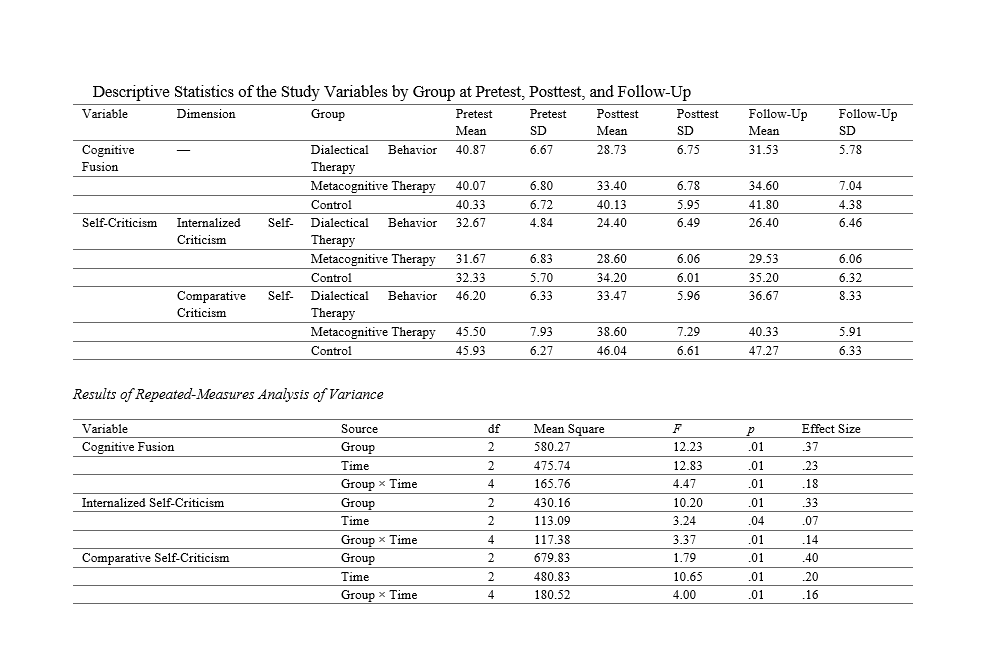
Findings: Repeated-measures analysis demonstrated significant differences among the groups in changes in cognitive fusion and comparative self-criticism across the assessment phases. Bonferroni comparisons indicated that DBT produced significantly greater reductions in cognitive fusion and comparative self-criticism than MCT (p < .05). However, the difference between DBT and MCT in reducing internalized self-criticism was not statistically significant (p > .05). The therapeutic advantages observed for DBT in cognitive fusion and comparative self-criticism were maintained at the two-month follow-up assessment.
Conclusion: Both therapeutic approaches can be useful for addressing maladaptive cognitive processes in women with GAD; however, DBT appears to have greater effectiveness than MCT in reducing cognitive fusion and comparative self-criticism. Its multidimensional, skills-based emphasis may therefore provide particular clinical benefits for reducing rigid cognitive involvement and socially comparative forms of self-criticism in this population.
Downloads
References
Amănălăchioaie, A., & Diaconu-Gherasim, L. R. (2021). The Role of Social Comparison and Type of Feedback on Self-Criticism in People with High Levels of Depressive Symptoms. Romanian Journal of Psychology, 23(2). https://doi.org/10.24913/rjap.23.2.03
American Psychiatric, A. (2022). Diagnostic and Statistical Manual of Mental Disorders: DSM-5-TR (5th ed.). American Psychiatric Association Publishing. https://doi.org/10.1176/appi.books.9780890425787
Awad, M. H., Elmutasim, M., Mohamed, M. M., & Hemmeda, L. (2025). Generalized Anxiety Disorder and Associated Factors among Sudanese Adolescents during the Sudan Army Conflict: A Cross Sectional Study. Global Epidemiology, 9, 100190. https://doi.org/10.1016/j.gloepi.2025.100190
Barrera-Caballero, S., Romero-Moreno, R., Marquez-Gonzalez, M., Jimenez-Gonzalo, L., Huertas-Domingo, C., Olazaran, J., & Losada-Baltar, A. (2024). Longitudinal Effects of Cognitive Fusion in Depressive and Anxious Symptoms of Family Caregivers of People with Dementia. Journal of Contextual Behavioral Science, 33, 100782. https://doi.org/10.1016/j.jcbs.2024.100782
Boehlen, F. H., Herzog, W., Schellberg, D., Maatouk, I., Schoettker, B., Brenner, H., & Wild, B. (2020). Gender-Specific Predictors of Generalized Anxiety Disorder Symptoms in Older Adults: Results of a Large Population-Based Study. Journal of affective disorders, 262, 174-181. https://doi.org/10.1016/j.jad.2019.10.025
Dong, M., Lu, W., Zeng, X., Yang, Y., Liao, D. D., Hou, C. L., & Wang, S. B. (2025). Prevalence and Correlates of Generalized Anxiety Disorder and Subthreshold Anxiety Symptoms in South China: A Network Perspective. Journal of affective disorders, 379, 232-240. https://doi.org/10.1016/j.jad.2025.03.026
Farshad, M. R., & Samavi, S. A. (2022). External Shame and Self-Criticism in Married Women: The Mediating Role of Cognitive Fusion and Experiential Avoidance. Women’s Health Bulletin, 9(4), 216-223. https://doi.org/10.30476/WHB.2022.96102.1187
Ferries, E., Suponcic, S., Bhattacharya, S., Kulkarni, A., Yeh, M., Silber, A., & Duong, P. (2025). SA5 Systematic Literature Review of Unmet Needs and Burden of Disease in Generalized Anxiety Disorder (GAD). Value in Health, 28(6), S395-S396. https://doi.org/10.1016/j.jval.2025.04.1761
Ferries, E., Suponcic, S., Louie, D., Robinson, K., Lam, F., Silber, A., & Strawn, J. R. (2026). The Prevalence and Burden of Generalized Anxiety Disorder in the United States Healthcare System: Real-World Prevalence and Incidence from 2020–2023. Journal of Mood & Anxiety Disorders, 100172. https://doi.org/10.1016/j.xjmad.2026.100172
Fisher, P., & Wells, A. D. (2021). Metacognitive Therapy. Arjomand.
Gillanders, D. T., Bolderston, H., Bond, F. W., Dempster, M., Flaxman, P. E., Campbell, L., & Remington, B. (2014). The Development and Initial Validation of the Cognitive Fusion Questionnaire. Behavior therapy, 45(1), 83-101. https://doi.org/10.1016/j.beth.2013.09.001
Hare, M., Conroy, K., Georgiadis, C., & Shaw, A. M. (2024). Abbreviated Dialectical Behavior Therapy Virtual Skills Group for Caregivers of Adolescents: An Exploratory Study of Service User and Clinical Outcomes. Child Psychiatry & Human Development, 1-13. https://doi.org/10.1007/s10578-024-01681-7
Herbert, J. D., Forman, E. M., Kaye, J. L., Gershkovich, M., Goetter, E., Yuen, E. K., & Marando-Blanck, S. (2018). Randomized Controlled Trial of Acceptance and Commitment Therapy versus Traditional Cognitive Behavior Therapy for Social Anxiety Disorder: Symptomatic and Behavioral Outcomes. Journal of Contextual Behavioral Science, 9, 88-96. https://doi.org/10.1016/j.jcbs.2018.07.008
Iancu, I., Bodner, E., & Ben-Zion, I. Z. (2015). Self-Esteem, Dependency, Self-Efficacy and Self-Criticism in Social Anxiety Disorder. Comprehensive Psychiatry, 58, 165-171. https://doi.org/10.1016/j.comppsych.2014.11.018
Jennifer, S. D. L. R., Brady, B. R., Ibrahim, M. M., Herder, K. E., Wallace, J. S., Padilla, A. R., & Vanderah, T. W. (2024). Co-Occurrence of Chronic Pain and Anxiety/Depression Symptoms in US Adults: Prevalence, Functional Impacts, and Opportunities. Pain, 165(3), 666-673. https://doi.org/10.1097/j.pain.0000000000003056
Karimi, I. V. S., Hassanzadeh, R., & Emadian, S. O. (2024). Examining the Effectiveness of Dialectical Behavior Therapy on Impulsivity, Emotion Regulation, Rumination, and Self-Criticism in Individuals with Trichotillomania. Health Nexus, 2(1), 57-65. https://doi.org/10.61838/kman.hn.2.1.7
Khakshoorshandiz, F., Sodagar, S., Malihiazkr, S., & Zarban, A. (2020). The Effectiveness of Dialectical Behavior Therapy and Mindfulness-Based Cognitive Therapy on Cognitive Components (Cognitive Fusion, Cognitive Avoidance and Cognitive Flexibility) and Oxidative Stress in Women with Type 2 Diabetes. Counseling Research and Development, 19(75), 5-33. https://doi.org/10.29252/jcr.19.75.5
Larijani, Z. S. (2013). Comparing the Effectiveness of Mindfulness-Based Cognitive Therapy and Metacognitive Therapy in Students with Symptoms of Depression, Rumination, Experiential Avoidance, and Metacognitive Beliefs Islamic Azad University, Central Tehran Branch].
Lazarus, G., & Shahar, B. (2018). The Role of Shame and Self-Criticism in Social Anxiety: A Daily-Diary Study in a Nonclinical Sample. Journal of Social and Clinical Psychology, 37(2), 107-127. https://doi.org/10.1521/jscp.2018.37.2.107
Linehan, M. (2021). Dialectical Behavior Therapy: A Skills Handbook. Arjomand.
Najarpour Ostadi, S., Akbari, B., Khalatbari, J., & Babapour, J. (2018). Effectiveness of Quality of Life Therapy and Dialectical Behavioral Therapy in Loneliness among Female Undergraduate Students with Smartphone Addiction. Journal of Modern Psychological Researches, 16(62), 32-45. https://doi.org/20.1001.1.27173852.1400.16.62.3.8
Neitzke, E. V., Dos Santos, F. G., Zanini, B. M., Cavalcante, M. B., Mason, J. B., Masternak, M. M., & Schneider, A. (2025). The Influence of Ovarian Activity and Menopause on Mental Health: Evidence from Animal Models and Women. Physiology & Behavior, 114886. https://doi.org/10.1016/j.physbeh.2025.114886
Pekin, Z., & Güme, S. (2025). Self-Criticism: Conceptualization, Assessment and Interventions. Current Approaches in Psychiatry, 17(1), 107-123. https://doi.org/10.18863/pgy.1455185
Samadi, F., Bahrinian, S., Razjoyan, K., & Shahabizadeh, F. (2023). The Effectiveness of Dialectical Behavior Therapy on Aggression, Self-Criticism and Self-Injurious Behaviors of Aged 12–18 Year with Bipolar Disorder. Rooyesh-e-Ravanshenasi Journal (RRJ), 12(3), 55-66. http://frooyesh.ir/article-1-4633-fa.html
Sanchez-Escamilla, F., Redondo-Delgado, M., Jímenez-Ros, A. M., & Pérez-Nieto, M. Á. (2025). Metabeliefs about Worry, Cognitive Fusion, and Acceptance: Associations and Mediations Analysis. Frontiers in psychology, 16, 1639105. https://doi.org/10.3389/fpsyg.2025.1639105
Sequeda, G., Acosta-López, J., Ahmad, M., & Durán-Rondon, S. (2026). Contextual Therapies for Substance Use, Experiential Avoidance, and Emotional Dysregulation: A Clinical Case Study. Addicta: The Turkish Journal On Addictions, 1-16. https://doi.org/10.15805/addicta.2025.24300
Simpson, N. J., Ogrodniczuk, J., & Kealy, D. (2025). Self-Criticism and Anxiety in the General Population. Archives of Psychiatry and Psychotherapy, 26(4), 18-23. https://doi.org/10.12740/APP/189810
Soltani, E., Momenzadeh, S., Hoseini, S. Z., & Bahrainian, S. A. (2016). Psychometric Properties of the Cognitive Fusion Questionnaire. Pajoohandeh Journal, 21(5), 290-297. http://pajoohande.sbmu.ac.ir/article-۱-۲۲۹۳-fa.html
Van Hout, E., Contreras, M., Mioshi, E., & Kishita, N. (2024). The Role of Experiential Avoidance and Cognitive Fusion in the Development of Anxiety Symptoms among Family Carers of People with Dementia. Journal of Behavioral and Cognitive Therapy, 34(1), 100482. https://doi.org/10.1016/j.jbct.2023.12.001
Wells, A., Reeves, D., Heal, C., Fisher, P., Doherty, P., Davies, L., & Capobianco, L. (2023). Metacognitive Therapy Home-Based Self-Help for Anxiety and Depression in Cardiovascular Disease Patients in the UK: A Single-Blind Randomised Controlled Trial. PLOS Medicine, 20(1), e1004161. https://doi.org/10.1371/journal.pmed.1004161
Wilks, C. R., & Ward-Ciesielski, E. F. (2020). Dialectical Behavior Therapy Skills Training for Generalized Anxiety Disorder: Considering the Value of Adapting Something New versus Improving What Works. Clinical Psychology: Science and Practice, 27(4), e12346. https://doi.org/10.1111/cpsp.12346
Xue, Y., Wang, W. D., Liu, Y. J., Wang, J., & Walters, A. S. (2025). Sleep Disturbances in Generalized Anxiety Disorder: The Central Role of Insomnia. Sleep Medicine, 132, 106545. https://doi.org/10.1016/j.sleep.2025.106545
Downloads
Additional Files
Publication Timeline
- Submitted
- Revised
- Accepted