Psychometric Evaluation and Validation of the Persian Version of the Screen for Adult Anxiety Related Disorders (SCAARED) in a Sample of Iranian Mothers
Keywords:
Anxiety Disorders, Psychometrics, Reliability, Validity, Mothers, SCAAREDAbstract
Objective: This study aimed to evaluate the psychometric properties and validate the Persian version of the Screen for Adult Anxiety Related Disorders (SCAARED) in a sample of Iranian mothers.
Methods and Materials: This descriptive-correlational psychometric study was conducted among mothers of lower-secondary school students in Mashhad, Iran, during the 2024–2025 academic year. The target population comprised approximately 110,000 mothers, of whom 296 were selected using multistage cluster sampling. Following forward and backward translation of the SCAARED, its face and content validity were evaluated by 15 experts in anxiety disorders. Construct validity was assessed through exploratory factor analysis (EFA) and confirmatory factor analysis (CFA). Internal consistency and construct reliability and validity were examined using Cronbach’s alpha, composite reliability, average variance extracted (AVE), the Fornell–Larcker criterion, and the heterotrait–monotrait (HTMT) ratio.
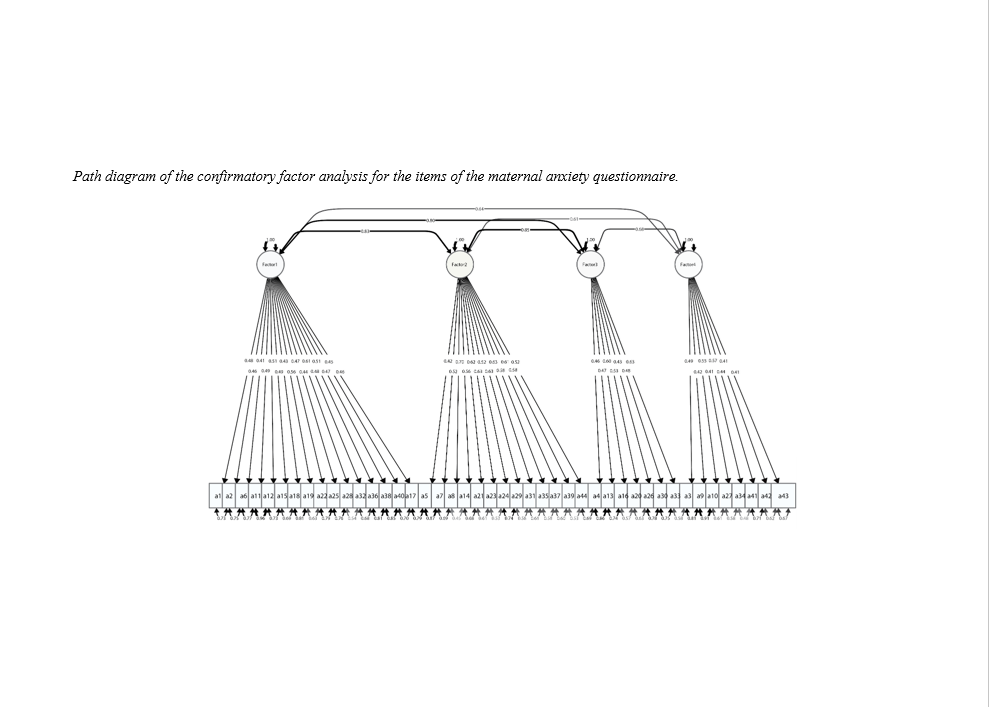
Findings: The content validity ratio (CVR) values for all 44 items ranged from 0.60 to 1.00, while item-level content validity index (I-CVI) values ranged from 0.87 to 1.00. EFA supported a four-factor structure accounting for 58.3% of the total variance. CFA further confirmed the adequacy of the four-factor model. The Cronbach’s alpha coefficient for the total scale was 0.807, indicating satisfactory internal consistency. The AVE was 0.586, supporting adequate convergent validity. Furthermore, the Fornell–Larcker criterion and HTMT matrix demonstrated satisfactory discriminant validity among the identified factors.
Conclusion: The Persian version of the SCAARED demonstrated satisfactory reliability, content validity, construct validity, convergent validity, and discriminant validity. Accordingly, it can be considered a valid and reliable instrument for screening anxiety disorders among Iranian mothers and may be used in both research and clinical settings.
Downloads
References
Ally, A., & Aloka, P. (2025). Sigmund Freud's Understandings of Anxiety: A Conceptual Review. Journal of Psychological Studies, 11, 35-48.
American Psychiatric Association, D. S. M. T. F. (2013). Diagnostic and Statistical Manual of Mental Disorders: DSM-5 (5th ed.). American Psychiatric Publishing. https://doi.org/10.1176/appi.books.9780890425596
Angulo, M., Rooks, B. T., Gill, M., Goldstein, T., Sakolsky, D., Goldstein, B., Monk, K., Hickey, M. B., Diler, R. S., Hafeman, D., Merranko, J., Axelson, D., & Birmaher, B. (2017). Psychometrics of the Screen for Adult Anxiety Related Disorders (SCAARED): A New Scale for the Assessment of DSM-5 Anxiety Disorders. Psychiatry research, 253, 84-90. https://doi.org/10.1016/j.psychres.2017.02.034
Ayano, G., Betts, K., Maravilla, J. C., & Alati, R. (2021). The Risk of Anxiety Disorders in Children of Parents with Severe Psychiatric Disorders: A Systematic Review and Meta-Analysis. Journal of affective disorders, 282, 472-487. https://doi.org/10.1016/j.jad.2020.12.134
Barton, A. W., Brikell, I., & Jorm, A. F. (2021). Parenting Stress and Child Anxiety: The Role of Parental Anxiety and Family Functioning. Journal of Child and Family Studies, 30(2), 364-374. https://doi.org/10.1007/s10826-021-01962-0
Becerra, R., Gainey, K., Murray, K., & Preece, D. A. (2023). Intolerance of Uncertainty and Anxiety: The Role of Beliefs about Emotions. Journal of affective disorders, 324, 349-353. https://doi.org/10.1016/j.jad.2022.12.064
Berghoff, C. R., Tull, M. T., DiLillo, D., Messman-Moore, T., & Gratz, K. L. (2017). The Role of Experiential Avoidance in the Relation between Anxiety Disorder Diagnoses and Future Physical Health Symptoms in a Community Sample of Young Adult Women. Journal of Contextual Behavioral Science, 6(1), 29-34. https://doi.org/10.1016/j.jcbs.2016.11.002
Bond, F. W., Hayes, S. C., Baer, R. A., Carpenter, K. M., Guenole, N., Orcutt, H. K., Waltz, T., & Zettle, R. D. (2011). Preliminary Psychometric Properties of the Acceptance and Action Questionnaire-II: A Revised Measure of Psychological Inflexibility and Experiential Avoidance. Behavior therapy, 42(4), 676-688. https://doi.org/10.1016/j.beth.2011.03.007
Chapman, L., Hutson, R., Dunn, A., Brown, M., Savill, E., & Cartwright-Hatton, S. (2022). The Impact of Treating Parental Anxiety on Children's Mental Health: An Empty Systematic Review. Journal of anxiety disorders, 88, 102557. https://doi.org/10.1016/j.janxdis.2022.102557
Csirmaz, L., Nagy, T., Vikor, F., & Kasos, K. (2022). Cognitive Behavioral Digital Interventions Are Effective in Reducing Anxiety in Children and Adolescents: A Systematic Review and Meta-Analysis. Journal of Prevention, 45(2), 237-267. https://doi.org/10.1007/s10935-023-00760-0
Essau, C. A., Lewinsohn, P. M., Lim, J. X., Ho, M. R., & Rohde, P. (2018). Incidence, Recurrence and Comorbidity of Anxiety Disorders in Four Major Developmental Stages. Journal of affective disorders, 228, 248-253. https://doi.org/10.1016/j.jad.2017.12.014
Farani, A. R., Khabaz, S. A., Nabavi, M., Didehvar, R., Masuomian, S., & Zahiriyan, M. (2022). The Psychometric Properties of the Persian Version of the Screen for Adult Anxiety Related Disorders (SCAARED) in Patients with Anxiety Disorders. Brain and Behavior, 12(7), e2647. https://doi.org/10.1002/brb3.2647
Gruszka, P., Ganahl, K., Stasch, N., Burger, C., Haberlandt, E., & Bauer, S. M. (2023). Parental Anxiety and Depression Are Associated with Adverse Mental Health in Children with Special Needs during the COVID-19 Pandemic. Frontiers in Public Health, 11, 1254277. https://doi.org/10.3389/fpubh.2023.1254277
Gu, Y., & Gu, S. (2020). From Uncertainty to Anxiety: How Uncertainty Fuels Anxiety in a Process Mediated by Intolerance of Uncertainty. Neural plasticity, 2020, 8866386. https://doi.org/10.1155/2020/8866386
Hwang, I., Chin, S., Mun, S., You, M. J., Moon, W., & Lho, S. K. (2024). Psychometrics of the Korean Version of the Screen for Adult Anxiety Related Disorders (SCAARED). BMC psychiatry, 24(1), 383. https://doi.org/10.1186/s12888-024-05800-5
Javaid, S. F., Hashim, I. J., & Hashim, M. J. (2023). Epidemiology of Anxiety Disorders: Global Burden and Sociodemographic Associations. Middle East Current Psychiatry, 30(1), 44. https://doi.org/10.1186/s43045-023-00315-3
Kowalchuk, A., Gonzalez, S. J., & Zoorob, R. J. (2022). Anxiety Disorders in Children and Adolescents. American family physician, 106(6), 657-664.
Krizova, K. (2020). A Longitudinal Examination of Family Factors in Childhood Anxiety: The Role of Parental Anxiety and Child Emotion Dysregulation [Doctoral dissertation, Virginia Tech].
Liu, L., Qian, J., & Zheng, W. (2025). Anxiety in the Family: A Five-Wave Random-Intercept Cross-Lagged Panel Analysis. Journal of Family Psychology.
Möller, E. L., Nikolić, M., Majdandžić, M., & Bögels, S. M. (2016). Associations between Maternal and Paternal Parenting Behaviors, Anxiety and Its Precursors in Early Childhood: A Meta-Analysis. Clinical psychology review, 45, 17-33. https://doi.org/10.1016/j.cpr.2016.03.002
Remes, O., Brayne, C., van der Linde, R., & Lafortune, L. (2016). A Systematic Review of Reviews on the Prevalence of Anxiety Disorders in Adult Populations. Brain and Behavior, 6(6), e00497. https://doi.org/10.1002/brb3.497
Sánchez-Cueva, S., Alonso-Esteban, Y., Sánchez-Cueva, P., Birmaher, B., & Alcantud-Marín, F. (2021). Psychometrics of the Spanish Version of the Screen for Adult Anxiety Related Disorders (SCAARED). Frontiers in Psychiatry, 12, 589422. https://doi.org/10.3389/fpsyt.2021.589422
Sibrava, N. J., & Borkovec, T. D. (2006). The Cognitive Avoidance Theory of Worry. In Worry and its psychological disorders: Theory, assessment and treatment (pp. 239-256). Wiley. https://doi.org/10.1002/9780470713143.ch14
Downloads
Additional Files
Publication Timeline
- Submitted
- Revised
- Accepted