Development, Validation, and Effectiveness of an Integrative Counseling Package Based on Emotion-Focused Therapy and Positive Psychology for Trauma-Exposed Women Heads of Household
Keywords:
Emotion-Focused Therapy, Positive Psychology, Trauma, Women Heads of Household, Emotional Self-Regulation, Emotional Inhibition, Character Strengths, Posttraumatic GrowthAbstract
Objective: This study aimed to develop and validate an integrative counseling package based on Emotion-Focused Therapy and positive psychology and to evaluate its effectiveness in improving emotional self-regulation, reducing emotional inhibition, enhancing character strengths, and promoting posttraumatic growth among trauma-exposed women heads of household.
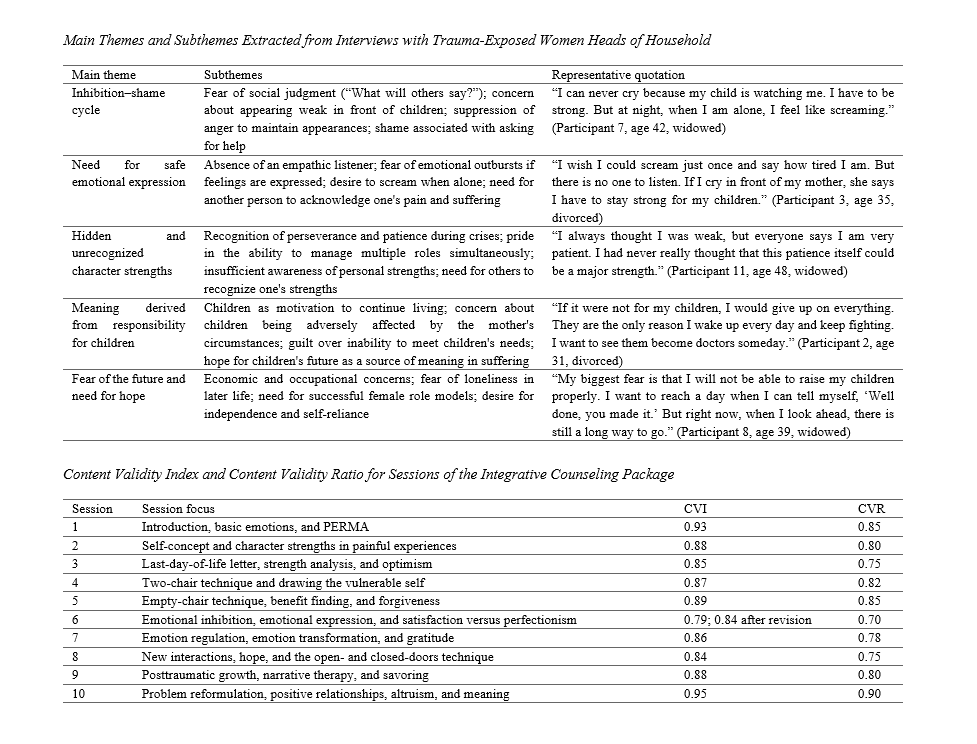
Methods and Materials: This developmental-applied study employed a sequential exploratory mixed-methods design. In the qualitative phase, 14 trauma-exposed women heads of household were selected through purposive sampling and interviewed using semi-structured interviews. The data were analyzed through thematic analysis, and the initial integrative package was developed by combining the qualitative findings with theoretical principles of Emotion-Focused Therapy and positive psychology. Content validity was evaluated by 10 experts using the Content Validity Index and Content Validity Ratio. In the quantitative phase, 72 eligible women were randomly allocated to four groups consisting of Emotion-Focused Therapy, positive psychology, integrative intervention, and control. Following attrition, data from 60 participants, 15 per group, were analyzed. The three interventions consisted of 10 group sessions of 90 minutes. Assessments were conducted at pretest, posttest, and three-month follow-up using measures of emotional self-regulation, emotional inhibition, character strengths, and posttraumatic growth. Data were analyzed using ANCOVA, repeated-measures multivariate analysis, and Bonferroni post hoc comparisons in SPSS 27.
Findings: Content validation supported the acceptability of the developed package, with a mean CVI of 0.86 and a mean CVR of 0.78. ANCOVA showed significant posttest differences among the four groups in emotional self-regulation, F(3,55) = 31.20, p < .001, η² = .64; emotional inhibition, F(3,55) = 29.70, p < .001, η² = .62; character strengths, F(3,55) = 42.80, p < .001, η² = .70; and posttraumatic growth, F(3,55) = 45.10, p < .001, η² = .71. Bonferroni comparisons indicated that the integrative intervention significantly outperformed the other three conditions across all outcomes, while EFT was more effective than positive psychology for emotion-related outcomes and positive psychology was more effective than EFT for character strengths and posttraumatic growth.
Conclusion: The validated integrative counseling package combining Emotion-Focused Therapy and positive psychology appears to be an effective intervention for simultaneously improving emotional functioning and strengthening positive psychological resources in trauma-exposed women heads of household.
Downloads
References
Ardani, M., & Eslami, H. (2024). Effectiveness of Emotion Regulation Training on the Social Intelligence of Female Heads of Household. Journal of Disability Studies, 14(87), 87-87.
Asadollahi, F., Mohammadi, M., Naziri, G., & Fath, N. (2022). Validation and Confirmatory Factor Analysis of the Persian Version of Kellner's Emotional Inhibition Questionnaire in a Clinical Population in Lorestan Province. Applied Psychology Quarterly, 16(4), 271-286.
Asadollahi, F., Mohammadi, M., Naziri, G., & Fath, N. (2024). Examining the Mediating Role of Emotional Inhibition in the Relationship between Levels of Emotional Awareness and Life Events with Post-Traumatic Stress Symptoms. Quarterly Journal of Applied Psychological Research, 15(2), 1-18.
Bakhshandeh Amnieh, T. (2018). Effectiveness of Emotion Regulation Training on the Quality of Life of Female Heads of Household in Tehran.
Fassbinder, E., & Arntz, A. (2019). Schema Therapy with Emotionally Inhibited and Fearful Patients. Journal of Contemporary Psychotherapy, 49(1), 7-14.
Foschiera, L. N., de Freitas, C. P. P., Luft, C. Z., Godoi, A. R., Dupont, M. F., & Habigzang, L. F. (2024). Evidence of Effectiveness of a Psychotherapy Protocol for Women with a History of Intimate Partner Violence: Follow-Up Study. Trends in Psychology, 32(4), 1287-1306.
Greenberg, L. S. (2017). Emotion-Focused Therapy. American Psychological Association.
Izadi, S. (2023). Comparison of the Effectiveness of Compassion-Focused Therapy and Emotion-Focused Therapy on Alexithymia in Adolescent Girls with Psychosomatic Problems. Psychological Science, 22(125), 2411-2428.
Kadiroğlu, İ., Çoban, S., & Şenkal Ertürk, İ. (2026). Emotion-Focused Therapy and Trauma: An Integrative Review. Person-Centered & Experiential Psychotherapies, 25(1), 91-107. https://doi.org/10.1080/14779757.2025.2541414
Malekpour Golsafidi, Z., Keshavarzi Ershadi, F., & Emamipour, S. (2022). Effectiveness of Positive Psychology Interventions on Post-Traumatic Growth and Psychological Distress among COVID-19 Survivors. Journal of Psychology, 26(3), 295-312.
McLeod, S. (2024). John Bowlby’s Attachment Theory.
Naderian, M. R., Gazanfari, A., Ahmadi, R., & Chorami, M. (2022). Effectiveness of Emotion-Focused Group Therapy in Social Intimacy, Social Acceptance, and Self-Compassion of Clients with Anxiety Referring to Counseling Centers. Razavi Journal of Medicine, 10(1), 73-80.
Najafi, M. (2016). Effectiveness of Emotion-Focused Couple Therapy (EFT) in Increasing Adjustment and Improving Physical and Psychological Health among Infertile Couples. Journal of Women and Midwifery, 18(173), 1-10.
Paivio, S. C., & Pascual-Leone, A. (2023). Emotion-Focused Therapy for Complex Trauma: An Integrative Approach. American Psychological Association.
Rezaeian, H., Rasouli, R., Askarbiyouki, S., & Asl Dehghan, F. (2018). Effectiveness of Psychological Empowerment in Enhancing Psychological Well-Being and Quality of Life of Female Heads of Household. Social Work Research Journal, 7(4), 5-14.
Sharifi Ardani, A., Sajjadipour, F. S., Yavari, F., Sharifi Ardani, E., & Akrami Abargouei, G. R. (2025). Psychometric Properties of the Persian Version of the Short Character Strengths Test in an Iranian Sample. Quarterly Journal of Applied Psychological Research, 16(4), 271-286.
Shirinkam, M., & Rostamnejad, M. (2026). Effectiveness of Trauma-Focused Emotion-Focused Therapy on Quality of Life and Self-Compassion in Women with Sexual Trauma Experience. Rooyesh-e-Ravanshenasi, 15(2), 261-270.
Torabi Momen, A., Raheb, G., Alipour, F., & Biglarian, A. (2017). Effectiveness of Group Social Work Intervention with a Developmental Approach on the Psychological and Social Empowerment of Female Heads of Household. Rehabilitation Research, 18(3), 242-253.
Yaghoubi Abolghasem, S. (2019). Effectiveness of a Positive Psychology Intervention on Adolescents' Psychological Well-Being. Health Psychology Journal, 8(3), 45-62.
Zamani Moghadam, M., & Afshani, S. A. (2021). Empowerment of Female Heads of Household in Iran: A Systematic Review. Social Welfare, 21(80), 45-80.
Downloads
Additional Files
Publication Timeline
- Submitted
- Revised
- Accepted