Identifying Individual, Family, and Social Factors Contributing to Psychological Empowerment Among Women
Keywords:
Psychological Empowerment, Women, Self-Efficacy, Autonomy, Family Support, Social Participation, Socioeconomic OpportunitiesAbstract
Objective: This study aimed to identify and explain the individual, family, and social factors contributing to psychological empowerment among women in Hungary.
Methods and Materials: This qualitative study was conducted using conventional qualitative content analysis. The participants were 24 adult women residing in Budapest, Debrecen, Szeged, and Pécs, Hungary, who were selected through purposive sampling with maximum variation in age, education, employment status, marital status, family structure, and socioeconomic background. Data were collected through individual semi-structured, in-depth interviews lasting approximately 45–70 minutes. Interviews explored participants’ experiences of psychological empowerment and the personal, relational, and social conditions that strengthened or restricted their autonomy, competence, self-confidence, and perceived control. Data collection and analysis were conducted concurrently until theoretical saturation was achieved. Interviews were transcribed verbatim and analyzed inductively through identification of meaning units, initial coding, constant comparison, categorization, and development of overarching dimensions. Credibility, dependability, confirmability, and transferability were strengthened through iterative analysis, member checking, peer discussion, reflexive documentation, and maintenance of an audit trail.
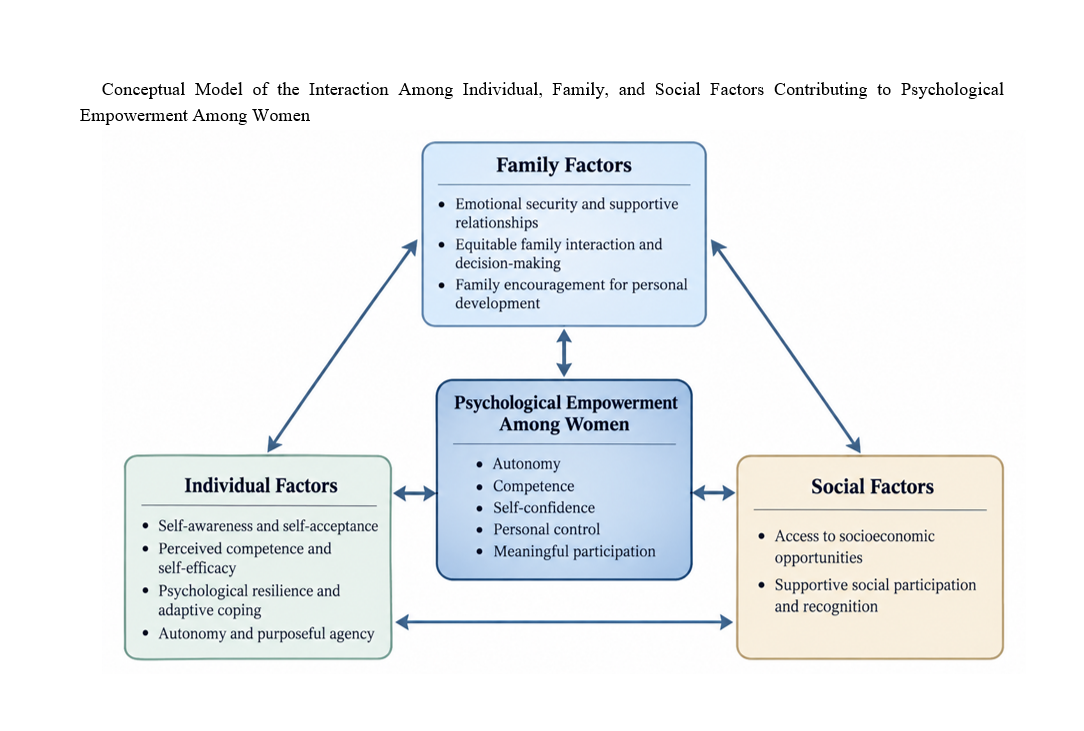
Findings: Analysis generated 683 initial codes, which were organized into 27 subcategories, nine major categories, and three overarching dimensions. Individual factors included self-awareness and self-acceptance, perceived competence and self-efficacy, psychological resilience and adaptive coping, and autonomy and purposeful agency. Family factors comprised emotional security and supportive relationships, equitable family interaction and decision-making, and family encouragement for personal development. Social factors included access to socioeconomic opportunities and supportive social participation and recognition.
Conclusion: Psychological empowerment among women is a multidimensional and dynamic process arising from the interaction of personal capacities, supportive family relationships, and enabling social conditions; therefore, sustainable empowerment requires interventions that simultaneously strengthen individual agency, relational support, and access to meaningful social and economic opportunities.
Downloads
References
Abbasi, A. (2026). A Phenomenological Exploration of Life Satisfaction Among Older Iranian Women. https://doi.org/10.21203/rs.3.rs-10284677/v1
Abdelwahed, A., Zhao, X., Gendia, M. A., & Ebrahim Abbas Abdullah Abbas, A. (2025). Intimate Partner Violence Among Poor Disabled Women in Egypt. Journal of interpersonal violence, 41(9-10), 2242-2276. https://doi.org/10.1177/08862605251326079
Al-Rashdi, N. A. S., & Abdelwahed, N. A. A. (2022). The Empowerment of Saudi Arabian Women Through a Multidimensional Approach: The Mediating Roles of Self-Efficacy and Family Support. Sustainability, 14(24), 16349. https://doi.org/10.3390/su142416349
Alhalawani, S., & Al‐Serhan, A. (2024). Reshaping Gender Norms: Exploring the Ripple Effect of Refugeeism on Women's Empowerment. Development Policy Review, 42(6). https://doi.org/10.1111/dpr.12805
Andriani, L., Lal, S., & Kalam, A. A. (2022). Entrepreneurial Activities and Women Empowerment in Rural India Between Microfinance and Social Capital. Strategic Change, 31(2), 227-237. https://doi.org/10.1002/jsc.2492
Antony, T. A. (2026). Mental Health and Psychosocial Support Interventions for Individuals Affected by Gender-Based Violence in Fragile Contexts: A Systematic Review. Cambridge Prisms Global Mental Health, 13. https://doi.org/10.1017/gmh.2026.10272
Bastian, B. L., Wood, B. P., & Ng, P. Y. (2023). The Role of Strong Ties in Empowering Women Entrepreneurs in Collectivist Contexts. International Journal of Gender and Entrepreneurship, 15(1), 122-146. https://doi.org/10.1108/ijge-10-2021-0171
Bosch, A., Jaga, A., Carrim, N. M. H., & Ngunjiri, F. W. (2025). Making Africa Visible: Pathways for Intellectual Activism in Work and Organization. Gender Work and Organization, 33(3), 689-697. https://doi.org/10.1111/gwao.70077
Chowdhury, S., & Haque, M. A. (2025). Understanding the Issues of Women’s Empowerment and Fertility in Bangladesh. Reproductive Health, 22(1). https://doi.org/10.1186/s12978-025-02065-3
Chowdhury, S., Khan, M. M. H., & Haque, M. A. (2024). Construction of Women's Empowerment Index for Bangladesh. Frontiers in Sociology, 9. https://doi.org/10.3389/fsoc.2024.1356756
Desai, S., Chen, F., Reddy, S., & McLaughlin, A. (2022). Measuring Women's Empowerment in the Global South. Annual Review of Sociology, 48(1), 507-527. https://doi.org/10.1146/annurev-soc-030420-015018
Hassan, A. F., Samah, A. A., Hariza, A. B., & Rosnon, M. d. R. (2024). Relationship Between Participation in Implementation, Cultural Collectivism, and Psychological Empowerment Among Women in Zanzibar Tourism Industry. International Journal of Academic Research in Business and Social Sciences, 14(11). https://doi.org/10.6007/ijarbss/v14-i11/22915
Hosanoo, Z., Rughoobur‐Seetah, S., Soupramanien, L. D. B., Doargajudhur, M., Lichy, J., & Wheatley, D. (2026). Gender and Power: Financial Independence and Women's Relational Empowerment in the Global South. Gender Work and Organization, 33(4), 1283-1297. https://doi.org/10.1111/gwao.70123
Kinati, W., Baker, D., Temple, E. C., Najjar, D., & Mulema, A. A. (2022). Empowerment Resources, Decision-Making and Gender Attitudes: Which Matter Most to Livestock Keepers in the Mixed and Livestock-Based Systems in Ethiopia? Cabi Agriculture and Bioscience, 3(1). https://doi.org/10.1186/s43170-022-00114-6
Kumar, P., & Mukherjee, A. (2025). Reimagining Singlehood in Urban India Through Intersectional Narratives and Support Systems: An Ethnographic Study. Journal of marital and family therapy, 51(3). https://doi.org/10.1111/jmft.70049
Kumar, V., Maral, P., Upadhyay, A., & Azam, S. F. (2024). Women: Autonomous Bodies, Are They? Understanding Autonomy and Well-Being. The Oriental Anthropologist a Bi-Annual International Journal of the Science of Man, 24(2), 246-261. https://doi.org/10.1177/0972558x241277121
Mahato, T., & Jha, M. K. (2024). Does Participation in Self-Help Group Affect the Psychological Empowerment of Tribal Women? Evidence From India. International Journal of Development Issues, 23(3), 447-462. https://doi.org/10.1108/ijdi-11-2023-0265
Mbah, C. S., Isiugo-Abanihe, U. C., & Nwokocha, E. E. (2023). Influence of Household Decisions on the Socio-Economic and Fertility Behaviour of Women in Rural Nigeria. Journal of International Cooperation and Development, 6(2), 91. https://doi.org/10.36941/jicd-2023-0014
Mosanya, M., & Kassie, S. (2024). Psychological Empowerment and Exercising: The Relationships Between Exercising, Self‐stereotyping, Agency, Autonomy and Physical Self‐efficacy in non‐Western Women. Journal of Community & Applied Social Psychology, 34(3). https://doi.org/10.1002/casp.2791
Nabayinda, J., Nabunya, P., Bahar, O. S., Kizito, S., Stark, L., Namatovu, P., Witte, S. S., Neilands, T. B., McKay, M. M., & Ssewamala, F. M. (2025). She Is a Guest in My House: Exploring the Barriers to Asset Development and Decision‐Making Autonomy Among Young Women in Southern Uganda. Journal of International Development, 37(7), 1543-1554. https://doi.org/10.1002/jid.70022
Navarro-Mantas, L., Lemus, S. d., García‐Sánchez, E., McGill, L., Hansen, N., & Megías, J. L. (2022). Defining Power and Agency in Gender Relations in El Salvador: Consequences for Intimate Partner Violence and Women’s Mental Health. Frontiers in psychology, 13. https://doi.org/10.3389/fpsyg.2022.867945
Olwanda, E., Opondo, K., Oluoch, D., Croke, K., Maluni, J., Jepkosgei, J., & Nzinga, J. (2023). The Role of Women’s Autonomy and Empowerment in Maternal Health Decision Making: Implications on the Implementation Process of a Service Delivery Reform in Kenya. a Qualitative Exploratory Study. https://doi.org/10.21203/rs.3.rs-3581151/v1
Olwanda, E., Opondo, K., Oluoch, D., Croke, K., Maluni, J., Jepkosgei, J., & Nzinga, J. (2024). Women’s Autonomy and Maternal Health Decision Making in Kenya: Implications for Service Delivery Reform - A Qualitative Study. BMC Women S Health, 24(1). https://doi.org/10.1186/s12905-024-02965-9
Pervin, S., Ismail, M. N., & Noman, A. H. M. (2023). Does Microfinance Singlehandedly Empower Women? A Case Study of Bangladesh. Sage Open, 13(2). https://doi.org/10.1177/21582440221096114
Rahman, M. W., Haque, A. B. M. M., Zaman, T., Palash, M. S., Nahiduzzaman, M., & Nazia, T. (2024). Women Empowerment Status in the Coastal Fishing Communities of Bangladesh. Sage Open, 14(2). https://doi.org/10.1177/21582440241250114
Samıer, E. A., & ElKaleh, E. S. (2021). Towards a Model of Muslim Women’s Management Empowerment: Philosophical and Historical Evidence and Critical Approaches. Administrative Sciences, 11(2), 47. https://doi.org/10.3390/admsci11020047
Sarker, T., Roy, R., Yeasmin, S., & Asaduzzaman, M. (2024). Enhancing Women's Empowerment as an Effective Strategy to Improve Food Security in Rural Bangladesh: A Pathway to Achieving SDG-2. Frontiers in Sustainable Food Systems, 8. https://doi.org/10.3389/fsufs.2024.1436949
Singh, B., & Singh, S. K. (2025). Evolving Dimensions of Women’s Empowerment in India. PLoS One, 20(7), e0327494. https://doi.org/10.1371/journal.pone.0327494
Sony, S. F., & Rifat, A. H. (2024). Female Day Laborers and Empowerment: A Study on Some Selected Rural Areas in Kishoreganj District, Bangladesh. International Journal of Sociology and Humanities, 6(1), 84-97. https://doi.org/10.33545/26648679.2024.v6.i1b.79
Tohan, M. M., Zaman, S., Sultana, N., Nurullah, A. S., & Rahman, M. A. (2025). Extent of Anxiety Among Married Women in Bangladesh and Its Potential Predictors: A Nation‐Wide Cross‐Sectional Study. Depression and Anxiety, 2025(1). https://doi.org/10.1155/da/7415491
Venugopalan, M., Bastian, B. L., & Viswanathan, P. K. (2021). The Role of Multi-Actor Engagement for Women’s Empowerment and Entrepreneurship in Kerala, India. Administrative Sciences, 11(1), 31. https://doi.org/10.3390/admsci11010031
Vijayalakshmi, A., & Lin, M. H. (2022). One‐click at a Time: Empowering Mothers for Their Adolescent Children's Educational Expenditures Through Social Media Usage. International Journal of Consumer Studies, 47(3), 1112-1125. https://doi.org/10.1111/ijcs.12891
Yunizar, C. H., & Xiong, Z. B. (2025). Investigating Early-Married Women’s Perceived Agency and Marital Quality in Rural Indonesia. Family Sciences, 1(2), 15. https://doi.org/10.3390/famsci1020015
Zhao, M. (2026). The Paradox of Empowerment: How Education and Autonomy in Mate Choice for Marriage Amplify the Impact of Childhood Harsh Parenting on Self-Esteem Among Women in Beijing. Family Sciences, 2(2), 16. https://doi.org/10.3390/famsci2020016
Downloads
Additional Files
Publication Timeline
- Submitted
- Revised
- Accepted