A Comparison of the Effectiveness of Dialectical Behavior Therapy and Metacognitive Therapy on Self-Injurious Behaviors and Self-Criticism in Women with Major Depressive Disorder
Keywords:
dialectical behavior therapy, metacognitive therapy, self-injurious behaviors, self-criticism, major depressive disorderAbstract
Objective: This study aimed to compare the effectiveness of dialectical behavior therapy (DBT) and metacognitive therapy (MCT) in reducing self-injurious behaviors and self-criticism among women with major depressive disorder.
Methods and Materials: This quasi-experimental study employed a pretest–posttest design with a control group and a two-month follow-up. The statistical population consisted of women with major depressive disorder attending the Jaryan-e Zendegi Psychology Clinic in Tehran. Forty-eight eligible participants were selected through purposive sampling and randomly assigned to DBT, MCT, and control groups, with 16 participants in each group. The DBT and MCT groups each received eight weekly 90-minute group sessions, whereas the control group received no intervention. Data were collected using the Inventory of Statements About Self-Injury, Levels of Self-Criticism Scale, and Beck Depression Inventory-II. Data were analyzed using repeated-measures analysis of variance and Bonferroni post hoc tests in SPSS version 27.
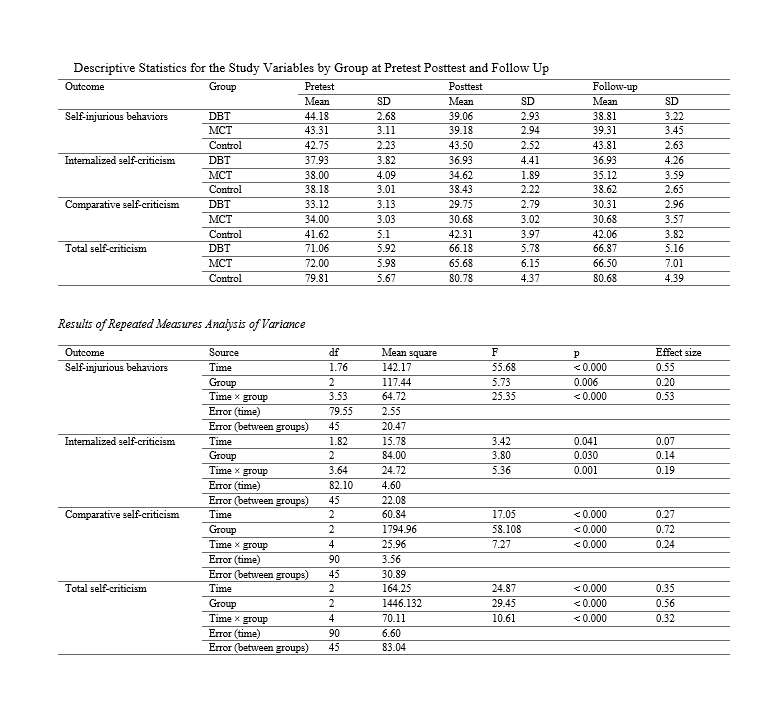
Findings: Repeated-measures analysis showed significant time × group interactions for self-injurious behaviors (F = 25.35, p < .001, η² = .53), internalized self-criticism (F = 5.36, p = .001, η² = .19), comparative self-criticism (F = 7.27, p < .001, η² = .24), and total self-criticism (F = 10.61, p < .001, η² = .32). Bonferroni comparisons indicated that both DBT and MCT significantly reduced self-injurious behaviors, comparative self-criticism, and total self-criticism compared with the control group (p < .05), and these effects were maintained at follow-up. MCT also significantly reduced internalized self-criticism compared with the control group (p = .037), whereas DBT did not (p > .05). No significant differences were found between DBT and MCT for any outcome (p > .05).
Conclusion: Both DBT and MCT appear to be effective and durable interventions for reducing self-injurious behaviors and self-criticism in women with major depressive disorder, although MCT may provide an additional advantage for internalized self-criticism relative to no treatment.
Downloads
References
Austin, J., Drossaert, C. H., Sanderman, R., Schroevers, M. J., & Bohlmeijer, E. T. (2021). Experiences of self-criticism and self-compassion in people diagnosed with cancer: A multimethod qualitative study. Frontiers in psychology, 12, 737725. https://doi.org/10.3389/fpsyg.2021.737725
Fagiolini, A., Mariano, M. P., Biesheuvel, E., & Purushottamahanti, P. (2024). A pooled analysis of the efficacy of sertraline in women, with a focus on those of childbearing age. Annals of General Psychiatry, 23(1), 44. https://doi.org/10.1186/s12991-024-00519-9
Ferrari, A. J., Santomauro, D. F., Aali, A., Abate, Y. H., Abbafati, C., Abbastabar, H., & Bell, M. L. (2024). Global incidence, prevalence, years lived with disability (YLDs), disability-adjusted life-years (DALYs), and healthy life expectancy (HALE) for 371 diseases and injuries in 204 countries and territories and 811 subnational locations, 1990–2021: A systematic analysis for the Global Burden of Disease Study 2021. The lancet, 403(10440), 2133-2161. https://doi.org/10.1016/S0140-6736(24)00757-8
Fisher, P., & Wells, A. (2021). Metacognitive therapy: Distinctive features. Arjmand.
Gold, H. R., & Smout, M. F. (2024). The influence of hated self on relationships between metacognitive beliefs, self-critical rumination, decentering and psychopathology. International Journal of Cognitive Therapy, 17(4), 762-786. https://doi.org/10.1007/s41811-024-00223-2
Goldstein, T. R., Merranko, J., Rode, N., Sylvester, R., Hotkowski, N., Fersch-Podrat, R., & Birmaher, B. (2024). Dialectical behavior therapy for adolescents with bipolar disorder: A randomized clinical trial. JAMA Psychiatry, 81(1). https://doi.org/10.1001/jamapsychiatry.2023.3399
Jimenez-Munoz, L., Penuelas-Calvo, I., Diaz-Olivan, I., Gutierrez-Rojas, L., Baca-Garcia, E., & Porras-Segovia, A. (2022). Suicide prevention in your pocket: A systematic review of ecological momentary interventions for the management of suicidal thoughts and behaviors. Harvard Review of Psychiatry, 30(2), 85-99. https://doi.org/10.1097/HRP.0000000000000331
Jomha, A., Sohn, M. N., Watson, M., Kopala-Sibley, D. C., & McGirr, A. (2025). Self-criticism predicts antidepressant effects of intermittent theta-burst stimulation in major depressive disorder. Journal of affective disorders, 372, 210-215. https://doi.org/10.1016/j.jad.2024.12.006
Kang, L., Li, R., Liu, H., Ma, S., Sun, S., Zhang, N., & Liu, Z. (2021). Nonsuicidal self-injury in undergraduate students with major depressive disorder: The role of psychosocial factors. Journal of affective disorders, 290, 102-108. https://doi.org/10.1016/j.jad.2021.04.083
Kiekens, G., Hasking, P., Claes, L., Mortier, P., Auerbach, R. P., Boyes, M., & Bruffaerts, R. (2018). The DSM-5 nonsuicidal self-injury disorder among incoming college students: Prevalence and associations with 12-month mental disorders and suicidal thoughts and behaviors. Depression and Anxiety, 35(7), 629-637. https://doi.org/10.1002/da.22754
Langenecker, S. A., Schreiner, M. W., Bessette, K. L., Roberts, H., Thomas, L., Dillahunt, A., & Watkins, E. R. (2024). Rumination-focused cognitive behavioral therapy reduces rumination and targeted cross-network connectivity in youth with a history of depression: Replication in a preregistered randomized clinical trial. Biological Psychiatry Global Open Science, 4(1), 1-10. https://doi.org/10.1016/j.bpsgos.2023.08.012
Li, J., Wen, P., Zhou, J., Zhong, Z., & Li, L. (2025). Dialectical behavioral therapy-based prevention of non-suicidal self-harm among secondary students in China: A randomized controlled trial. BMC public health, 25(1), 4392. https://doi.org/10.1186/s12889-025-24978-1
Linehan, M. (2021). Dialectical behavior therapy: Skills training manual. Arjmand.
Lo, B. C. Y., & Cheng, S. K. L. (2024). Emotional risk factors, rumination, and self-criticism in relation to suicidal ideation among Chinese depressive outpatients. Behavioral Sciences, 14(11), 1111. https://doi.org/10.3390/bs14111111
Lynch, T. R., Hempel, R. J., Whalley, B., Byford, S., Chamba, R., Clarke, P., & Russell, I. T. (2020). Refractory depression–mechanisms and efficacy of radically open dialectical behavior therapy (RefraMED): Findings of a randomized trial on benefits and harms. The British Journal of Psychiatry, 216(4), 204-212. https://doi.org/10.1192/bjp.2019.53
Lynch, T. R., Lynch, T., Hempel, R. J., Hempel, R., Whalley, B., Byford, S., & Russell, I. (2018). Radically open dialectical behavior therapy for refractory depression: The RefraMED RCT. Efficacy and Mechanism Evaluation, 5(7), 1-112. https://doi.org/10.3310/eme05070
Nagy, L. M., Shanahan, M. L., & Baer, R. A. (2021). An experimental investigation of the effects of self-criticism and self-compassion on implicit associations with non-suicidal self-injury. Behaviour Research and Therapy, 139, 103819. https://doi.org/10.1016/j.brat.2021.103819
Nordahl, H. M., & Wells, A. (2019). Metacognitive therapy of early traumatized patients with borderline personality disorder: A phase-II baseline controlled trial. Frontiers in psychology, 10, 1694. https://doi.org/10.3389/fpsyg.2019.01694
Otto, M. W., Birk, J. L., Fitzgerald, H. E., Chauvin, G. V., Gold, A. K., & Carl, J. R. (2022). Stage models for major depression: Cognitive behavior therapy, mechanistic treatment targets, and the prevention of stage transition. Clinical psychology review, 95, 102172. https://doi.org/10.1016/j.cpr.2022.102172
Ramsey, W. A., Berlin, K. S., Del Conte, G., Lightsey, O. R., Schimmel-Bristow, A., Marks, L. R., & Strohmer, D. C. (2021). Targeting self-criticism in the treatment of nonsuicidal self-injury in dialectical behavior therapy for adolescents: A randomized clinical trial. Child and Adolescent Mental Health, 26(4), 320-330. https://doi.org/10.1111/camh.12452
Robillard, C. L., Claes, L., Victor, S. E., Myin-Germeys, I., & Kiekens, G. (2025). Self-criticism is a real-time predictor of non-suicidal self-injury and disordered eating: An ecological momentary assessment study among treatment-seeking individuals. Journal of affective disorders, 371, 13-21. https://doi.org/10.1016/j.jad.2024.10.121
Schneider, R. A., Chen, S. Y., Lungu, A., & Grasso, J. R. (2020). Treating suicidal ideation in the context of depression. BMC psychiatry, 20(1), 497. https://doi.org/10.1186/s12888-020-02894-5
Seney, M. L., Glausier, J., & Sibille, E. (2022). Large-scale transcriptomics studies provide insight into sex differences in depression. Biological Psychiatry, 91(1), 14-24. https://doi.org/10.1016/j.biopsych.2020.12.025
Spijker, J., Muntingh, A., & Batelaan, N. (2020). Advice for clinicians on how to treat comorbid anxiety and depression. JAMA Psychiatry, 77(6), 645-646. https://doi.org/10.1001/jamapsychiatry.2020.0601
Tian, X., Hu, N., Lu, L., Tan, L., & Li, P. (2024). Gender differences in major depressive disorder at different ages: A REST-meta-MDD project-based study. BMC psychiatry, 24(1), 575. https://doi.org/10.1186/s12888-024-06021-6
Vijayapriya, C. V., & Tamarana, R. (2023). Effectiveness of dialectical behavior therapy as a transdiagnostic treatment for improving cognitive functions: A systematic review. Research in Psychotherapy (Milano), 26(2), 662. https://doi.org/10.4081/ripppo.2023.662
Werner, A. M., Tibubos, A. N., Rohrmann, S., & Reiss, N. (2019). The clinical trait self-criticism and its relation to psychopathology: A systematic review–Update. Journal of affective disorders, 246, 530-547. https://doi.org/10.1016/j.jad.2018.12.069
Yosep, I., Kurniawan, K., Maulana, I., Mardhiyah, A., Hazmi, H., & Hikmat, R. (2026). Implementation of dialectical behavior therapy in reducing self-harm behavior and risk of suicide in adolescents and young adults: A scoping review. International Journal of Africa Nursing Sciences, 101085. https://doi.org/10.1016/j.ijans.2026.101085
Zarghami, M., Babakhanian, M., Asgarabad, M. H., Ghazanfanpour, M., Akrami, F. S., Nazeri, N., & Molavi, N. (2020). Psychometric properties of the inventory of statements about self-injury (ISAS) in Iranian opioid and alcohol abusers. Iran J Psychiatry Behav Sci, 14(4), e88494. https://doi.org/10.5812/ijpbs.88494
Zhang, J. Y., Ji, X. Z., Meng, L. N., & Cai, Y. J. (2019). Effects of modified mindfulness-based stress reduction (MBSR) on the psychological health of adolescents with subthreshold depression: A randomized controlled trial. Neuropsychiatric Disease and Treatment, 2695-2704. https://doi.org/10.2147/NDT.S216401
Downloads
Additional Files
Publication Timeline
- Submitted
- Revised
- Accepted