The Effectiveness of Schema Therapy on Forgiveness and Marital Adjustment in Married Women
Keywords:
Schema Therapy, Assertiveness, Anger Regulation, Forgiveness, Marital Adjustment, Married WomenAbstract
Objective: This study aimed to determine the effectiveness of schema therapy in improving forgiveness and marital adjustment among married women.
Methods and Materials: The present study employed a quasi-experimental pretest-posttest control-group design with a 45-day follow-up. The statistical population consisted of married women attending the Family Cultural Center of Isfahan in 2025. Using convenience sampling, 36 eligible women were initially recruited and randomly assigned to experimental and control groups; following attrition, the final sample consisted of 30 participants, with 15 women in each group. The experimental group received eight sessions of schema therapy, each lasting approximately 60–90 minutes, whereas the control group received no intervention during the study period. Data were collected using the Heartland Forgiveness Scale and the Dyadic Adjustment Scale. Measurements were conducted at pretest, posttest, and follow-up. Data were analyzed in SPSS version 26 using descriptive statistics and repeated-measures analysis of variance with Greenhouse–Geisser correction where required.
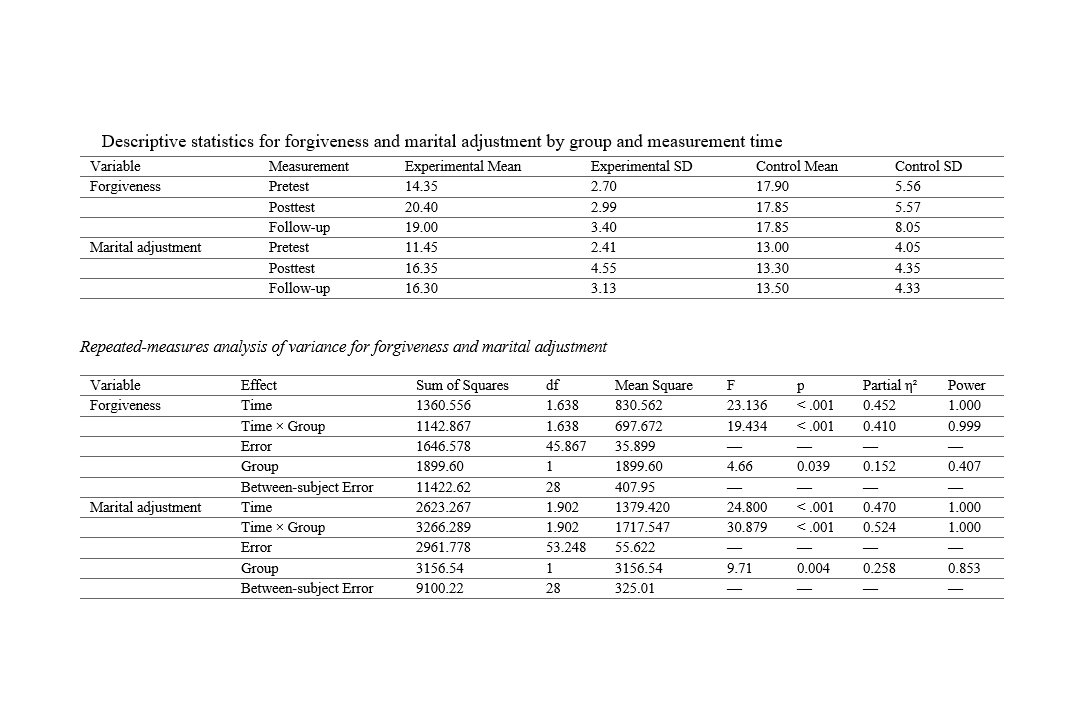
Findings: Repeated-measures analysis showed a significant effect of time on forgiveness, F(1.638, 45.867) = 23.136, p < .001, partial η² = 0.452, and a significant Time × Group interaction, F(1.638, 45.867) = 19.434, p < .001, partial η² = 0.410. The between-group effect was also significant, F(1, 28) = 4.66, p = .039, partial η² = 0.152. For marital adjustment, the effect of time was significant, F(1.902, 53.248) = 24.800, p < .001, partial η² = 0.470, as was the Time × Group interaction, F(1.902, 53.248) = 30.879, p < .001, partial η² = 0.524. The between-group effect was significant, F(1, 28) = 9.71, p = .004, partial η² = 0.258. Bonferroni comparisons indicated significant pretest-posttest and pretest-follow-up differences for both outcomes.
Conclusion: Schema therapy was effective in improving forgiveness and marital adjustment among married women, and the effects remained evident at the 45-day follow-up, supporting its usefulness as a psychological intervention for enhancing marital functioning.
Downloads
References
Ahmadi, A., Jafari Roshan, M., & Baseri, A. (2025). A model of marital adjustment based on moral integrity and spirituality: The mediating role of cognitive flexibility and moderating role of marital duration. Psychological Dynamics in Mood Disorders, 4(1), 120-137.
Bateni Noushabadi, R., & Khayyatan, F. (2026). Effectiveness of schema therapy on emotion regulation and self-criticism in individuals with generalized anxiety disorder. Journal of Health Promotion Management, 15(1), 94-106.
Bedir Akpınarlı, B., & Eryücel, S. (2024). Marital adjustment, spiritual well-being, and locus of control in married couples. Religions, 15(11), 1376. https://doi.org/10.3390/rel15111376
Bolluk Ugur, G., & Çakmak Tolan, Ö. (2024). The examination of mediating role of mindfulness in the relation between marriage role expectations, forgiveness and marital adjustment. Current Psychology, 43(48), 36566-36585. https://doi.org/10.1007/s12144-024-07031-z
Borzyszkowska, A., Wojtynkiewicz, E., & Mamełka, K. (2023). Forgiveness and early maladaptive schemas and trauma among women with an alcohol-use disorder parent. Alcoholism and Drug Addiction, 36(1), 41-52. https://doi.org/10.5114/ain.2023.129515
Brudek, P., & Kaleta, K. (2023). Marital offence-specific forgiveness as mediator in the relationships between personality traits and marital satisfaction among older couples: Perspectives on Lars Tornstam's theory of gerotranscendence. Ageing & Society, 43(1), 161-179. https://doi.org/10.1017/S0144686X21000465
Charestad, H., Moharrami, J., & Jafari Kadijani, N. (2026). Evaluating a conceptual model of communication patterns and marital burnout: The mediating roles of forgiveness and self-worth in married women. Assessment, Evaluation and Interventions in Couples Therapy, 3(2), 1-20.
Côté-Lussier, C., & David, J. D. (2023). Intuitive anger in the context of crime and punishment. Psychology, Crime & Law, 29(5), 465-487. https://doi.org/10.1080/1068316X.2022.2027946
Ebrahimi Gerafmi, S. (2025). Effectiveness of anger management training on reducing domestic violence in marital relationships. Journal of Research Studies in Future Psychology, 3, 15-19.
Fincham, F. D., & Maranges, H. M. (2024). Psychological perspectives on divine forgiveness: Seeking divine forgiveness. Frontiers in psychology, 15, 1256402. https://doi.org/10.3389/fpsyg.2024.1256402
Grünebaum, A., McLeod-Sordjan, R., Pollet, S., Moreno, J., Bornstein, E., Lewis, D., Katz, A., Warman, A., Dudenhausen, J., & Chervenak, F. (2023). Anger: An underappreciated destructive force in healthcare. Journal of Perinatal Medicine, 51(7), 850-860. https://doi.org/10.1515/jpm-2023-0099
Hagberg, T., Manhem, P., Oscarsson, M., Michel, F., Andersson, G., & Carlbring, P. (2023). Efficacy of transdiagnostic cognitive-behavioral therapy for assertiveness: A randomized controlled trial. Internet Interventions, 32, 100629. https://doi.org/10.1016/j.invent.2023.100629
Harmon-Jones, E., & Harmon-Jones, C. (2023). Anger: Causes and components. In Anger, aggression, and interventions for interpersonal violence (pp. 99-118). Routledge. https://doi.org/10.4324/9781003417989-6
Körük, S., & Özabacı, N. (2023). How do early maladaptive schemas and family functions predict dyadic marital adjustment? A test on Turkish married individuals. Journal of sex & marital therapy, 49(7), 772-782. https://doi.org/10.1080/0092623X.2023.2195857
Moon, E. J., & Nam, J. (2025). Exploring the relationship between other-directedness schema and dysfunctional anger expression in Korean adults: Mediating roles of rejection sensitivity and mentalizing. Journal of Rational-Emotive & Cognitive-Behavior Therapy, 43, 35. https://doi.org/10.1007/s10942-025-00606-0
Mrvoljak-Theodoropoulou, I., & Aggeli, K. (2026). The relationship between assertiveness, trait anxiety, and early maladaptive schemas. Professional psychology: Research and practice. https://doi.org/10.1037/pro0000685
Overman, S., Neo, S., & Hall, A. T. (2025). The emotional backlash of public accountability. Public Performance & Management Review, 1-29. https://doi.org/10.1080/15309576.2025.2469787
Özmen, A. (2023). Anger and psychological symptoms relationship: Mediator role of maladaptive schemas. Frontiers in psychology, 14, 1183618. https://doi.org/10.3389/fpsyg.2023.1183618
Pop, G. V., Nechita, D. M., Miu, A. C., & Szentagotai-Tatar, A. (2025). Anger and emotion regulation strategies: A meta-analysis. Scientific reports, 15. https://doi.org/10.1038/s41598-025-91646-0
Pukat, L. S., Udele, J., & Samaila, R. T. (2025). Effect of schema therapy and assertiveness training on social anxiety and interpersonal sensitivity among secondary school students in Plateau State, Nigeria. Education Annals, 2(7).
Rahimi Sadegh, M., Ghanbari Hashemabadi, B., & Aghamohammadian Sherbaf, H. (2025). Effectiveness of mindfulness-based schema therapy on quality of life, anger, and rumination among university students. Rooyesh-e-Ravanshenasi, 14(5), 11-22.
Rajaeizadeh, M., & Khayyatan, F. (2025). Effectiveness of schema therapy on distress tolerance, resilience, emotion regulation, and parenting styles of mothers of children with attention-deficit/hyperactivity disorder. Rooyesh-e-Ravanshenasi, 14(2), 123-134.
Ramos, G. A., Johnson, W., VanEpps, E. M., & Graham, J. (2024). When consumer decisions are moral decisions: Moral Foundations Theory and its implications for consumer psychology. Journal of Consumer Psychology, 34(3), 519-535. https://doi.org/10.1002/jcpy.1427
Salimi Golangeshi, A., & Dastmardi, Z. (2025). The relationship between dimensions of life skills and anger: The mediating role of emotional self-awareness. Experimental and Cognitive Psychology, 2(1), 1-14.
Sasani Siahkamari, A., Mohebi, M., & Karami, Z. (2025). Designing a model for developing and deepening students’ assertiveness: A case study of Imam Hassan Mojtaba Police Officer Training University. Educational Measurement, 16(60), 57-82.
Sistani, F., Khayyatan, F., & Yousefi, Z. (2025). Effectiveness of schema therapy on attitudes toward love and perfectionism among single women reluctant to marry. Research in Behavioural Sciences, 23(2), 204-219.
Torajizadeh, M., Mohammadi Jalali Farahani, M., & Taghvaei, D. (2025). Comparing functional analytic psychotherapy and schema therapy on emotional experience toward the spouse, forgiveness, and gratitude among couples attending counseling centers in Isfahan. Psychological Achievements, 32(1), 499-524.
Vismaya, A., Gopi, A., Romate, J., & Rajkumar, E. (2024). Psychological interventions to promote self-forgiveness: A systematic review. BMC psychology, 12(1), 258. https://doi.org/10.1186/s40359-024-01671-3
Worthington, E. L. (2024). REACH forgiveness: A narrative analysis of group effectiveness. International Journal of Group Psychotherapy, 74(3), 330-364. https://doi.org/10.1080/00207284.2024.2340593
Wunk, M. (2024). Are religious practices indirectly related to stress at work through the tendency to forgive? A sample of Polish employees. Journal of religion and health, 63(3), 2259-2275. https://doi.org/10.1007/s10943-022-01710-6
Downloads
Additional Files
Publication Timeline
- Submitted
- Revised
- Accepted