Comparing the Effectiveness of Self-Compassion Therapy and Contextual Schema Therapy on Body Image Concerns in Women with Breast Cancer After Mastectomy
Keywords:
self-compassion, contextual schema therapy, mastectomy, body image concernsAbstract
Objective: This study aimed to compare the effectiveness of self-compassion therapy and contextual schema therapy in reducing body image concerns in women with breast cancer after mastectomy.
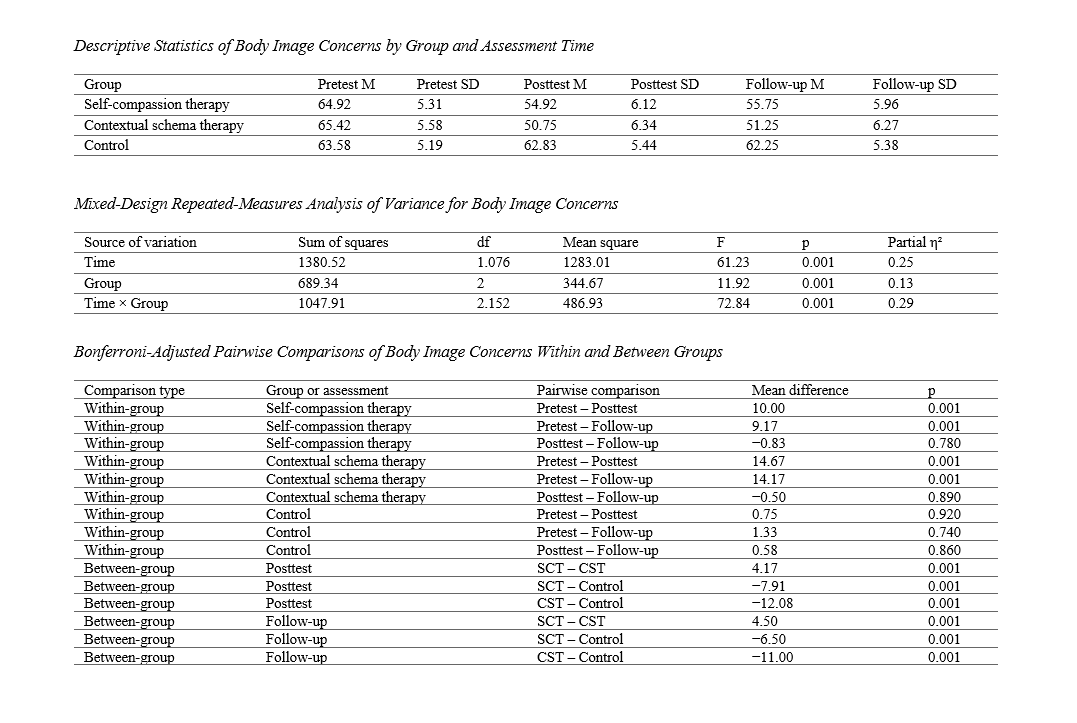
Methods and Materials: This applied, quasi-experimental study employed a pretest–posttest design with a one-month follow-up and a control group. The statistical population comprised women with breast cancer who had undergone mastectomy and attended the Mashhad Cancer Patients Association in 2025–2026. Initially, 45 eligible women were recruited through purposive convenience sampling and randomly allocated to two experimental groups and one control group (15 participants per group). Following attrition and random exclusion of three control participants to maintain balanced group sizes, 36 participants were included in the final analysis. The experimental groups received eight weekly 90-minute sessions of self-compassion therapy or contextual schema therapy, while the control group received no intervention. Data were collected using the Body Image Concern Inventory and analyzed using repeated-measures analysis of variance and Bonferroni post hoc tests.
Findings: Significant main effects were observed for time (F = 61.23, p = 0.001, η² = 0.25) and group (F = 11.92, p = 0.001, η² = 0.13), alongside a significant time-by-group interaction (F = 72.84, p = 0.001, η² = 0.29). Both interventions significantly reduced body image concerns compared with the control group at posttest and follow-up (p = 0.001). Contextual schema therapy demonstrated significantly greater effectiveness than self-compassion therapy at posttest (MD = 4.17, p = 0.001) and follow-up (MD = 4.50, p = 0.001). Neither experimental group demonstrated significant changes between posttest and follow-up (p > 0.05).
Conclusion: Both therapeutic approaches effectively reduced body image concerns, with treatment gains maintained at the one-month follow-up. Contextual schema therapy demonstrated superior effectiveness, suggesting its potential as a complementary psychological intervention within comprehensive psycho-oncological rehabilitation programs for women experiencing body image concerns after mastectomy.
Downloads
References
Akbari, M., Lotfi Kashani, F., & Vaziri, S. (2017). The efficacy of four-factor psychotherapy on increasing sexual self-esteem in breast cancer survivors. Iranian Journal of Breast Diseases, 10(1), 48-60. http://ijbd.ir/article-1-605-fa.html
Anoushirvani, E., Razeghi, N., Nouhi, S., & Aghae, H. (2023). Effectiveness of compassion-based therapy on self-criticism and sexual schemas in women with breast cancer. Journal of Applied Family Therapy, 3(2), 433-448. https://doi.org/10.61838/kman.afj.3.2.22
Breines, J., Toole, A., Tu, C., & Chen, S. (2025). Self-compassion, body image, and self-reported disordered eating. Self and identity, 13, 432-448. https://doi.org/10.1080/15298868.2013.838992
Chen, X., Wang, L., Liu, L., Jiang, M., & Wang, W. (2021). Factors associated with psychological distress among patients with breast cancer during the COVID-19 pandemic: a cross-sectional study in Wuhan, China. Supportive Care in Cancer, 29, 1-10. https://doi.org/10.1007/s00520-020-05879-y
Cuzzolaro, M. (2018). Body schema and body image: history and controversies. In M. Cuzzolaro & S. Fassino (Eds.), Body image, eating, and weight: a guide to assessment, treatment, and prevention (pp. 1-24). Springer. https://doi.org/10.1007/978-3-319-90817-5_1
Elmi, Z., Soudagar, S., Hosseinzadeh Taghvaei, M., Salahian, A., & Hosseini Shokouh, S. J. (2024). Comparison of the effectiveness of schema therapy and compassion therapy on self-criticism and stigma in patients with human immunodeficiency virus. Journal of Mashhad University of Medical Sciences, 4(67), 14-38. https://doi.org/10.22038/mjms.2024.79876.4603
Emens, L. A., & Loi, S. (2023). Immunotherapy approaches for breast cancer patients in 2023. Cold Spring Harbor Perspectives in Medicine, 13(4), a041332. https://doi.org/10.1101/cshperspect.a041332
Germer, C. (2021). Self-compassion from the path of mindfulness (M. Sarafraz & H. Abdolshahi, Trans.). Arjmand Publications.
Ghazanfariyan pour, S., & Chalabianloo, G. (2021). The effectiveness of a short time self-compassion intervention program on positive and negative affect and life satisfaction. Rooyesh, 10(3), 121-134. http://frooyesh.ir/article-1-2539-en.html
Gholamin Mian Gasheh, H. (2023). The effectiveness of schema therapy on body image and emotional difficulties in women. 5th Annual Congress of the Iranian Scientific Association of Psychotherapy: The Place of Relationship in Psychotherapy, Tehran, Iran.
Gilbert, P. (2014). The origins and nature of compassion focused therapy. British Journal of Clinical Psychology, 53(1), 6-41. https://doi.org/10.1111/bjc.12043
Gnant, M., Fitzal, F., Rinnerthaler, G., Steger, G. G., & Greil-Ressler, S. (2021). Duration of adjuvant aromatase-inhibitor therapy in postmenopausal breast cancer. New England Journal of Medicine, 385(5), 395-405. https://doi.org/10.1056/NEJMoa2104162
Gol, A., Aghamohammadian Sharbaf, H., Bigdeli, I., & Farid Hosseini, F. (2024). Gender comparison of the effectiveness of contextual schema therapy on improving quality of life in patients with migraine. Journal of Sabzevar University of Medical Sciences, 31(5), 681-692. https://doi.org/10.30468/jsums.2024.7683.2996
Hajiarbabi, F., Shareh, H., & Pourfarahani, M. (2023). The effect of group acceptance and commitment therapy based on schema therapy on sexual self-esteem and marital burnout in women undergoing dialysis. Journal of Fundamentals of Mental Health, 7(25), 123-131. https://doi.org/10.22038/jfmh.2023.22283
Heidari Kebriti, M., Khadem, N., Dowlatkhah, F., Ahmadi Zadeh Rayeni, A., & Sabouei, F. (2022). The effectiveness of self-compassion therapy on Islamic lifestyle, sexual satisfaction, and sexual function in patients with breast cancer. Islamic Lifestyle Journal, 5(3), 412-420. https://www.islamiilife.com/article_186653.html
Jagsi, R., Griffith, K. A., Harris, E. E., Wright, J. L., Recht, A., & Taghian, A. G. (2024). Omission of radiotherapy after breast-conserving surgery for women with breast cancer with low clinical and genomic risk: 5-year outcomes of IDEA. Journal of Clinical Oncology, 42(4), 390-398. https://doi.org/10.1200/JCO.23.01197
Karami Mohajeri, Z., Karbalaei Harafteh, F., Khalatbari, J., & Fardin, M. (2026). The Effectiveness of Integrating Schema Therapy and Acceptance and Commitment Therapy on Subjective Well-Being and Body Image Concern in Women with Breast Cancer. Journal of Psychological Science, 24(145), 197-220.
Karami Mohajery, Z., Karbalaei Herofteh, F. S., Khalatbari, J., & Fardin, M. (2025). The Effectiveness of Integrating Schema Therapy and Acceptance and Commitment Therapy on Subjective Well-Being and Concern about Body Image among Women with Breast Cancer. Journal of Psychological Science, 24(145), 197-220.
Kazemzadeh, J., Rabeipour, S., & Rajabzadeh, H. (2022). Investigating the status of sexual self-esteem and its related factors in breast cancer survivors. Nursing and Midwifery Journal, 20(1), 85-93. https://doi.org/10.52547/unmf.20.1.85
Ke, Q., Timmins, F., Furlong, E., & Stokes, D. (2023). Unmet care needs of women who have undergone breast cancer surgery: a scoping review. Journal of Advanced Nursing, 79(8), 2894-2910. https://doi.org/10.1111/jan.15634
Khademi, M., Talebian Sharif, J., & Azadi, M. (2019). The effectiveness of schema therapy on early maladaptive schemas in women with breast cancer. 3rd International Conference on Research in Psychology, Counseling and Educational Sciences, Iran.
Khodaei Anzab, S., Jahangiri, A., & Shakiba, A. (2025). Comparison of the Effectiveness of Cognitive-Behavioral Therapy and Schema Therapy on Sexual Function and Body Image in Women with Breast Cancer. Psychology of Motivation, Behavior and Health, 3(1), 1-13.
Kiarasi, Z., Emadian, S. O., & Hassanzadeh, R. (2022). Effectiveness of compassion-focused therapy on posttraumatic growth and death anxiety in women with breast cancer. Middle Eastern Journal of Disability Studies, 12, 108. http://jdisabilstud.org/article-1-2520-en.html
Neff, K. D. (2023). Self-compassion: theory, method, research, and intervention. Annual review of psychology, 74, 193-218. https://doi.org/10.1146/annurev-psych-032420-031047
Phoosuwan, N., & Lundberg, P. C. (2023). Life satisfaction, body image and associated factors among women with breast cancer after mastectomy. Psycho-Oncology, 32(4), 610-618. https://doi.org/10.1002/pon.6113
Roediger, E., Stevens, B. A., & Brockman, R. (2018). Contextual schema therapy: an integrative approach to personality disorders, emotional dysregulation, and interpersonal functioning. New Harbinger Publications.
Sabola, N. E., Shattla, S. I., Sweelam, R. K., Shahin, M. A., & Shehata, H. S. (2023). Compassion-based intervention protocol effectiveness on health-related outcomes of women with breast cancer. HIV Nursing, 23(3), 923-934.
Sattin, D., Parma, C., Lunetta, C., Zulueta, A., Lanzone, J., & Giani, L. (2023). An overview of the body schema and body image: theoretical models, methodological settings and pitfalls for rehabilitation of persons with neurological disorders. Brain Sciences, 13(10), 1410. https://doi.org/10.3390/brainsci13101410
Soheil Alvandi, S., Karimi, A., & Bahraminia, F. (2022). Investigating the effect of schema therapy on body image concern and social anxiety in girls. 7th International Conference on Management, Psychology and Humanities with a Sustainable Development Approach, Tehran, Iran.
Sohrabi, M., Bakhtiarpour, S., Sohrabi, F., Eftekhar Saadi, Z., & Asgari, P. (2025). Effect of contextual schema therapy on body image and psychosomatic symptoms in individuals with perfectionism disorder. Health Education and Health Promotion, 11(4), 621-626.
Stefan, S., Stroian, P., Fodor, L., Matu, S., Nechita, D., & Boldea, I. (2023). An online contextual schema therapy workshop for social anxiety symptoms: a randomized control trial. Journal of Contextual Behavioral Science, 28, 123-131. https://doi.org/10.1016/j.jcbs.2023.10.001
Takahashi, E., Fukuda, R., Takahashi, T., & Katsuragawa, T. (2025). Self-Compassion, Well-Being, and Body Image Concern in Young Japanese Women: The Role of Positive and Negative Facets of Self-Compassion. PLoS One, 20(11), e0334753. https://doi.org/10.1371/journal.pone.0334753
Tran, M. A. Q., Lin, C.-Y., Nguyen, N. D. T., Pham, M. V., Pham, T. V., & Mai, D. L. (2026). Body Image, Narcissism, Envy, and Suicidal Ideation Among Vietnamese University Students: The Mediating and Moderating Roles of Loneliness, Depression, and Self-Compassion. Emerging Adulthood. https://doi.org/10.1177/21676968261423231
Tylka, T. L., & Huellemann, K. L. (2023). Self-compassion and body image. In A. Finlay-Jones, K. Bluth, & K. D. Neff (Eds.), Handbook of self-compassion (pp. 183-200). Springer. https://doi.org/10.1007/978-3-031-22348-8_11
Zhang, K., Hu, X., Ma, L., Xie, Q., Wang, Z., & Fan, C. (2023). The efficacy of schema therapy for personality disorders: a systematic review and meta-analysis. Nordic journal of psychiatry, 77(7), 641-650. https://doi.org/10.1080/08039488.2023.2202684
Zhu, F., Liu, C., Zhang, W., Qiang, W., Yin, X., & Lu, Q. (2023). The mediating effect of coping styles between self-compassion and body image disturbance in young breast cancer survivors: a cross-sectional study. BMC Nursing, 22(1), 178. https://doi.org/10.1186/s12912-023-01344-3
Downloads
Additional Files
Publication Timeline
- Submitted
- Revised
- Accepted