A Randomized Controlled Trial on Cognitive Therapy’s Role in Enhancing Pain Self-Efficacy and Reducing Catastrophizing in Breast Cancer Patients
DOI:
https://doi.org/10.61838/kman.pwj.5.2.15Keywords:
Cognitive therapy, pain self-efficacy, meta-emotions, catastrophizing, breast cancer, chronic pain, randomized controlled trialAbstract
Objective: To evaluate the effectiveness of cognitive therapy on pain self-efficacy, meta-emotions, and catastrophizing in women with breast cancer.
Methods and Materials: A randomized controlled trial was conducted with 30 women diagnosed with breast cancer experiencing chronic pain. Participants were randomly assigned to an intervention group (n = 15) or a control group (n = 15). The intervention group received a ten-week cognitive therapy program, while the control group received standard care. Data were collected at baseline, post-intervention, and five months follow-up using the Pain Self-Efficacy Questionnaire (PSEQ), Meta-Emotion Scale (MES), and Pain Catastrophizing Scale (PCS). Statistical analyses included ANOVA with repeated measures and Bonferroni post-hoc tests.
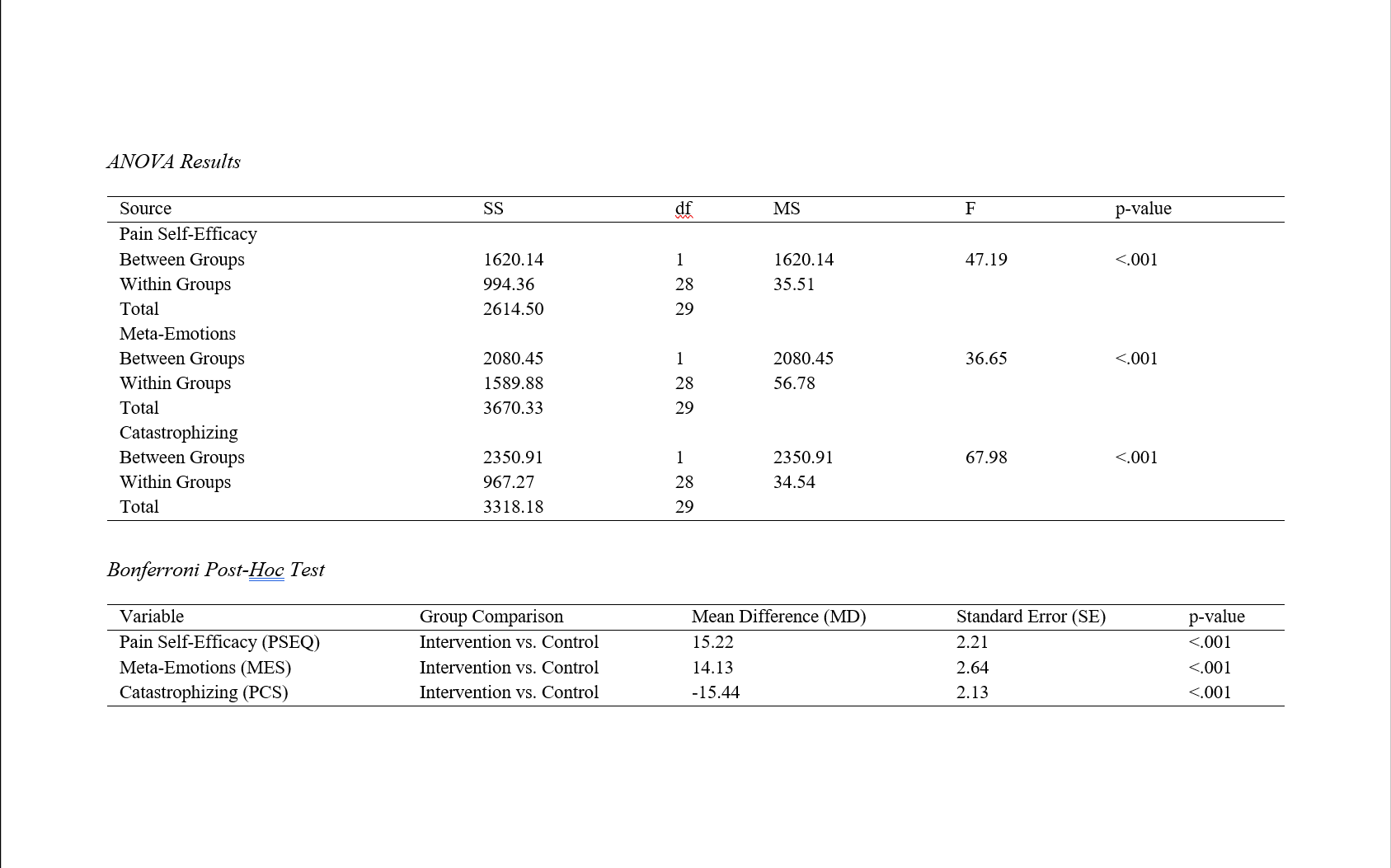
Findings: Descriptive statistics showed significant improvements in the intervention group compared to the control group. The intervention group had a mean pain self-efficacy score of 45.67 (SD = 6.23) versus 30.45 (SD = 5.89) in the control group. Meta-emotions scores were 52.89 (SD = 7.34) in the intervention group and 38.76 (SD = 6.45) in the control group. Catastrophizing scores were 20.23 (SD = 4.56) for the intervention group and 35.67 (SD = 5.78) for the control group. ANOVA results revealed significant differences for pain self-efficacy (F(1, 28) = 47.19, p < .001), meta-emotions (F(1, 28) = 36.65, p < .001), and catastrophizing (F(1, 28) = 67.98, p < .001). Bonferroni post-hoc tests confirmed these differences with p-values < .001 for all comparisons.
Conclusion: Cognitive therapy significantly enhances pain self-efficacy, improves meta-emotional regulation, and reduces catastrophizing in women with breast cancer. These findings support the integration of cognitive-behavioral and meta-emotional interventions into chronic pain management practices to improve psychological well-being and quality of life for breast cancer survivors.
Downloads
Downloads
Additional Files
Publication Timeline
Issue
Section
License
Copyright (c) 2024 Mehdi Ebrahimkhani (Corresponding Author); Eham Norouzi, Azam Hosseini, Fatemeh Jamshidi (Author)

This work is licensed under a Creative Commons Attribution-NonCommercial 4.0 International License.