Comparison of the Effectiveness of Neurocognitive Rehabilitation Program and Acceptance and Commitment Therapy on Metacognitive Skills, Executive Functions, and Emotion Regulation in Women with Breast Cancer
DOI:
https://doi.org/10.61838/kman.pwj.6.2.8Keywords:
Neurocognitive rehabilitation, Acceptance and Commitment Therapy, Breast cancer, Metacognitive skills, Executive functions, Emotion regulationAbstract
Objective: This study aimed to compare the effectiveness of Neurocognitive Rehabilitation Program (NRP) and Acceptance and Commitment Therapy (ACT) on metacognitive skills, executive functions, and emotion regulation in women with breast cancer.
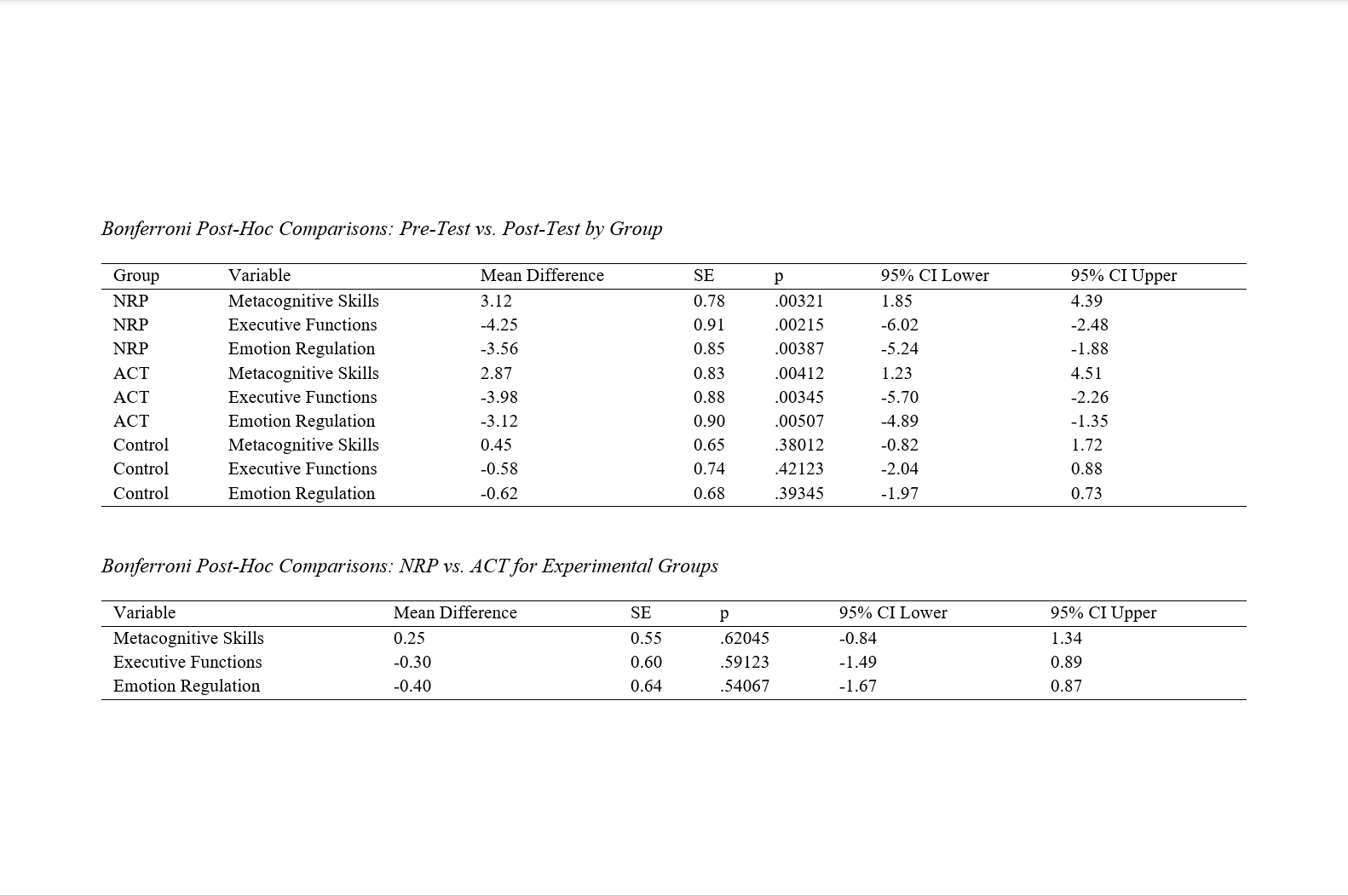
Methods and Materials: A randomized controlled trial (RCT) design was used, with 45 women with breast cancer from Tehran randomly assigned to three groups: NRP (n = 15), ACT (n = 15), and a control group (n = 15). The interventions lasted for eight to twelve weeks, and assessments were conducted at pre-test, post-test, and five-month follow-up. Standardized measures were used, including the Metacognitive Awareness Inventory (MAI), Behavior Rating Inventory of Executive Function-Adult Version (BRIEF-A), and Difficulties in Emotion Regulation Scale (DERS). Data were analyzed using repeated-measures ANOVA with Bonferroni post-hoc tests in SPSS-27.
Findings: Both NRP and ACT significantly improved metacognitive skills, executive functions, and emotion regulation over time (p < 0.05) compared to the control group. The NRP group showed slightly greater improvements in executive functions, whereas the ACT group demonstrated slightly higher effectiveness in emotion regulation, but these differences were not statistically significant (p > 0.05). The control group did not exhibit significant changes in any variable. No significant differences between NRP and ACT were found, suggesting both interventions are equally effective in addressing cognitive and emotional challenges in breast cancer patients.
Conclusion: These findings suggest that both interventions can be used as viable psychological treatments for improving cognitive flexibility, self-regulation, and emotional resilience in this population.
Downloads
References
Abdolmohamamadi, K., Mohammadzadeh, A., & Ghadiri Sourman Abadi, F. (2023). The Effectiveness of Computerized Cognitive Rehabilitation in Improving Response Inhibition and Working Memory in Adolescents with Tendency to Substance Use [Research]. Research on Addiction, 16(66), 71-90. https://doi.org/10.52547/etiadpajohi.16.66.71
Ahmadi Raq Abadi, A., Bagherzadeh Golmakani, Z., Akbarzadeh, M., Mansouri, A., & Khodabakhsh, M. R. (2022). Comparison of the Effectiveness of Acceptance and Commitment Therapy and Metacognitive Therapy on Adaptive and Maladaptive Cognitive Emotion Regulation Strategies in Patients with Substance Use Disorder Under Methadone Maintenance Therapy. Clinical Psychology and Counseling Research, 12(1), 60-78. https://tpccp.um.ac.ir/index.php/article_43043.html?lang=en
Babaei, F., Abdollahi, M., Amini Gilvani, M., & Masoomifard, M. (2024). The Mediating Role of Theory of Mind in the Relationship Between Executive Functions and Marital Burnout Using Structural Equation Modeling and Artificial Neural Networks (SEM-ANN). International Journal of Education and Cognitive Sciences, 5(4), 62-73. https://doi.org/10.61838/kman.ijecs.5.4.7
Balsamo, L. M., Mitchell, H.-R., Ross, W., Metayer, C., Hardy, K. K., & Kadan-Lottick, N. S. (2019). Monitoring neurocognitive functioning in childhood cancer survivors: evaluation of CogState computerized assessment and the Behavior Rating Inventory of Executive Function (BRIEF). BMC psychology, 7(1), 26. https://doi.org/10.1186/s40359-019-0302-3
Baniasadi, T. (2024). Comparison of Executive Function and Working Memory among Children with High and Low Levels of Physical Activity. International Journal of Education and Cognitive Sciences, 5(3), 9-15. https://doi.org/10.61838/kman.ijeas.5.3.2
Catalan, M., De Michiel, A., Bratina, A., Mezzarobba, S., Pellegrini, L., Marcovich, R., Tamiozzo, F., Servillo, G., Zugna, L., Bosco, A., Sartori, A., Pizzolato, G., & Zorzon, M. (2011). Treatment of Fatigue in Multiple Sclerosis Patients: A Neurocognitive Approach. Rehabilitation Research and Practice, 2011, 670537. https://doi.org/10.1155/2011/670537
Davoodi, M., Malihi Alzakerini, S., Nikpajouh, A., & Sabet, M. (2023). Comparing the Effectiveness of Metacognitive Skills Training with Executive Function Skills Training on Biological Markers in Patients with Coronary Artery Disease. Journal of Assessment and Research in Applied Counseling (JARAC), 5(5), 45-52. https://doi.org/10.61838/kman.jarac.5.5.6
Enayati Shabkolai, M., Enayati Shabkalai, M., & Bagheri Dadokolai, M. (2023). The Effectiveness of Treatment based on Acceptance and Commitment on Social Adaptation, Academic Self-Regulation and Cognitive Flexibility of Students with Specific Learning Disorders. International Journal of Education and Cognitive Sciences, 4(1), 33-41. https://doi.org/10.61838/kman.ijecs.4.1.5
Esfahani, A., Zinali, S., & Kayani, R. (2019). Acceptance-based group therapy on pain-related anxiety and cognitive-emotional regulation in breast cancer: a clinical trial study. Journal of Arak University of Medical Sciences, 23(2), 138-149. https://doi.org/10.32598/JAMS.23.2.3364.2
Hosseini, S., Salehi, M., Jadidi, M., & Aghili, M. (2023). The Mediating Role of cognitive Emotion Regulation Explaining the Casual Relationship between Personality Traits and Fear of Cancer Recurrence in Breast Cancer Survivors [Research]. Iranian Journal of Breast Diseases, 16(2), 4-21. https://doi.org/10.30699/ijbd.16.2.4
Jeloudari, S., Soodagar, S., & Bahrami Heidji, M. (2020). The effectiveness of acceptance and commitment therapy on psychological flexibility and emotional cognitive regulation in women with breast cancer. Quarterly Journal of Applied Psychology, 13(4), 527-548. https://apsy.sbu.ac.ir/article_97266.html
Khodadadi Jokar, F., Panahi Far, S., & Yazdanbakhsh, K. (2023). Comparison of the Impact of Couples Therapy Using the Imago Model Versus Acceptance and Commitment Therapy on Emotion Regulation Strategies in Divorce-Seeking Couples. Counseling and Family Psychotherapy, 12(2), 177-206. https://fcp.uok.ac.ir/article_62737.html
Khosh Lahjeh Sedgh, A., Madahi, M. E., & Mohammadhani, S. (2015). Effectiveness of Metacognitive Therapy on Self-Efficacy, Quality of Life, and Life Satisfaction in Female Breast Cancer Patients.
Kianpour Barjoee, L., Amini, N., Keykhosrovani, M., & Shafiabadi, A. (2022). Effectiveness of Positive Thinking Training on Perceived Stress, Metacognitive Beliefs, and Death Anxiety in Women with Breast Cancer: Perceived Stress in Women with Breast Cancer. Archives of Breast Cancer, 9(2), 195-203. https://doi.org/10.32768/abc.202292195-203
Kohnashin Tarami, F., Afshari Nia, K., & Kakabrai, K. (2021). Comparison of the effectiveness of acceptance and commitment therapy and metacognitive therapy in increasing life satisfaction among nurses working in social security hospitals in Kermanshah. Psychological Methods and Models, 12(43), 69-55. https://jpmm.marvdasht.iau.ir/article_4729.html?lang=en
Mobaraki, S., & Esmkhani Akbarinejad, H. (2024). A study on the effectiveness of emotion-focused couple therapy on marital commitment and interpersonal emotion regulation in couples with a spouse suffering from breast cancer. Iranian Journal of Breast Diseases, 17(2), 69-85. https://doi.org/10.61186/ijbd.17.2.69
Pashang, S., Sarah, P., & Aniss Khosh Lahjeh, S. (2019). Acceptance and commitment therapy compared with metacognition therapy in reducing symptoms and increasing life satisfaction in patients with irritable bowel syndrome. GOVARESH, 24, 22-29. https://doi.org/10.29252/iau.29.2.181
Pourjaberi, B., Shirkavand, N., & Ashoori, J. (2023). The Effectiveness of Cognitive Rehabilitation Training on Prospective Memory and Cognitive Flexibility in Individuals with Depression. International Journal of Education and Cognitive Sciences, 4(3), 45-53. https://doi.org/10.61838/kman.ijecs.4.3.5
Sarabadani, A., Hasanzadeh, R., & Ghanadzadegan, H. (2023). The effectiveness of acceptance and commitment therapy on distress tolerance and cognitive emotion regulation in women with generalized anxiety disorder. Applied Family Therapy Journal (AFTJ), 4(2), 96-114. https://doi.org/10.61838/kman.aftj.4.2.6
Shahidi, S., Hasanzadeh, R., & Mirzaian, B. (2023). The effectiveness of metacognitive therapy on psychological toughness and distress tolerance in female patients with psoriasis. Journal of Applied Family Therapy, 3(5), 374-388. https://doi.org/10.22034/aftj.2022.331799.1422
Vatanpanah, S., Khalatbari, J., Tayyebi, A., & Sabet, M. (2024). Effectiveness of Acceptance and Commitment Therapy on Emotional Eating Behavior, Emotion dysregulation, Perceived Stress, and Rumination in Women with Chronic Obesity. Journal of Adolescent and Youth Psychological Studies (JAYPS), 5(1), 8-18. https://doi.org/10.61838/kman.jayps.5.1.2
Zhu, P., Liu, X., Shang, X., Chen, Y., Chen, C., & Wu, Q. (2023). Mindfulness-Based Stress Reduction for Quality of Life, Psychological Distress, and Cognitive Emotion Regulation Strategies in Patients With Breast Cancer Under Early Chemotherapy-a Randomized Controlled Trial. Holistic Nursing Practice, 37(3), 131-142. https://doi.org/10.1097/HNP.0000000000000580
Downloads
Additional Files
Publication Timeline
- Submitted
- Revised
- Accepted
Issue
Section
License
Copyright (c) 2025 Amin Rafiepoor (Corresponding Author); Fatemeh Karfeh Raveshi, Saranaz Moghimi (Author)

This work is licensed under a Creative Commons Attribution-NonCommercial 4.0 International License.