The Effectiveness of Schema Therapy on Post-traumatic Growth and Self-Compassion in Women with Breast Cancer
DOI:
https://doi.org/10.61838/kman.pwj.6.2.10Keywords:
Schema therapy, Post-traumatic growth, Self-compassion, Breast cancer, Randomized controlled trial, Psychological interventionAbstract
Objective: This study aimed to investigate the effectiveness of schema therapy in enhancing post-traumatic growth and self-compassion among women diagnosed with breast cancer.
Methods and Materials: The study employed a randomized controlled trial design with two groups: an experimental group receiving schema therapy and a control group receiving no psychological intervention. Thirty women with breast cancer from Tehran were selected through purposive sampling and randomly assigned to each group (15 participants per group). The schema therapy intervention was conducted over ten weekly sessions, each lasting 60 minutes. Participants completed the Post-Traumatic Growth Inventory (PTGI) and the Self-Compassion Scale (SCS) at three time points: pre-test, post-test, and five-month follow-up. Data were analyzed using repeated measures ANOVA and Bonferroni post-hoc tests in SPSS version 27.
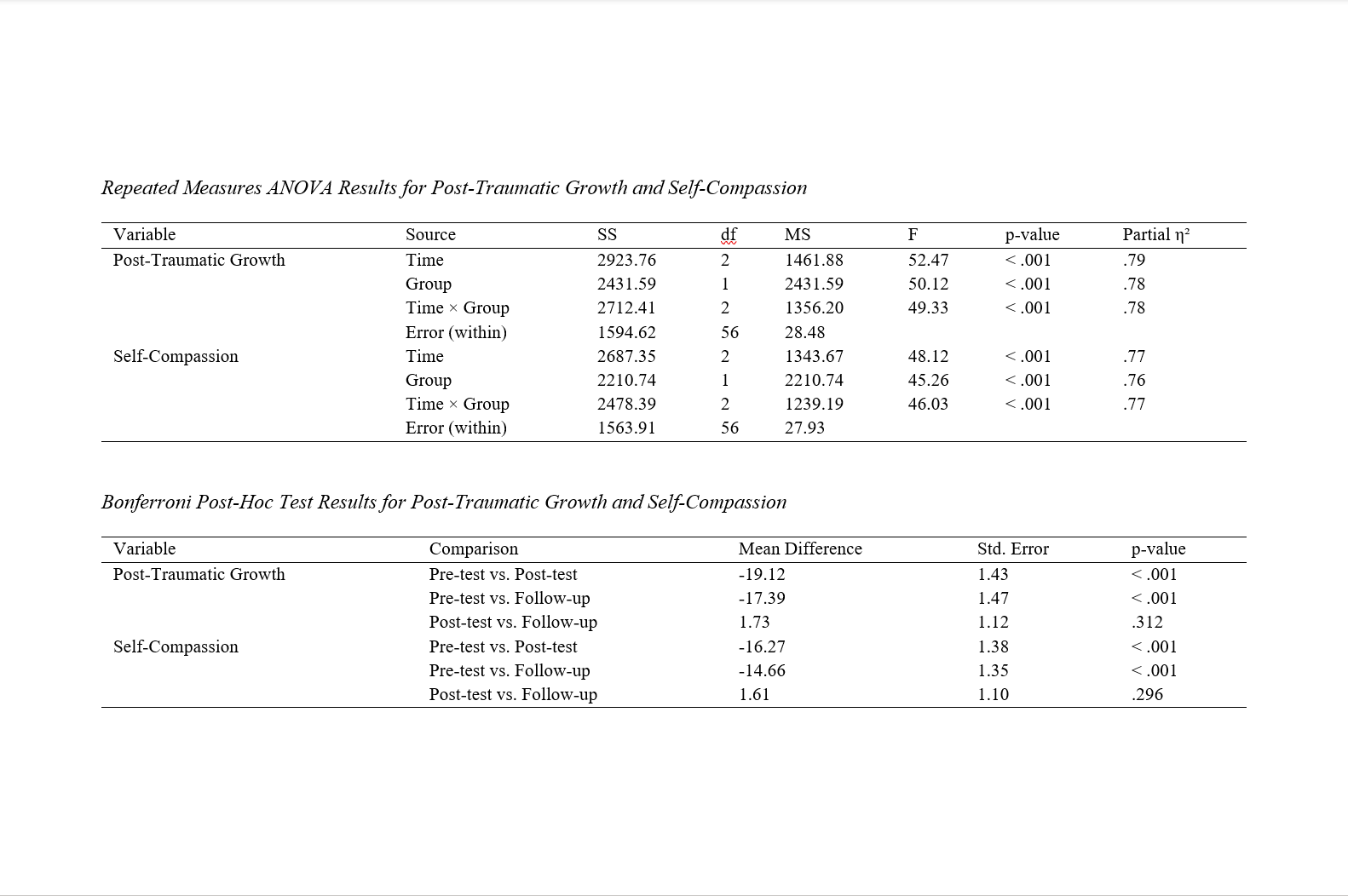
Findings: The results showed a significant increase in post-traumatic growth and self-compassion in the experimental group compared to the control group across all stages. The experimental group’s mean post-traumatic growth scores improved from 48.73 (SD = 6.21) at pre-test to 67.85 (SD = 5.94) at post-test, while self-compassion scores increased from 62.19 (SD = 5.37) to 78.46 (SD = 5.08). Repeated measures ANOVA confirmed significant time and group interaction effects for both variables (Post-Traumatic Growth: F(2, 56) = 49.33, p < .001, η² = .78; Self-Compassion: F(2, 56) = 46.03, p < .001, η² = .77). Bonferroni post-hoc tests showed that improvements were statistically significant from pre-test to post-test and were sustained at follow-up.
Conclusion: Schema therapy is an effective psychological intervention for promoting post-traumatic growth and enhancing self-compassion in women with breast cancer, with lasting effects observed up to five months after the intervention.
Downloads
References
Alizadeh, N., Mirzaian, B., & Abbasi, G. (2022). Comparison of the Effectiveness of Schema Therapy and Short-Term Psychodynamic Therapy on Psychological Capital in Females with Breast Cancer. frooyesh, 10(11), 229-240. http://frooyesh.ir/article-1-3094-en.html
Bahrami Hidaji, M., Peyvandi, P., & Mohammadi Shirmahaleh, F. (2022). The efficacy of cognitive therapy based on acceptance and commitment with a focus on self-compassion emotional schemas and empathy in couples. Journal of Psychological Science, 21(120), 2449-2467. https://doi.org/10.52547/JPS.21.120.2449
Bourdon, D. É., El-Baalbaki, G., Girard, D., Lapointe-Blackburn, É., & Guay, S. (2019). Schemas and coping strategies in cognitive-behavioral therapy for PTSD: A systematic review. European Journal of Trauma & Dissociation, 3(1), 33-47. https://doi.org/10.1016/j.ejtd.2018.09.005
Cockram, D. M., Drummond, P. D., & Lee, C. W. (2010). Role and treatment of early maladaptive schemas in Vietnam veterans with PTSD. Clinical Psychology & Psychotherapy, 17(3), 165-182. https://doi.org/10.1002/cpp.690
Faustino, B., Vasco, A. B., Silva, A. N., & Marques, T. (2020). Relationships between emotional schemas, mindfulness, self-compassion and unconditional self-acceptance on the regulation of psychological needs. Research in Psychotherapy: Psychopathology, Process and Outcome, 23(2). https://doi.org/10.4081/ripppo.2020.442
Ghayour Kazemi, F., Shahhabizadeh, F., Safara, M., & Shahidsales, S. (2022). Effectiveness of Transdiagnostic Intervention and Mindfulness-Based Schema Therapy on Cancer Self-Efficacy and Resilience in Women with Breast Cancer. North Khorasan University of Medical Sciences, 14(3), 24-33. https://doi.org/10.32592/nkums.14.3.24
Manapour, M., & Afkaneh, S. (2023). The Effectiveness of Online Reality Therapy on Post-Traumatic Growth and Psychological Distress in Bereaved Individuals During the COVID-19 Pandemic. Journal of Psychology Growth(8), 87-96. http://frooyesh.ir/article-1-4707-en.html
Masoumi, S., Amiri, M., & Afrashteh, M. Y. (2022). Self-Compassion: The Factor That Explains a Relationship between Perceived Social Support and Emotional Self-Regulation in Psychological Well-Being of Breast Cancer Survivors. Iranian Journal of Psychiatry, 17(3), 341. https://www.ncbi.nlm.nih.gov/pmc/articles/PMC9699804/
Nikogoftar, M., & Shourangiz, K. (2023). Developing a Post-Traumatic Growth Model Based on Emotional Schemas with the Mediating Role of Self-Compassion Among Widowed Women Who Lost Their Husbands to COVID-19. Journal of Positive Psychology Research(2), 83-102. https://ppls.ui.ac.ir/article_27834.html?lang=en
Peeters, N., van Passel, B., & Krans, J. (2022). The effectiveness of schema therapy for patients with anxiety disorders, OCD, or PTSD: a systematic review and research agenda. British Journal of Clinical Psychology, 61(3), 579-597. https://doi.org/10.1111/bjc.12324
Rezagholiyan, M., Nemati, F., & Hashemi, T. (2025). Development of a Model of Students' Subjective Well-Being Based on Attachment Styles, Self-Compassion, and Emotion Regulation Styles with the Mediating Role of Quality of Life. Journal of Adolescent and Youth Psychological Studies (JAYPS), 6(1), 21-33. https://doi.org/10.61838/
Sadeghian-Lemraski, S., Akbari, H., & Mirani, A. (2024). The Effectiveness of Dialectical Behavior Therapy on Self-Compassion and Integrative Self-Knowledge in People with Borderline Personality Disorder : The effectiveness of DBT in people with BPD. International Journal of Body, Mind and Culture, 11(5), 660-668. https://doi.org/10.22122/ijbmc.v11i5.660
Salarirad, Z., Leilabadi, L., Kraskian Mujembari, A., & Salehi, M. (2022). Emotion Focused Therapy Enduringly Reduces Depression and Increases Self-Compassion in Women with Breast Cancer: A Semi-Experimental Study [Applicable]. Iranian Journal of Breast Diseases, 14(4), 4-20. https://doi.org/10.30699/ijbd.14.4.4
Shi, J., Sznajder, K. K., Liu, S., Xie, X., Yang, X., & Zheng, Z. (2022). Resilience and Posttraumatic Growth of Patients With Breast Cancer During the COVID-19 Pandemic in China: The Mediating Effect of Recovery [Original Research]. Frontiers in psychology, 12. https://doi.org/10.3389/fpsyg.2021.811078
Song, Y. Y., Liu, H., Wang, S., & Jiang, X. L. (2022). Dyadic effects of rumination and self-disclosure on posttraumatic growth in newly diagnosed gynecological cancer couples: an actor-partner interdependence modeling approach. Supportive Care in Cancer, 30(6), 5167-5174. https://doi.org/10.1007/s00520-022-06869-y
Thimm, J. C. (2017). Relationships between early maladaptive schemas, mindfulness, self-compassion, and psychological distress. International journal of psychology and psychological therapy, 17(1), 3-17. https://www.researchgate.net/publication/315977623_Relationships_between_early_maladaptive_schemas_mindfulness_self-compassion_and_psychological_distress
Wan, X., Huang, H., Peng, Q., Zhang, Y., Hao, J., Lu, G., & Chen, C. (2022). The relation between coping style and posttraumatic growth among patients with breast cancer: A meta-analysis [Systematic Review]. Frontiers in psychology, 13. https://doi.org/10.3389/fpsyg.2022.926383
Yakın, D., Gençöz, T., Steenbergen, L., & Arntz, A. (2019). An integrative perspective on the interplay between early maladaptive schemas and mental health: The role of self-compassion and emotion regulation. Journal of Clinical Psychology, 75(6), 1098-1113. https://doi.org/10.1002/jclp.22755
Zahra, K., Khan, S., Sadia, R., & Aslam, I. (2024). Resilience and Post-Traumatic Growth Among Cancer Patients: A Moderated Mediation Analysis Through Perceived Social Support and Stress. Psychology in Russia State of Art, 17(2), 34-49. https://doi.org/10.11621/pir.2024.0203
Zeinali Siyavashani, E., & dehghan, m. (2021). Role of Emotional Expression and Emotion Regulation in Post-Traumatic Growth in People with Cancer and Multiple Sclerosis: According to the Moderating role of Illness Type. Navid No, 24(78), 42-53. https://doi.org/10.22038/nnj.2021.55171.1264
Downloads
Additional Files
Publication Timeline
- Submitted
- Revised
- Accepted
Issue
Section
License
Copyright (c) 2025 Nasrin Zavari (Author); Seyedeh Zahra Sadati (Corresponding Author); Morvarid Sadat Hoseini, Zohreh Zadhasan (Author)

This work is licensed under a Creative Commons Attribution-NonCommercial 4.0 International License.