Effectiveness of Interpersonal Psychotherapy on Relationship Satisfaction and Anxiety in Women with Rejection Sensitivity
DOI:
https://doi.org/10.61838/Keywords:
Interpersonal Psychotherapy, Rejection Sensitivity, Relationship Satisfaction, AnxietyAbstract
Objective: This study aimed to evaluate the effectiveness of Interpersonal Psychotherapy (IPT) in improving relationship satisfaction and reducing anxiety among women with high rejection sensitivity.
Methods and Materials: A randomized controlled trial design was implemented with 30 women from Mexico who met the criteria for elevated rejection sensitivity. Participants were randomly assigned to either an experimental group (n = 15) receiving 12 weekly sessions of IPT or a waitlist control group (n = 15). Assessments were conducted at three time points: pre-test, post-test, and five-month follow-up, using the Couples Satisfaction Index (CSI-32) to measure relationship satisfaction and the Beck Anxiety Inventory (BAI) to assess anxiety. Data were analyzed using repeated measures ANOVA with Bonferroni post-hoc tests in SPSS-27 to evaluate within-group and between-group changes over time.
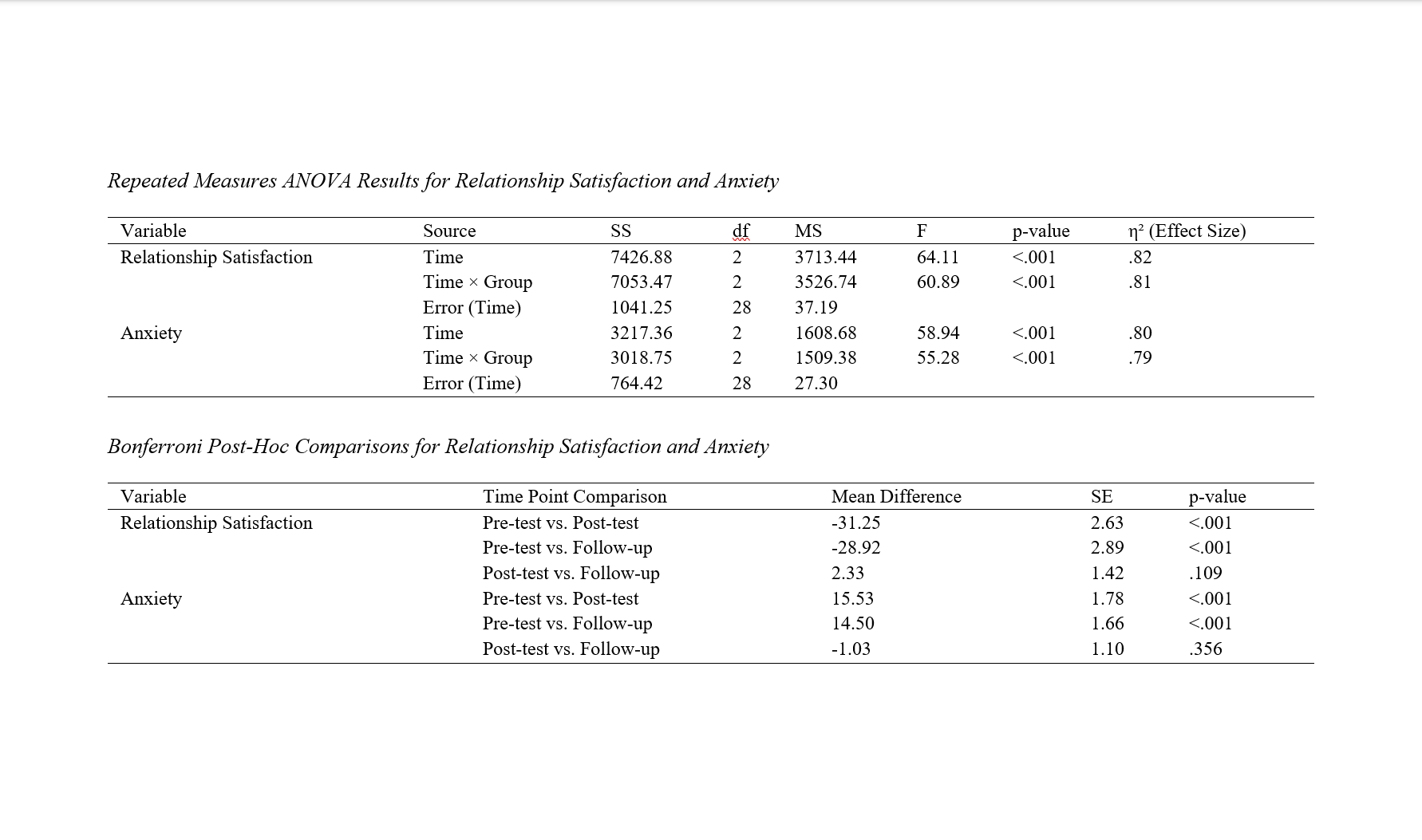
Findings: Repeated measures ANOVA revealed significant interaction effects between time and group for relationship satisfaction (F(2,28) = 60.89, p < .001, η² = .81) and anxiety (F(2,28) = 55.28, p < .001, η² = .79). Bonferroni post-hoc tests indicated that the IPT group experienced a significant increase in relationship satisfaction from pre-test to post-test (p < .001) and follow-up (p < .001), with no significant decline at follow-up (p = .109). Similarly, anxiety levels significantly decreased from pre-test to post-test (p < .001) and remained stable at follow-up (p = .356), while no significant changes were observed in the control group.
Conclusion: The results suggest that Interpersonal Psychotherapy is a highly effective intervention for enhancing relationship satisfaction and reducing anxiety in women with rejection sensitivity. The therapeutic gains were not only significant immediately after the intervention but were also sustained at the five-month follow-up, indicating long-term benefits of the approach.
Downloads
References
Adjin, D. M. O., & Muat, H. (2019). The Prospect of Post-Adoption Satisfaction and the Digital Gender Divide. 192-211. https://doi.org/10.4018/978-1-5225-7068-4.ch010
Ammara, S., & Jameel, R. (2022). Rejection Sensitivity and Anuptaphobia in Unmarried Women: The Moderating Role of Social Support. Journal of Professional & Applied Psychology, 3(2), 195-207. https://doi.org/10.52053/jpap.v3i2.85
Chehreh, R., Ozgoli, G., Abolmaali, K., Nasiri, M., & Karamelahi, Z. (2021). Child-Free Lifestyle and the Need for Parenthood and Relationship With Marital Satisfaction Among Infertile Couples. Iranian Journal of Psychiatry. https://doi.org/10.18502/ijps.v16i3.6249
Choi, J., & Lim, J. (2023). Does Your Childhood Attachment Make You Bully Your Lover? The Role of Rejection Sensitivity and Romantic Relationship Satisfaction. Emerging Adulthood, 11(6), 1423-1432. https://doi.org/10.1177/21676968231193185
Cultice, R. A., Sanchez, D. T., & Albuja, A. F. (2021). Sexual Growth Mindsets and Rejection Sensitivity in Sexual Satisfaction. Journal of Social and Personal Relationships, 39(4), 1131-1153. https://doi.org/10.1177/02654075211054390
David, L., & Nitu, A. G. (2024). Personality Traits Differences in Young People Opting for Online vs. Traditional Dating. Series Vii - Social Sciences and Law, 143-152. https://doi.org/10.31926/but.ssl.2023.16.65.2.1
Farajİ, H. (2024). Investigation of the Relationship Between Borderline Personality Organization and Perceived Abuse Experiences in Romantic Relationships: Moderating Role of Rejection Sensitivity. Journal of Health Sciences and Medicine, 7(3), 259-263. https://doi.org/10.32322/jhsm.1452696
Golestani, M., & Molaei Zarandi, H. (2023). The effectiveness of acceptance and commitment therapy on anxiety and fear of negative evaluation in women at risk of divorce. Behavioral Science Research and Studies, 55, 38-50. https://www.magiran.com/paper/2626263/investigating-the-effectiveness-of-acceptance-and-commitment-therapyon-anxiety-and-fear-of-negative-evaluation-of-women-facing-divorce?lang=en
Hasana, L. (2024). Rejection Sensitivity, Adult Self-Expression, and Life Satisfaction in Single Child. International Journal for Research in Applied Science and Engineering Technology, 12(4), 530-536. https://doi.org/10.22214/ijraset.2024.59820
Huß, B., & Pollmann‐Schult, M. (2019). Relationship Satisfaction Across the Transition to Parenthood: The Impact of Conflict Behavior. Journal of Family Issues, 41(3), 383-411. https://doi.org/10.1177/0192513x19876084
Jee, E. S., & Ahn, H. N. (2020). Mediating Effect of Responsibility Attribution in Relationship Between Rejection Sensitivity and Romantic Relationship Satisfaction. Korean Association for Learner-Centered Curriculum and Instruction, 20(10), 1139-1155. https://doi.org/10.22251/jlcci.2020.20.10.1139
Kim, R. A., & Ha, J. H. (2023). The Moderating Effect of Commitment in the Relationship Between Disconnection and Rejection Schema and Marital Satisfaction of Married Women. Korean Association for Learner-Centered Curriculum and Instruction, 23(1), 509-520. https://doi.org/10.22251/jlcci.2023.23.1.509
Lee, C., & Seo, E. (2023). The Impact of Unmarried Individuals’ Anxious Attachment on Interpersonal Problems: The Mediating Effect of Rejection Sensitivity and the Moderating Effect of Psychological Well-Being. Korean Association for Learner-Centered Curriculum and Instruction, 23(21), 883-894. https://doi.org/10.22251/jlcci.2023.23.21.883
Mishra, M., Reis, S., & Allen, M. S. (2024). Predicting Relationship Outcomes From Rejection Sensitivity in Romantic Couples: Testing Actor and Partner Effects. Current Psychology, 43(36), 29095-29107. https://doi.org/10.1007/s12144-024-06431-5
Morgan, P., Wittenborn, A. K., Morlan, G. L., & Snyder, R. (2024). Emotion Regulation Difficulties as a Mediator Between Relationship Satisfaction Predicting Depressive Symptom Trajectories Among Couples in Couple Therapy. Behavioral Sciences, 14(12), 1215. https://doi.org/10.3390/bs14121215
Pellón, I., Martínez-Pampliega, A., & Cormenzana, S. (2024). Post-divorce adjustment, coparenting and somatisation: Mediating role of anxiety and depression in high-conflict divorces. Journal of Affective Disorders Reports, 16, 100697. https://doi.org/10.1016/j.jadr.2023.100697
Qazi, S., Najam, S., & Mahmood, I. (2023). Exploring the Mediating Role of Fear of Intimacy in the Interplay of Partner Rejection and Marital Satisfaction Among Married Women. Global Social Sciences Review, VIII(IV), 1-14. https://doi.org/10.31703/gssr.2023(viii-iv).01
Richter, M., Kouri, G., Meuwly, N., & Schoebi, D. (2024). Rejection in Romantic Relationships: Does Rejection Sensitivity Modulate Emotional Responses to Perceptions of Negative Interactions? BMC psychology, 12(1). https://doi.org/10.1186/s40359-024-01864-w
Richter, M., & Schoebi, D. (2021). Rejection Sensitivity in Intimate Relationships. Zeitschrift Für Psychologie, 229(3), 165-170. https://doi.org/10.1027/2151-2604/a000448
Ryu, J., & Lee, S. (2024). The Moderated Mediating Effects of Mentalization Through Rejection Sensitivity in the Relationship Between Covert Narcissism and Relationship Addiction. Korean Association for Learner-Centered Curriculum and Instruction, 24(19), 31-46. https://doi.org/10.22251/jlcci.2024.24.19.31
Saylan, E., & Oktan, V. (2023). Body Image Among Adolescents: What Is Its Relationship With Rejection Sensitivity and Self-Efficacy? Clinical Child Psychology and Psychiatry, 29(2), 479-492. https://doi.org/10.1177/13591045231188411
Shan, H., Ishak, Z., & Fan, L. (2022). The Higher the Life Satisfaction, the Better the Psychological Capital? Life Satisfaction and Psychological Capital: A Moderated Mediation Model. Frontiers in psychology, 12. https://doi.org/10.3389/fpsyg.2021.772129
Terada, M., & Kawamoto, T. (2017). Rejection Sensitivity, Self-Efficacy, and Learning Strategy: Mediating and Moderating the Role of Basic Needs Satisfaction. Psychology, 08(03), 449-462. https://doi.org/10.4236/psych.2017.83028
TÖNbÜL, Ö., & Özdemir, A. (2024). Childhood Trauma and Relationship Satisfaction in Married Turkish Individuals: Mediating the Role of Attachment Injuries. The Family Journal. https://doi.org/10.1177/10664807241256667
White VanBoxel, J. M., Miller, D. L., Morgan, P., Iqbal, N., Edwards, C., & Wittenborn, A. K. (2024). Exploring associations among baseline emotion regulation and change in relationship satisfaction among couples in a randomized controlled trial of emotionally focused therapy compared to usual care. Family Process. https://doi.org/10.1111/famp.12972
Zavala, A. G. d., & Bierwiaczonek, K. (2020a). Male, National, and Religious Collective Narcissism Predict Sexism. Sex Roles, 84(11-12), 680-700. https://doi.org/10.1007/s11199-020-01193-3
Zavala, A. G. d., & Bierwiaczonek, K. (2020b). Three Types of Collective Narcissism—Male, Religious, and National—Predict Sexism. https://doi.org/10.31234/osf.io/3em9t
Downloads
Additional Files
Publication Timeline
- Submitted
- Revised
- Accepted
Issue
Section
License

This work is licensed under a Creative Commons Attribution-NonCommercial 4.0 International License.