Comparison of the Effectiveness of Emotion Efficacy Therapy and Compassion-Focused Therapy on Dispositional Mindfulness and Illness Acceptance in Women with Multiple Sclerosis
DOI:
https://doi.org/10.61838/kman.pwj.6.3.4Keywords:
Emotion Efficacy Therapy, Compassion-Focused Therapy, Dispositional Mindfulness, , Illness Acceptance, Multiple Sclerosis.Abstract
Objective: The present study aimed to compare the effectiveness of Emotion Efficacy Therapy (EET) and Compassion-Focused Therapy (CFT) on dispositional mindfulness and illness acceptance in women with MS.
Materials and Methods: This study employed a quasi-experimental design with pretest-posttest and a control group. The statistical population included all women diagnosed with multiple sclerosis who referred to MS specialty centers in Isfahan during the second half of 2023. A total of 54 women with MS were selected through convenience sampling and were randomly assigned to three groups: Emotion Efficacy Therapy (18 participants), Compassion-Focused Therapy (18 participants), and control group (18 participants). The instruments used in this study included the Five Facet Mindfulness Questionnaire (Baer et al., 2006) and the Illness Acceptance Questionnaire (Bishop et al., 2015).
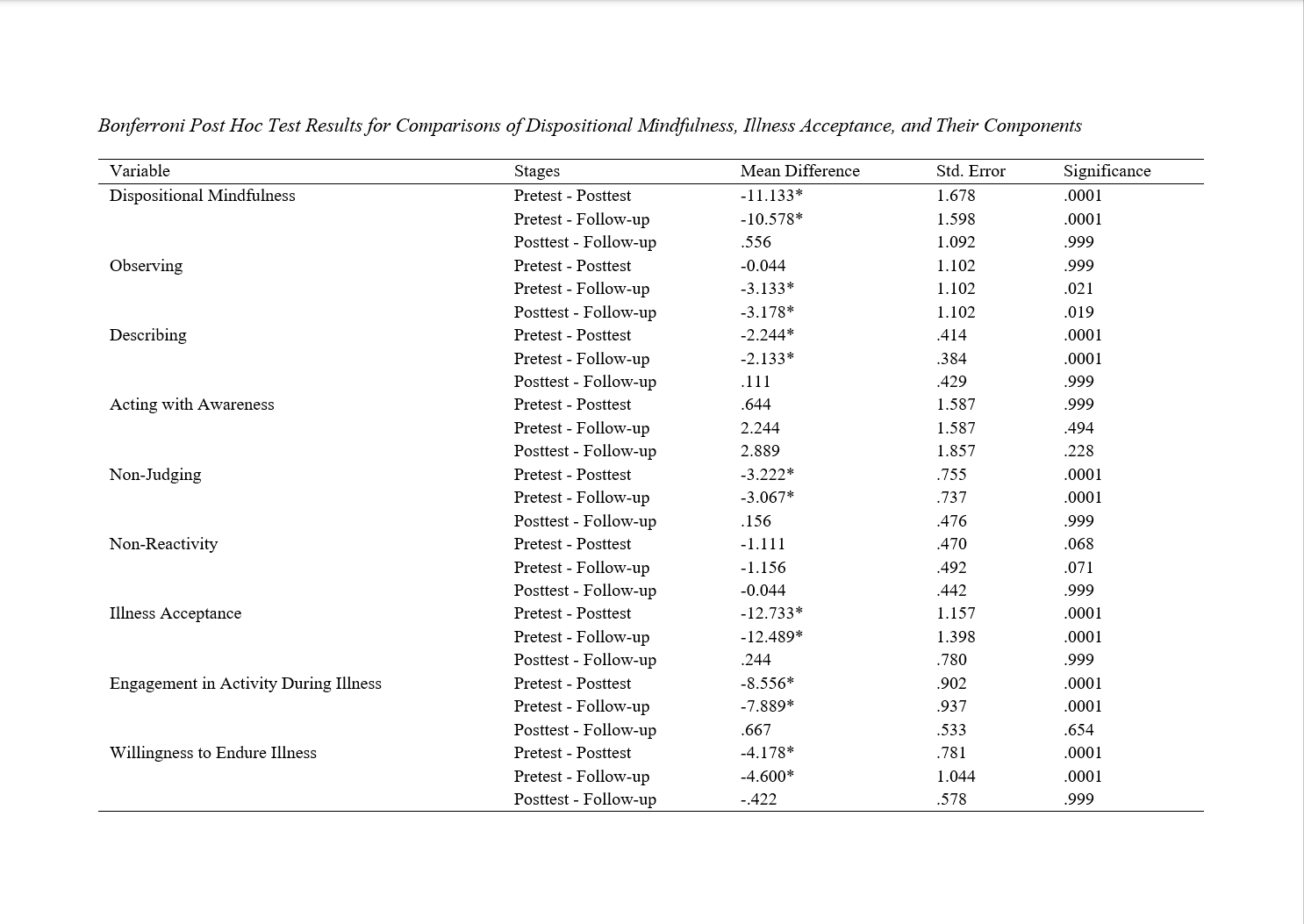
Findings: The findings revealed that both therapeutic approaches were effective in improving dispositional mindfulness (except for the facets of acting with awareness and non-reactivity) and illness acceptance in women with multiple sclerosis. There was no significant difference in the effectiveness of the two therapies on the measured variables.
Conclusion: The results suggest that both therapeutic approaches can be considered effective methods for enhancing mindfulness and illness acceptance in women with multiple sclerosis. Given their similar efficacy, the choice between these therapies can be based on client preference or therapist expertise.
Downloads
References
Alizadeh, M., Mahmoud Alilu, M., Bakhshipour, A., & Birami, M. (2023). The Effectiveness of Acceptance and Commitment Therapy on Emotional Dysregulation in Patients with Multiple Sclerosis: A Single Case Study. Journal of Nursing Psychology, 11(4), 83-94. https://ijpn.ir/article-1-2228-fa.html
Amini, F., Zarei, H., Aghayousefi, A., & Hashemi, I. (2019). The impact of mindfulness on the decision-making style of Parsian Gas Refinery: The mediating role of self-reflection. Knowledge and research in applied psychology, 2IS - 12, 57-83. https://journals.iau.ir/article_667684.html
Andalib, L., Rezaei, R., Emami, S., Ansari, M., & Shahidi. (2023). Razi Journal of Medical Sciences. 30(4), 138-150. https://rjms.iums.ac.ir/article-1-7953-en.html
Baer, R. A., Smith, G. T., Hopkins, J., Krietemeyer, J., & Toney, L. (2006). Using self-report assessment methods to explore facets of mindfulness. Assessment, 13(1), 27-45. https://doi.org/10.1177/1073191105283504
Carvalho, S. A., Skvarc, D., Barbosa, R. A. U. T. T., Santos, D., & Trindade, I. A. (2022). A pilot randomized controlled trial of online acceptance and commitment therapy versus compassion‐focused therapy for chronic illness. Clinical Psychology & Psychotherapy, 29(2), 524-541. https://doi.org/10.1002/cpp.2643
Dammers, M. A. (2020). Self-criticism in the context of chronic illness http://essay.utwente.nl/82401/
Dehghani, Z., Mardani, Z., & Rezvanian, H. (2024). The effectiveness of compassion-based therapy on improving treatment adherence and blood lipids (cholesterol, triglycerides, LDL, and HDL) in patients with type 2 diabetes. Health Psychology, 13(50), 77-96. https://doi.org/10.30473/hpj.2024.67476.57
Dīnparast, A., Rasouli, N., & Qotb, A. (2023). Comparison of the Effects of Schema Therapy and Mindfulness Techniques on Sleep Disorders in Individuals with Multiple Sclerosis. Journal of Islamic Lifestyle with a Focus on Health, 7(2), 257-267. https://www.sid.ir/paper/1135816/fa
Ebadi, S., & Babaei Kafaki, H. (2022). Comparison of the effectiveness of mindfulness-based cognitive intervention with metacognitive intervention on reducing anxiety symptoms and rumination in women with multiple sclerosis. Journal of Applied Psychological Research, 13(2), 403-419. https://journals.ut.ac.ir/article_88617.html
Ebrahimi, S. A. U. A. K., & Farakhi, N. (2023). The Effectiveness of Supportive Therapy on Psychological Capital and Post-Traumatic Growth in Women with Multiple Sclerosis. Journal of Applied Family Therapy, 4(1). https://ensani.ir/fa/article/544751/
Fooladi, A., Khademi, A., & Shaker Dolq, A. (2023). Comparison of the effectiveness of metacognitive therapy and compassion-based therapy on the level of cyberchondria symptoms in nurses. Health Psychology, 12(46), 7-22. https://doi.org/10.30473/hpj.2023.65641.5655
Hofmann, S. G. (2018). Cognitive-behavioral therapy: Principles and applications. Tehran: Arjanman Publishing. https://www.amazon.com/Science-Cognitive-Behavioral-Therapy/dp/0128034572
Hofmann, S. G., Sawyer, A. T., Witt, A. A., & Oh, D. (2010). The effect of mindfulness-based therapy on anxiety and depression: A meta-analytic review. Journal of consulting and clinical psychology, 78(2), 169-183. https://doi.org/10.1037/a0018555
Horesh, D., Glick, I., Taub, R., Agmon-Levin, N., & Shoenfeld, Y. (2017). Mindfulness-based. https://doi.org/10.1007/s40263-018-0489-5
Jacobs, B. M. A. U. T. P., Bestwick, J. P., Noyce, A. J., Marshall, C. R., Mathur, R., & Dobson, R. (2024). Modifiable risk factors for multiple sclerosis have consistent directions of effect across diverse ethnic backgrounds: a nested case-control study in an English population-based cohort. Journal of Neurology, 271(1), 241-253. https://doi.org/10.1007/s00415-023-11971-0
Johannsen, M., Schlander, C., Farver-Vestergaard, I., Lundorff, M., Wellnitz, K. B., Komischke-Konnerup, K. B., & O'Connor, M. (2022). Group-based compassion-focused therapy for prolonged grief symptoms in adults-Results from a randomized controlled trial. Psychiatry research, 314, 114683. https://doi.org/10.1016/j.psychres.2022.114683
Keng, S. L., Smoski, M. J., & Robins, C. J. (2011). Effects of mindfulness on psychological health: A review of empirical studies. Clinical psychology review, 31(6), 1041-1056DO -. https://doi.org/10.1016/j.cpr.2011.04.006
Lee, B., McDaniels, B., & Grenawalt, T. A. (2023). Resilience as a moderator in the relationship between disability related stress and community participation in individuals with multiple sclerosis. Psychology, Health & Medicine, 28(9), 2745-2755. https://doi.org/10.1080/13548506.2022.2072915
MaKay, M., & West, A. (2016). Emotion efficacy therapy: A brief, exposure-based treatment for emotion regulation integrating ACT and DBT. New Harbinger Publications. https://psycnet.apa.org/record/2016-49941-000
Masoudi, L., Shaygan Nejad, V., & Rahimi, R. (2023). Journal of Clinical Psychology and Personality. 21(1), 73-84. https://cpap.shahed.ac.ir/?_action=article&au=32852&_au=%D8%B4%D8%A7%DB%8C%DA%AF%D8%A7%D9%86%20%D9%86%DA%98%D8%A7%D8%AF%D8%8C%20%D9%88%D8%AD%DB%8C%D8%AF
Mazloom, M., Mohammadi Khani, S., & Akbari, M. (2020). Comparison of cognitive-behavioral therapy and emotion-focused therapy in the psychological adjustment of women with breast cancer: The role of cognitive and emotional flexibility, values-based action, and illness perception as mechanisms of change, Kharazmi University.
McCracken, L. M., & Vowles, K. E. (2014). Acceptance and commitment therapy and mindfulness for chronic pain: Model, process, and progress. American psychologist, 69(2), 178-187. https://doi.org/10.1037/a0035623
Mirmaeini, P., Bayazi, M., & Khalatbari, J. (2021). Comparison of the effects of acceptance and commitment therapy with compassion-focused therapy on the severity of anxiety and feelings of loneliness in patients with multiple sclerosis. Journal of Knowledge Horizon, 27(4), 534-549. https://doi.org/10.32598/hms.27.4.3426.1
Najafi, A., Mousavi-Pour, S., & Sajadi-Nejad, M. (2022). The effectiveness of a meaning-centered intervention program on general well-being, resilience, and quality of life in patients with multiple sclerosis. Journal of Psychology Growth, 11(12), 85-96. https://frooyesh.ir/article-1-4272-fa.html&sw=%D9%85%D8%B9%D9%86%D8%A7%D8%AF%D8%B1%D9%85%D8%A7%D9%86%DB%8C
Nosrati, M., Moameni, M., Karami, M., & Mazdeh, M. (2018). The relationship between psychological capital and disease acceptance with life satisfaction in patients with multiple sclerosis. Journal of Health and Care, 20(2), 114-122. https://doi.org/10.29252/jhc.20.2.114
Pourhaji, F., Jamali, J., Taraghdar, M. M., Peyman, N., & Tehrani, H. (2024). Design and validation of a Questionnaire on the factors influencing self-care behaviors in patients with Multiple sclerosis (QFASMS). BMC Neurology, 24(1), 20. https://doi.org/10.1186/s12883-023-03522-x
Rostami, F., Vakilian, A., Esmaeilian, S., Jalali, N., & Tahernia, H. (2024). Epidemiology and Clinical Features of Multiple Sclerosis in Rafsanjan City, Kerman Province, Iran: A Cross-Sectional Study from 2011 to 2020.
Sajadian, M., & Motaharian, N. (2022). The effectiveness of emotional efficiency-based therapy on health-related quality of life, pain anxiety, pain acceptance, and emotional awareness in women with chronic low back pain. Clinical Psychology Journal, 14(2), 23-31. https://www.sid.ir/paper/1114893/fa
Spek, A. A., Van Ham, N. C., Nyklíček, I., Hawes, J., & Sweeny, K. (2013). Mindfulness-based therapy in adults with an autism spectrum disorder: a randomized controlled trial Mindfulness. Research in Developmental Disabilities, 34(1), 246-253. https://doi.org/10.1016/j.ridd.2012.08.009 10.1016/B978-0-323-91497-0.00090-4
Vidal, J., & Soldevilla, J. M. (2023). Effect of compassion-focused therapy on self-criticism and self-soothing: A meta-analysis. British Journal of Clinical Psychology, 62(1), 70-81. https://doi.org/10.1111/bjc.12394
Walton, C., King, R., Rechtman, L., Kaye, W., Leray, E., Marrie, R. A., & Baneke, P. (2020). Rising prevalence of multiple sclerosis worldwide: Insights from the Atlas of MS. Multiple Sclerosis Journal, 26(14), 1816-1821. https://doi.org/10.1177/1352458520970841
Downloads
Additional Files
Publication Timeline
- Submitted
- Revised
- Accepted
Issue
Section
License
Copyright (c) 2025 Elahe Jafari Fesharaki (Author); Zohreh Raeisi (Corresponding Author); Mohammad Soltanizadeh, Masoud Etemadifar, Parinaz Sadat Sajjadian (Author)

This work is licensed under a Creative Commons Attribution-NonCommercial 4.0 International License.