Factors Influencing Help-Seeking Behavior in Women with Postpartum Depression
DOI:
https://doi.org/10.61838/kman.pwj.6.3.6Keywords:
Postpartum depression, Help-seeking behavior, Qualitative research, Maternal mental healthAbstract
Objective: This study aimed to explore the psychological, interpersonal, structural, and systemic factors influencing help-seeking behavior among women experiencing postpartum depression in Greece.
Methods and Materials: A qualitative research design was employed using semi-structured, in-depth interviews with 21 women diagnosed with postpartum depression within the first year after childbirth. Participants were recruited using purposive sampling, and data collection continued until theoretical saturation was reached. Interviews were transcribed verbatim and analyzed thematically using NVivo 14 software. Thematic analysis followed Braun and Clarke’s six-step framework. Rigor was ensured through independent coding, member checking, and maintenance of reflexivity throughout the research process.
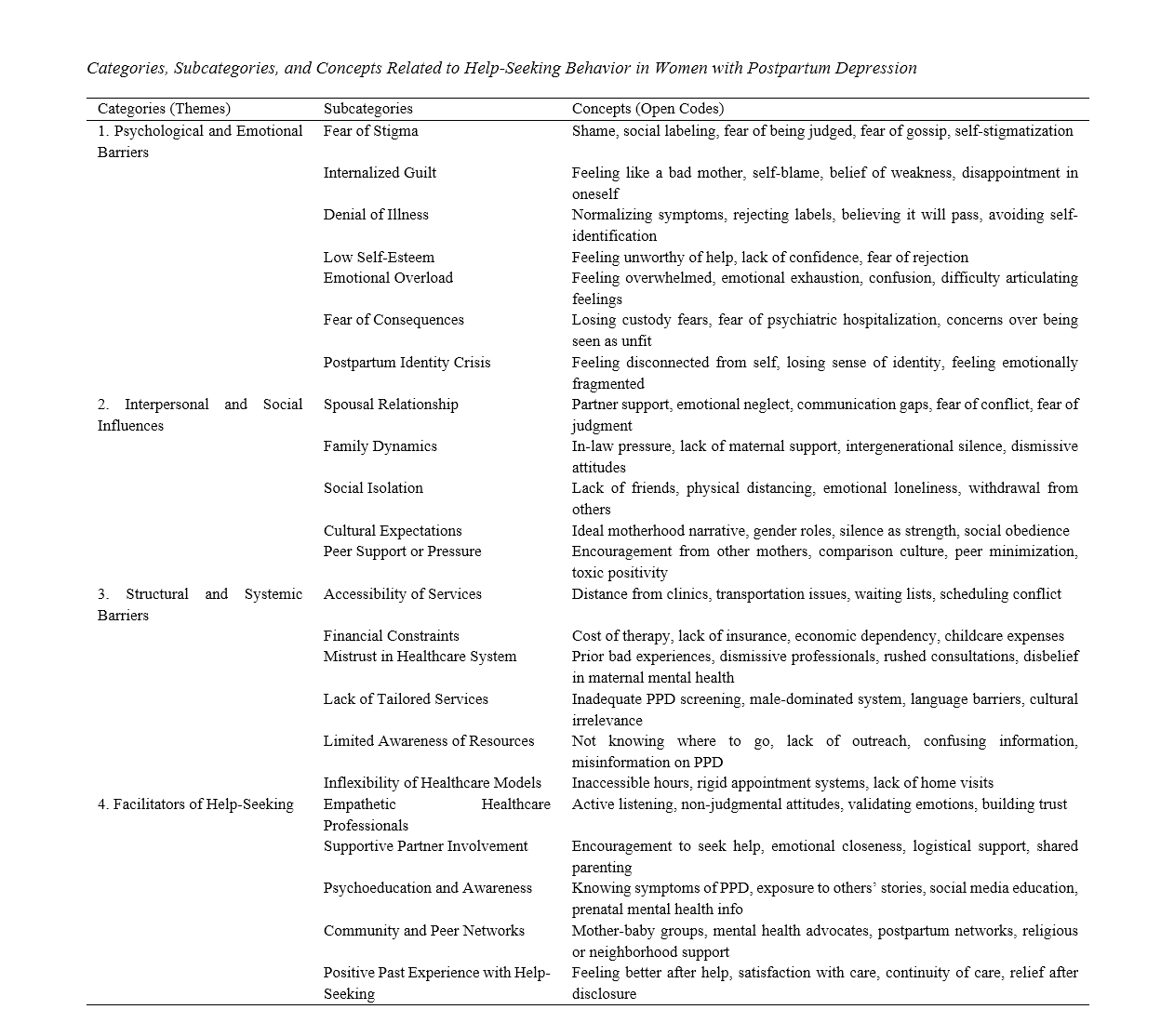
Findings: Thematic analysis revealed four main categories: (1) Psychological and Emotional Barriers, including fear of stigma, internalized guilt, and denial of illness; (2) Interpersonal and Social Influences, such as spousal support, family dynamics, and cultural expectations; (3) Structural and Systemic Barriers, including limited accessibility, financial constraints, and mistrust in healthcare services; and (4) Facilitators of Help-Seeking, such as empathetic healthcare professionals, psychoeducation, community networks, and positive prior experiences with mental health care. Participants’ narratives highlighted a complex interplay between internal struggles and external conditions that either hindered or encouraged their willingness to seek professional help.
Conclusion: Help-seeking behavior in women with postpartum depression is shaped by a constellation of interrelated psychological, social, and systemic factors. Addressing these barriers requires a multidimensional approach that includes stigma reduction, mental health literacy, empathetic provider training, and culturally sensitive, accessible services. Interventions should empower women to recognize and validate their emotional experiences while facilitating supportive environments that normalize seeking care during the postpartum period.
Downloads
References
Amarasinghe, G., & Agampodi, S. (2022). Help-Seeking Intention for Depression and Suicidal Ideation During Pregnancy and Postpartum in Rural Sri Lanka, a Cross-Sectional Study. Rural and Remote Health. https://doi.org/10.22605/rrh7273
Beck, C. T. (2023). Experiences of Postpartum Depression in Women of Color. MCN the American Journal of Maternal/Child Nursing, 48(2), 88-95. https://doi.org/10.1097/nmc.0000000000000889
Branquinho, M., Canavarro, M. C., & Fonseca, A. (2022). A Blended Cognitive–Behavioral Intervention for the Treatment of Postpartum Depression: A Case Study. Clinical Case Studies, 21(5), 438-456. https://doi.org/10.1177/15346501221082616
Fischbein, R., Cook, H., Baughman, K. R., & Díaz, S. (2022). Using Machine Learning to Predict Help-Seeking Among 2016–2018 Pregnancy Risk Assessment Monitoring System Participants With Postpartum Depression Symptoms. Women S Health, 18. https://doi.org/10.1177/17455057221139664
I.T, A., O.O, O., P.O, A., A.E, N., Dangana, J., & Faith, J. (2022). Predictors of Help-Seeking Intention of Nursing Mothers Towards Postpartum Depression in Osogbo, Osun State. African Journal of Health Nursing and Midwifery, 5(4), 60-70. https://doi.org/10.52589/ajhnm-mvyln2on
Jones, A., & Duong, C. C. (2024). Exploring Predictors of Help‐seeking Behaviors Among Women With Postpartum Depression: A Social Media Recruited Sample. Public Health Nursing, 41(5), 894-900. https://doi.org/10.1111/phn.13350
Khamidullina, Z., Marat, A., Muratbekova, S., Mustapayeva, N. M., Chingayeva, G., Shepetov, A., Ibatova, S. S., Terzić, M., & Aimagambetova, G. (2025). Postpartum Depression Epidemiology, Risk Factors, Diagnosis, and Management: An Appraisal of the Current Knowledge and Future Perspectives. Journal of clinical medicine, 14(7), 2418. https://doi.org/10.3390/jcm14072418
Kharchenko, A., Yurieva, V. S., Yakupova, V., & Suarez, A. (2024). Psychological and Pharmacological Care for Postpartum Depression and Postpartum PTSD in Russia: Socio-Economic Factors. Counseling Psychology and Psychotherapy, 32(2), 9-30. https://doi.org/10.17759/cpp.2024320201
Kita, Y. (2025). Influence on Consultation Behavior of Pregnant and Postpartum Women in Japan: Insights From a Nation-Wide Survey. Healthcare, 13(12), 1422. https://doi.org/10.3390/healthcare13121422
Korolyova, D. V., Yakunina, S. A., Shemyakin, V. V., Svidinskaya, E. A., & Sosnova, E. A. (2024). Risk Factors for Postpartum Depression. V F Snegirev Archives of Obstetrics and Gynecology, 11(3), 280-292. https://doi.org/10.17816/aog628811
Mirsalimi, F., Ghofranipour, F., Noroozi, A., & Montazeri, A. (2020). The Postpartum Depression Literacy Scale (PoDLiS): Development and Psychometric Properties. BMC Pregnancy and Childbirth, 20(1). https://doi.org/10.1186/s12884-019-2705-9
Odufuwa, O., Olaniyan, O., & Okuonzi, S. A. (2022). Determinants of Mental Healthcare-Seeking Behavior of Postpartum Women in Ibadan, Nigeria. Frontiers in Global Women S Health, 3. https://doi.org/10.3389/fgwh.2022.787263
Ong, C. M., Briones, D. J., Mallari, M. A., Paboroquez, A., Sanchez, J. M., Rufino, N. L., Agustin, A. M., & Adarlo, G. (2024). Examining the Social Determinants of Seeking Help for Postpartum Mental Health. Journal of Systemics Cybernetics and Informatics, 22(2), 54-62. https://doi.org/10.54808/jsci.22.02.54
Place, J. M., Renbarger, K. M., Griend, K. V. D., Guinn, M., Wheatley, C., & Holmes, O. (2024). Barriers to Help-Seeking for Postpartum Depression Mapped Onto the Socio-Ecological Model and Recommendations to Address Barriers. Frontiers in Global Women S Health, 5. https://doi.org/10.3389/fgwh.2024.1335437
Putri, L. W. (2023). Literature Review: Husband's Role in Reduce the Incidence of Postpartum Depression in Working Women in Indonesia. Muhammadiyah International Public Health and Medicine Proceeding, 3(1), 198-205. https://doi.org/10.61811/miphmp.v3i1.439
Sita, V. K., & Meenakshi. (2021). A Cross Sectional Study on Prevalence of Postpartum Depression Among Recently Delivered Women in a Tertiary Care Hospital, Chennai, India. Journal of Pharmaceutical Research International, 7-11. https://doi.org/10.9734/jpri/2021/v33i63b35246
Xiao, M., Huang, S., Tang, G., Hu, Y., & Lei, J. (2025). Status and Perceived Barriers of Psychological Help-Seeking Behaviors for Perinatal Depressive Symptoms Among Chinese Women: A Cross-Sectional Study. Journal of Psychosocial Nursing and Mental Health Services, 1-10. https://doi.org/10.3928/02793695-20250416-01
Zhang, J., Wang, P., Fan, W., & Lin, C. (2024). Comparing the Prevalence and Influencing Factors of Postpartum Depression in Primiparous and Multiparous Women in China. Frontiers in Psychiatry, 15. https://doi.org/10.3389/fpsyt.2024.1479427
Downloads
Additional Files
Publication Timeline
- Submitted
- Revised
- Accepted
Issue
Section
License

This work is licensed under a Creative Commons Attribution-NonCommercial 4.0 International License.