Psychosocial Pathways to Burnout in Women in High-Responsibility Caring Professions
DOI:
https://doi.org/10.61838/kman.pwj.4299Keywords:
Burnout, emotional labor, caregiving professions, gendered leadership, psychosocial stressAbstract
Objective: This study aimed to explore the psychosocial mechanisms contributing to burnout in women occupying high-responsibility caregiving roles, with an emphasis on emotional labor, institutional dynamics, and identity conflict.
Methods and Materials: Using a qualitative exploratory design, semi-structured interviews were conducted with 22 women employed in leadership or supervisory positions within caregiving professions (e.g., healthcare, education, social work) across South Africa. Participants were selected using purposive sampling and interviews continued until theoretical saturation was achieved. Data were analyzed thematically using Braun and Clarke’s framework, supported by NVivo 14 software.
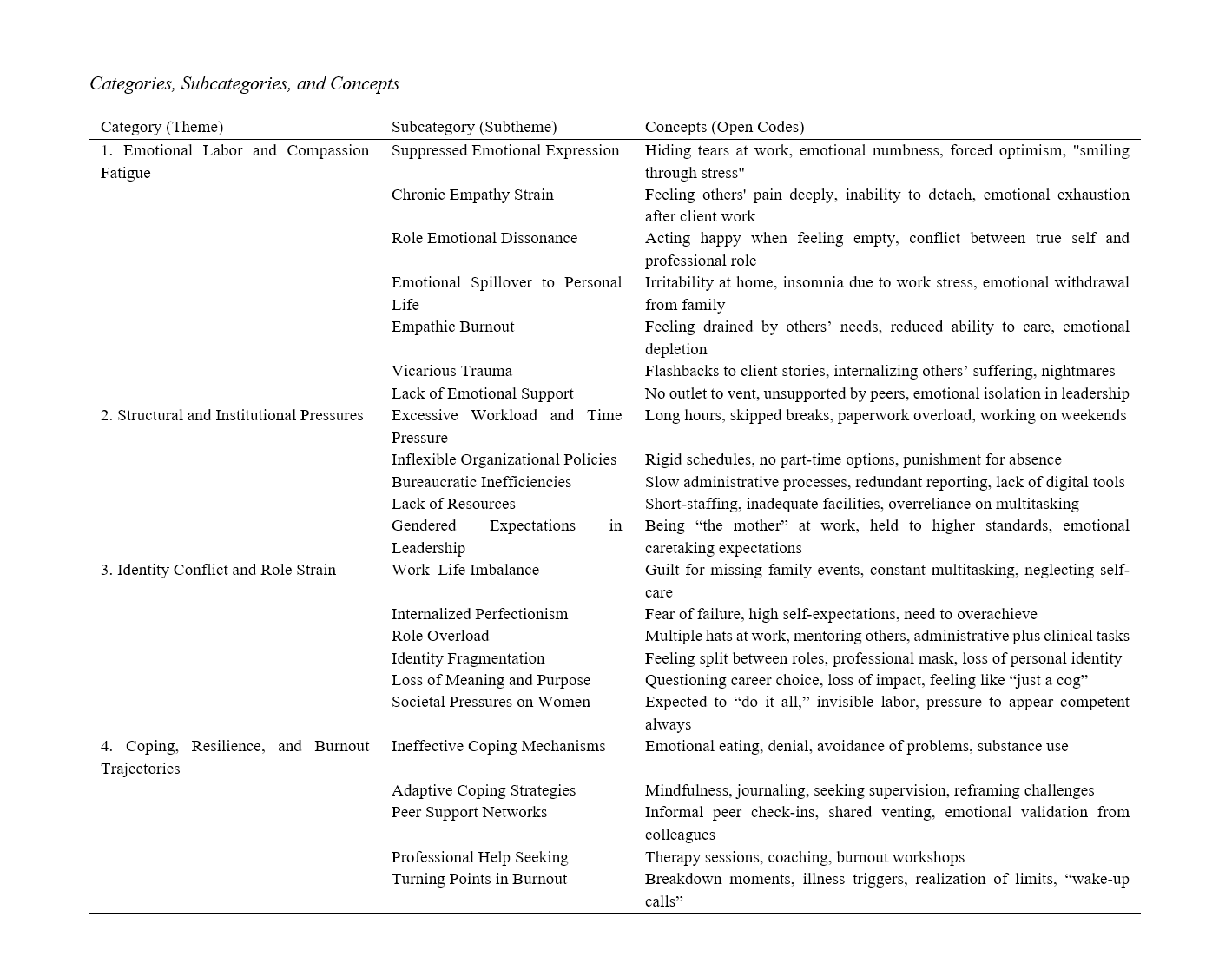
Findings: Four major themes emerged from the analysis: (1) Emotional Labor and Compassion Fatigue, which encompassed empathic strain, emotional dissonance, and vicarious trauma; (2) Structural and Institutional Pressures, highlighting excessive workload, lack of resources, and gendered expectations in leadership; (3) Identity Conflict and Role Strain, which included work-life imbalance, internalized perfectionism, and identity fragmentation; and (4) Coping, Resilience, and Burnout Trajectories, where participants described both adaptive (e.g., mindfulness, peer support) and maladaptive (e.g., avoidance, emotional suppression) coping mechanisms. Emotional suppression, systemic neglect, and the invisibility of women’s labor emerged as key drivers in burnout progression.
Conclusion: Burnout among women in high-responsibility caregiving roles is deeply rooted in psychosocial and structural contexts rather than individual weakness. Addressing this issue requires organizational reform, recognition of emotional labor, and the development of supportive policies that are gender-responsive and trauma-informed. This study contributes to a more nuanced understanding of the lived experiences of female professionals and underscores the urgent need for institutional interventions.
Downloads
References
Adedokun, T. A., & Adedokun, E. T. (2023). Assessing Community Attitudes Towards Home-Based Male Caregivers for Daycare Children. Indonesian Journal of Early Childhood Education Studies, 12(2), 211-222. https://doi.org/10.15294/ijeces.v12i2.71614
Burdorf, A. (2023). How to Improve Intervention Research on the Psychosocial Work Environment? Scandinavian Journal of Work Environment & Health, 49(5), 311-313. https://doi.org/10.5271/sjweh.4107
Chica‐Pérez, A., Correa‐Casado, M., Fernández‐Sola, C., Granero‐Molina, J., Cortés-Rodríguez, A. E., & Hernández‐Padilla, J. M. (2025). The Family Caregiver Role From the Perspective of Older Women Experiencing Poverty in a High‐Income Country: A Qualitative Study. Journal of Advanced Nursing. https://doi.org/10.1111/jan.17043
Coleman, B., Martinez, B., Ansryan, L. Z., Guzman, A. A., Aronow, H., Olanisa, L., Williams-Rivers, M., Chang, D., Runyan, C., Huie, N., Pamu, J., & Sandau, K. E. (2025). Understanding Care Partner Experiences in the First Month After Durable Left Ventricular Assist Device Implantation. Progress in Transplantation, 35(2), 88-96. https://doi.org/10.1177/15269248251343383
Dube, M. (2021). Women’s Burden of Caring for Orphans: The Bio-Psychosocial and Economic Challenges for Caregivers in a Rural Community in South Africa. Technium Social Sciences Journal, 26, 790-803. https://doi.org/10.47577/tssj.v26i1.5304
Dungy, M. L., & Krings, A. (2024). Responsibilization and Retraditionalization: How Neoliberal Logics Reproduce Gender Inequities Among Women Community Organizers in Chicago. Affilia, 39(4), 683-700. https://doi.org/10.1177/08861099241238199
Foo, C. Y. S., Tay, A. K., Yang, Y., & Verdeli, H. (2023). Psychosocial Model of Burnout Among Humanitarian Aid Workers in Bangladesh: Role of Workplace Stressors and Emotion Coping. https://doi.org/10.21203/rs.3.rs-2073274/v1
Gan, R., Chen, S., & Xue, J. (2023). Psychosocial Pathways Linking Mindfulness Traits and Burnout in University Students in China During the COVID-19 Pandemic: A Cross-Sectional Path Analysis Study. https://doi.org/10.21203/rs.3.rs-3589123/v1
Gatsi, O., Devi, A. B., & Devi, R. (2021). The Impact of Working From Home Induced by Covid 19 on Working Women in Harare, Zimbabwe. International Journal of Academic Research in Business and Social Sciences, 11(10). https://doi.org/10.6007/ijarbss/v11-i10/11275
Gottenborg, S., Hoff, T., Johnsen, S. Å. K., Rydstedt, L. W., & Øvergård, K. I. (2025). A Longitudinal Path Analysis of the Reciprocal and Cyclical Relationships Between Sickness Absence, Job Demands, Job Resources, and Burnout. Frontiers in psychology, 16. https://doi.org/10.3389/fpsyg.2025.1557898
Kaltenegger, H. C., Becker, L., Rohleder, N., Nowak, D., Quartucci, C., & Weigl, M. (2023). Associations of Technostressors at Work With Burnout Symptoms and Chronic Low-Grade Inflammation: A Cross-Sectional Analysis in Hospital Employees. International Archives of Occupational and Environmental Health, 96(6), 839-856. https://doi.org/10.1007/s00420-023-01967-8
Kamihiro, N., Taga, F., Miyachi, J., Matsui, T., & Nishigori, H. (2023). Deconstructing the Masculinized Assumption of the Medical Profession: Narratives of Japanese Physician Fathers. BMC Medical Education, 23(1). https://doi.org/10.1186/s12909-023-04855-4
Liang, W., Wang, J., Wang, X., Chen, G., Chen, R., & Cheng, J. (2024). Perceived Doctor-Patient Relationship, Authentic Leadership and Organizational Climate on Physician Burnout: Job Satisfaction as a Mediator. BMC Health Services Research, 24(1). https://doi.org/10.1186/s12913-024-12150-1
Maria Raquel Gomes Maia, P., & Rebeca Nunes Guedes de, O. (2023). Caring to Deny, Confront, Shiver: Negativity as a Critique of the “Natural Caregiver” Stereotype in Nursing. Revista da Escola de Enfermagem da USP, 57. https://doi.org/10.1590/1980-220x-reeusp-2023-0129en
Miesner, K. (2023). Baby Steps: Why the Florida Supreme Court’s New Parental Leave Continuance Rule Reinvigorates the FMLA’s Underlying Gender Equity Goals Within the Legal Profession and Why More States Should Follow Suit. Fiu Law Review, 18(1), 235-260. https://doi.org/10.25148/lawrev.18.1.12
Montañés, P., Calvo, J. C. A., & García, G. M. (2022). Burnout in Nursing: A Vision of Gender and “Invisible” Unrecorded Care. Journal of Advanced Nursing, 79(6), 2148-2154. https://doi.org/10.1111/jan.15523
Nalyvaiko, O., Вус, В., Zotova, L., Kostruba, N., & Tayeh, R. (2025). Mental Health and Psychosocial Support Coordination in Wartime (Ukraine): Lessons From a Humanitarian Perspective. Mental Health Global Challenges Journal, 8(1), 27-35. https://doi.org/10.56508/mhgcj.v8i1.268
Owen, J. A., Owen, R., Hughes, J. G., Leach, J., Anderson, D., & Jones, E. S. (2022). Psychosocial and Physiological Factors Affecting Selection to Regional Age-Grade Rugby Union Squads: A Machine Learning Approach. Sports, 10(3), 35. https://doi.org/10.3390/sports10030035
Potter, R., Afsharian, A., Richter, S., Neser, D., Zadow, A., Dollard, M. F., & Lushington, K. (2024). Longitudinal Investigation of Restructuring, Psychosocial Safety Climate and Burnout in Australian Universities During COVID-19 2020–2022. Journal of Industrial Relations. https://doi.org/10.1177/00221856241247577
Teoh, K. B., & Kee, D. M. H. (2020). Psychosocial Safety Climate and Burnout Among Academicians: The Mediating Role of Work Engagement. International Journal of Society Systems Science, 12(1), 1. https://doi.org/10.1504/ijsss.2020.106946
Thirunavukkarasu, G. (2021). Fair Access to Regulated Professions: Decoding the Transition of Migrant Caregivers to Nursing in Ontario. https://doi.org/10.32920/ryerson.14660490.v1
Yanmaz, F. H., Bozkurt, M. A., & Cesur, B. (2022). Ebelik Uygulamalarında Gözden Kaçabilen Bir Nokta: Fiziksel Engelli Kadınlarda Doğum Öncesi Dönem Ve Bakım Üzerine Geleneksel Bir Derleme. Anatolian Journal of Health Research, Volume 3 Issue 3(Volume 3 Issue 3), 154-156. https://doi.org/10.29228/anatoljhr.64878
Downloads
Additional Files
Publication Timeline
- Submitted
- Revised
- Accepted
Issue
Section
License

This work is licensed under a Creative Commons Attribution-NonCommercial 4.0 International License.