Identifying Patterns of Meta-Emotional Beliefs in Emotionally Suppressed Women
DOI:
https://doi.org/10.61838/kman.pwj.4334Keywords:
meta-emotional beliefs, emotional suppression, women’s mental health, emotion regulation, interpersonal emotion dynamicsAbstract
Objective: This study aimed to explore the underlying patterns of meta-emotional beliefs in emotionally suppressed women and understand how these beliefs influence emotional regulation and interpersonal behavior.
Methods and Materials: Using a qualitative research design, 26 women from Spain who self-identified as emotionally suppressed were interviewed through semi-structured, in-depth conversations. Participants were recruited through purposive sampling, and interviews continued until theoretical saturation was achieved. Data were transcribed verbatim and analyzed using thematic analysis within a constructivist framework, supported by NVivo 14 software. Coding followed Braun and Clarke’s six-phase approach, identifying key themes, subthemes, and concepts that reflect participants' beliefs and strategies related to emotional suppression.
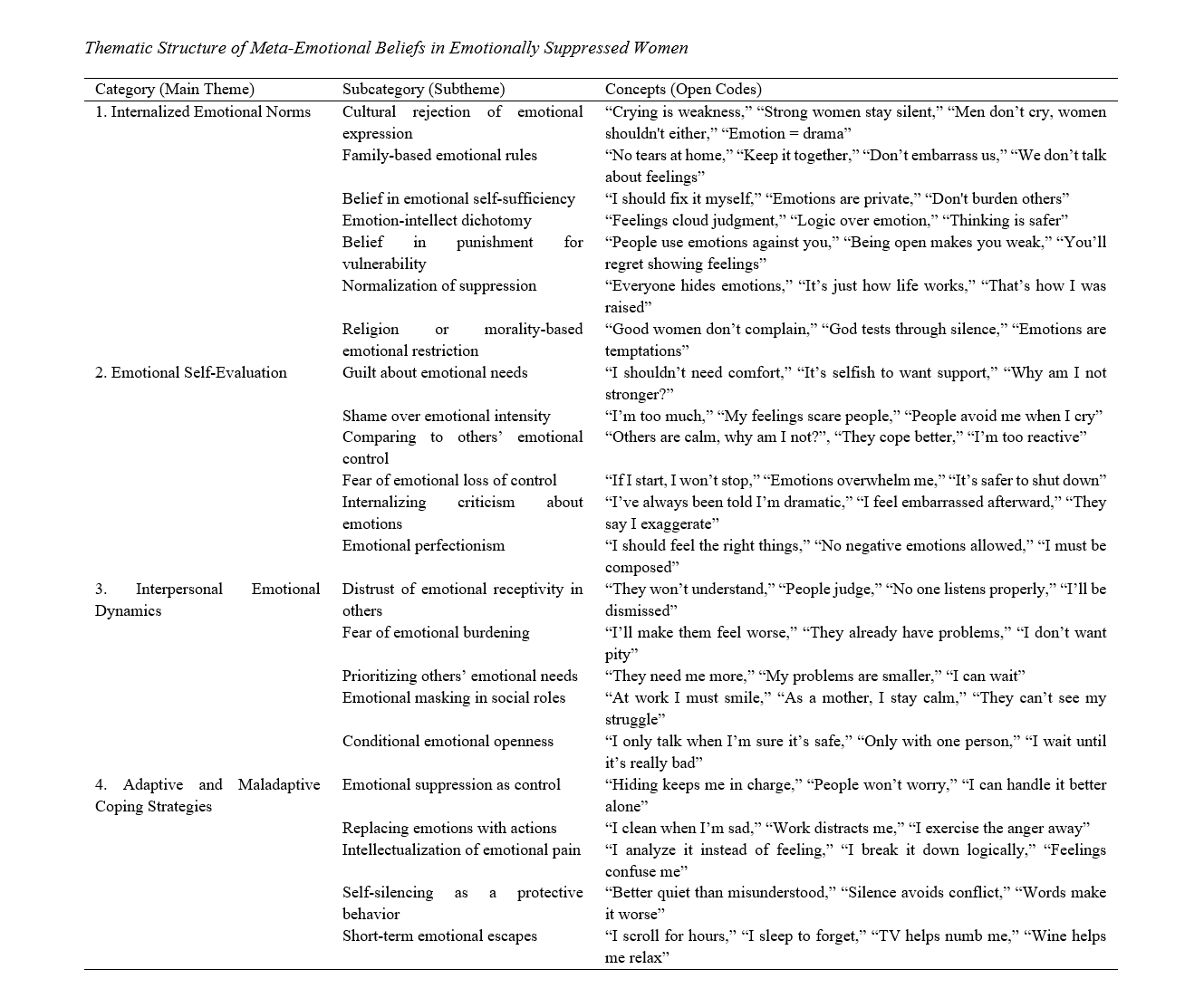
Findings: Analysis revealed four major themes: (1) Internalized Emotional Norms, encompassing cultural, familial, and moral beliefs that discourage emotional expression; (2) Emotional Self-Evaluation, involving shame, guilt, and perfectionistic beliefs about emotional experience; (3) Interpersonal Emotional Dynamics, reflecting fears of rejection, emotional burdening, and conditional disclosure; and (4) Adaptive and Maladaptive Coping Strategies, including suppression, distraction, intellectualization, and emotional masking. Participants consistently reported beliefs that emotions were dangerous, untrustworthy, or inappropriate, and these beliefs shaped both their intrapersonal experiences and relational behaviors.
Conclusion: The findings suggest that emotional suppression in women is underpinned by complex, internalized meta-emotional beliefs formed through sociocultural, familial, and relational influences. These beliefs contribute to rigid emotional regulation strategies that prioritize control and social acceptance over emotional authenticity.
Downloads
References
Bahlinger, K., Clamor, A., & Lincoln, T. M. (2023). Believing in Change Matters! The Role of Emotion Malleability Beliefs in Emotion Regulation and Paranoid Ideation. Cognitive therapy and research, 48(3), 466-476. https://doi.org/10.1007/s10608-023-10443-z
Berglund, A. M., James, S. H., Raugh, I. M., & Strauss, G. P. (2023). Beliefs About the Uncontrollability and Usefulness of Emotion in the Schizophrenia-Spectrum: Links to Emotion Regulation and Negative Symptoms. Cognitive therapy and research, 47(2), 282-294. https://doi.org/10.1007/s10608-023-10357-w
Brown, D. W., Bryant, S., Lozada, F. T., Bocknek, E. L., & Brophy‐Herb, H. E. (2024). A Thematic Analysis of Low-Income African American Fathers’ Meta-Emotion Interview Responses. Journal of Black Psychology. https://doi.org/10.1177/00957984241302542
Chang, M. L. (2020). Emotion Display Rules, Emotion Regulation, and Teacher Burnout. Frontiers in Education, 5. https://doi.org/10.3389/feduc.2020.00090
Chen, X. (2023). A Review on the Influence of Parental Meta-Emotional Philosophy on Preschool Children's Emotion Regulation. Journal of Education Humanities and Social Sciences, 22, 632-639. https://doi.org/10.54097/ehss.v22i.13244
D’Amico, A., & Geraci, A. (2021). The Role of Emotional and Meta-Emotional Intelligence in Pre-Adolescents’ Well-Being and Sociometric Status. Frontiers in psychology, 12. https://doi.org/10.3389/fpsyg.2021.749700
D’Amico, A., & Geraci, A. (2023). Beyond Emotional Intelligence: The New Construct of Meta-Emotional Intelligence. Frontiers in psychology, 14. https://doi.org/10.3389/fpsyg.2023.1096663
Deplancke, C., Somerville, M. P., Harrison, A., & Vuillier, L. (2022). It’s All About Beliefs: Believing Emotions Are Uncontrollable Is Linked to Symptoms of Anxiety and Depression Through Cognitive Reappraisal and Expressive Suppression. Current Psychology, 42(25), 22004-22012. https://doi.org/10.1007/s12144-022-03252-2
Goodman, F. R., Kashdan, T. B., & İmamoğlu, A. (2021). Valuing Emotional Control in Social Anxiety Disorder: A Multimethod Study of Emotion Beliefs and Emotion Regulation. Emotion, 21(4), 842-855. https://doi.org/10.1037/emo0000750
Huang, Y., Zhang, Q. M., Shang, C., Cui, L., & Wei, P. (2024). Fundamental Beliefs About Emotion Influence the Process of Emotion Regulation: An ERP Study. https://doi.org/10.22541/au.171366983.34808516/v1
jafari, T., Zarei, M., Shahraki, M. N., & Amani, O. (2023). Investigating the Relationship Between Burnout, Internalized Shame and Metacognitive Beliefs on Emotion Regulation in Women Affected by Marital Infidelity. PWJ, 4(1), 90-98. https://doi.org/10.61838/kman.pwj.4.1.10
Mansueto, G., Jarach, A., Caselli, G., Ruggiero, G. M., Sassaroli, S., Nikčević, A. V., Spada, M. M., & Palmieri, S. (2024). A Systematic Review of the Relationship Between Generic and Specific Metacognitive Beliefs and Emotion Dysregulation: A Metacognitive Model of Emotion Dysregulation. Clinical Psychology & Psychotherapy, 31(1), 1-842. https://doi.org/10.1002/cpp.2961
Mazidi, M., Preece, D. A., Becerra, R., Gross, J., & MacLeod, C. M. (2025a). Beliefs About Emotions in Self and Others: Links With Emotion Regulation and Psychological Distress. https://doi.org/10.21203/rs.3.rs-6200309/v1
Mazidi, M., Preece, D. A., Becerra, R., Gross, J. J., & MacLeod, C. (2025b). Beliefs About Emotions in Self and Others: Links With Emotion Regulation and Psychological Distress. https://doi.org/10.31219/osf.io/es6ac_v1
Mirzaei, F., & Hefzabad, S. B. (2024). The Effectiveness of Acceptance and Commitment Therapy on Anxiety, Metacognitive and Meta-Emotional Beliefs in Obese Women With Eating Disorders in Khomain City. PDMD, 3(3), 292-310. https://doi.org/10.61838/kman.pdmd.3.3.21
Rong, S., Liu, S., Coplan, R. J., Chen, X., & Liu, J. (2023). Examining a Complex Model Linking Maternal Reflective Functioning, Maternal Meta-Emotion Philosophies, and Child Emotion Regulation. Children, 10(7), 1161. https://doi.org/10.3390/children10071161
Roshannia, S., Rezaei, F., & Dosti, L. (2021). Role of Meta-Cognitive Beliefs and Emotional Schemes in Predicting the Symptoms of Post Traumatic Stress Disorder in People Referring to Legal Medicine. Journal Of Shahid Sadoughi University Of Medical Sciences. https://doi.org/10.18502/ssu.v29i7.7265
Samadifard, H. R., Narimani, M., Aghajani, S., & Basharpoor, S. (2021). Sexual Health in Married Women and the Role of Meta-Cognitive Belief and Emotion Regulation Strategies in Predicting That. Shenakht Journal of Psychology and Psychiatry, 8(2), 61-73. https://doi.org/10.32598/shenakht.8.2.61
Shang, C., Zhang, Q., Pang, X., Wei, Y., Huang, Y., & Cui, L. (2024). Emotion Beliefs, Emotion Regulation Strategies, and Test Anxiety of Chinese Adolescents in Grade 8: Evidence From Physiological Recordings During an Exam. Stress and Health, 40(4). https://doi.org/10.1002/smi.3376
Tenore, K., Granziol, U., Luppino, O. I., Mancini, F., & Mancini, A. (2024). Group Imagery Imagery Rescripting via Telehealth Decreases Dysfunctional Personality Beliefs and the Meta-Emotional Problem but Does Not Increase Positive Self-Compassion. Current Psychology, 43(23), 20614-20625. https://doi.org/10.1007/s12144-024-05815-x
Visco‐Comandini, F., Gragnani, A., Giacomantonio, M., Romano, G., Petrucci, M., & Mancini, F. (2021). Depression in the Mirror: Depression Severity and Its Link to Negative Judgments of Symptoms. Frontiers in Psychiatry, 12. https://doi.org/10.3389/fpsyt.2021.621282
Zahedian, E., Bahreini, M., Ghasemi, N., & Mirzaei, K. (2020). The Effectiveness of Group Meta-Cognitive Therapy on Depression, Cognitive Emotional Regulation, and Meta-Cognitive Beliefs in Women With Breast Cancer: A Randomized Clinical Trial. https://doi.org/10.21203/rs.3.rs-117625/v1
Zahedian, E., Bahreini, M., Ghasemi, N., & Mirzaei, K. (2021). Group Meta-Cognitive Therapy and Depression in Women With Breast Cancer: A Randomized Controlled Trial. BMC Women S Health, 21(1). https://doi.org/10.1186/s12905-021-01258-9
Zerwas, F. K., Tharp, J. A., Chen, S., & Mauss, I. B. (2022). Individual Differences in Social Power: Links With Beliefs About Emotion and Emotion Regulation. Journal of personality, 91(2), 314-331. https://doi.org/10.1111/jopy.12721
Zhou, X., Zhang, T., Wang, D. J., Wang, F., & Peng, K. (2025). The Immediate and Delayed Beliefs in Headlines With High-Arousal Sentence Starters. Communication Research. https://doi.org/10.1177/00936502251343979
Downloads
Additional Files
Publication Timeline
- Submitted
- Revised
- Accepted
Issue
Section
License
Copyright (c) 2025 Mariana Oliveira (Author); Carmen Sánchez

This work is licensed under a Creative Commons Attribution-NonCommercial 4.0 International License.