Modeling the Structural Relationships of Post-Traumatic Growth Based on Perceived Social Support and Emotion Regulation with the Mediating Role of Self-Care Behaviors in Women with Breast Cancer
DOI:
https://doi.org/10.61838/kman.pwj.4723Keywords:
post-traumatic growth, perceived social support, emotion regulation, self-care behaviorsAbstract
Objective: This study aimed to model the structural relationships between perceived social support and emotion regulation with post-traumatic growth (PTG), emphasizing the mediating role of self-care behaviors in women diagnosed with breast cancer.
Methods and Materials: The research employed a descriptive–correlational design using structural equation modeling (SEM). The statistical population comprised all women with breast cancer in Tehran, Iran. A total of 310 participants were selected through convenience sampling. Data collection tools included the Post-Traumatic Growth Inventory (Tedeschi & Calhoun, 1996), the Multidimensional Scale of Perceived Social Support (Zimet et al., 1988), the Affect Control Questionnaire (Williams & Chambless, 1997), and the Self-Efficacy for Self-Care Scale (Lorig, 1996). Data were analyzed using SPSS version 26 and AMOS software. Descriptive and inferential statistics, including direct and indirect effect testing and fit indices, were applied to evaluate the proposed model.
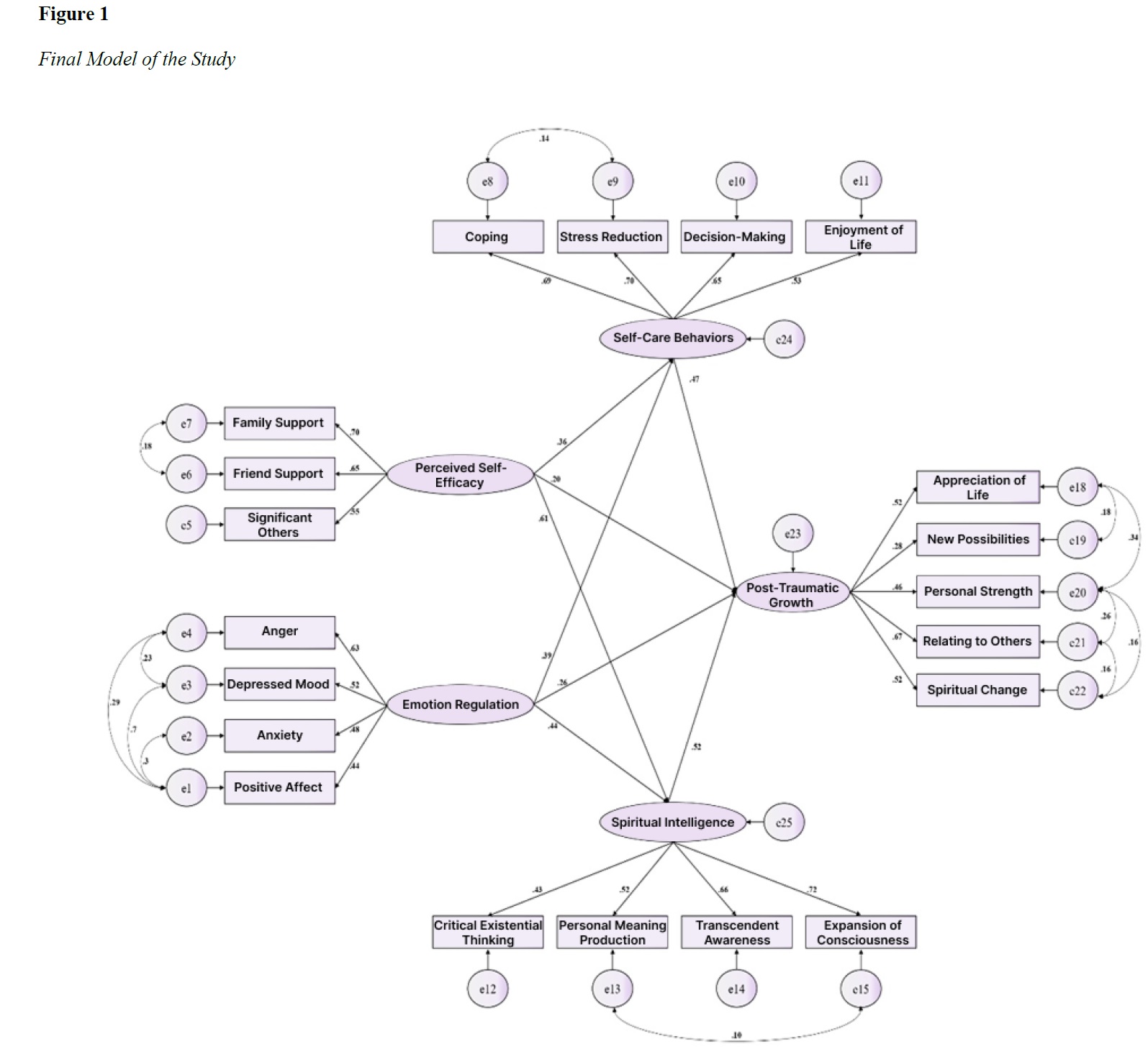
Findings: The results indicated that perceived social support (β = 0.20, t = 3.35, p < 0.001) and emotion regulation (β = 0.26, t = 3.78, p < 0.001) had significant direct effects on PTG. Additionally, both variables significantly predicted self-care behaviors (β = 0.36, t = 4.20, and β = 0.39, t = 4.55, respectively). Self-care behaviors also had a strong direct effect on PTG (β = 0.47, t = 5.35, p < 0.001) and mediated the indirect relationships between social support, emotion regulation, and PTG (β = 0.17–0.18, p < 0.001). The overall model demonstrated an excellent fit (χ²/df = 2.10; RMSEA = 0.05; CFI = 0.94; GFI = 0.96).
Conclusion: The findings suggest that fostering social support, improving emotion regulation, and enhancing self-care behaviors can collectively promote post-traumatic growth among women with breast cancer.
Downloads
References
Aflakseir, A., Soltani, S., & Mollazadeh, J. (2018). Posttraumatic growth, meaningfulness, and social support in women with breast cancer. International Journal of Cancer Management, 11(10). https://doi.org/10.5812/ijcm.11469
Babazadeh Nemini, S., Elahi, A., Sirefi, M., Sabat, M., & Azadeh, P. (2021). Predicting Post-Traumatic Growth Based on Perceived Social Support: The Mediating Role of Resilience in Women with Breast Cancer: A Structural Equation Modeling Approach. Journal of Health Education and Promotion in Iran, 9(2), 172-186. https://doi.org/10.52547/ijhehp.9.2.172
Chin, C.-H., Tseng, L.-M., Chao, T.-C., Wang, T.-J., Wu, S.-F., & Liang, S.-Y. (2021). Self-care as a mediator between symptom-management self-efficacy and quality of life in women with breast cancer. PLoS One, 16(2), e0246430. https://doi.org/10.1371/journal.pone.0246430
Gu, Y., Bie, F., Hu, M., Huang, L., Chen, J., Hu, X., Luo, C., & Ye, Z. (2023). Social Support and Posttraumatic Growth Among Postoperative Patients With Breast Cancer: A Latent Profile and Moderated Mediation Analysis. Perspectives in psychiatric care, 2023(1). https://doi.org/10.1155/2023/9289446
Karimi Dastaki, A., & Mahmudi, M. (2024). The Effectiveness of Life Meaning Workshops on Resilience, Negative Affect, and Perceived Social Support in Students. Journal of Psychological Dynamics in Mood Disorders (PDMD), 3(1), 187-197. https://doi.org/10.22034/pdmd.2024.448984.1063
Kim, K., Lee, J., & Yoon, J. (2023). Effects of Emotional Regulation, Resilience, and Distress Disclosure on Post-Traumatic Growth in Nursing Students. International journal of environmental research and public health, 20(4), 2782. https://doi.org/10.3390/ijerph20042782
Mohammad, H., & Borjali, M. (2021). Predicting Post-Traumatic Growth based on Attachment Styles and Cognitive Emotion Regulation in Iranian immigrant girls. Applied Family Therapy Journal (AFTJ), 2(4), 369-382. https://journals.kmanpub.com/index.php/aftj/article/view/820
Mousavi, S., Goodarzi, M., & Taghavi, S. M. (2020). Prediction of Post Traumatic Growth based on Gratitude and Perceived Social Support in Women with Blood Cancer. Journal Health Psychology, 8(30), 39-53. https://journals.sbmu.ac.ir/en-jrrh/article/view/30915
Nemini, S. B., Seyyed Ahmad Elahi, M. R., Sirefi, M., Sabat, M., & Azadeh, P. (2021). Predicting Post-Traumatic Growth Based on Perceived Social Support: The Mediating Role of Resilience in Women with Breast Cancer: A Structural Equation Modeling Approach. Journal of Health Education and Promotion in Iran, 9(2), 172-186. https://doi.org/10.52547/ijhehp.9.2.172
Savenysheva, S. S., & Razygraeva, Y. (2024). Parental Burnout, Post-Traumatic Growth and Social Support for Mothers of Children With Disabilities. Vestnik of Saint Petersburg University Psychology, 14(1), 128-142. https://doi.org/10.21638/spbu16.2024.108
Wu, L., Pan, Y., Zheng, Q. X., Chen, X., Jiang, X. M., Lin, Y., & Liu, G. (2024). Post Traumatic Growth, Resilience, Social Support and Coping Styles in the Parents of Very Low Birth Weight Infants: A Multi-Center Cross Sectional Study. https://doi.org/10.21203/rs.3.rs-4440727/v1
Yao, Y., Wang, P., Zhao, K., Li, Q., & Li, Y. (2024). Proactive Personality, Social Support and Post-Traumatic Growth Caused by COVID-19: Mediating Effect Meaning in Life in China. BMC psychology, 12(1). https://doi.org/10.1186/s40359-024-02156-z
Zahra, K., Khan, S., Sadia, R., & Aslam, I. (2024). Resilience and Post-Traumatic Growth Among Cancer Patients: A Moderated Mediation Analysis Through Perceived Social Support and Stress. Psychology in Russia State of Art, 17(2), 34-49. https://doi.org/10.11621/pir.2024.0203
Zahra, R., Zainab, R. A., Qamar, Z., Rehman, A., Niazi, S., & Yousaf, A. (2024). Religiosity as a Predictor of Post-Traumatic Growth and Psychological Distress Among Heart Patients: Mediating Role of Perceived Social Support. Pakistan Heart Journal, 57(1), 23-28. https://doi.org/10.47144/phj.v57i1.2688
Zeinali Siavoshani, E., & Dehghan, M. (2021). The Role of Emotional Expression and Emotion Regulation in Post-Traumatic Growth in Patients with Cancer and Multiple Sclerosis: Considering the Moderating Role of Disease Type. Navid No, 24(78), 42-53. https://doi.org/10.22038/nnj.2021.55171.1264
Zeinali Siyavashani, E., & dehghan, m. (2021). Role of Emotional Expression and Emotion Regulation in Post-Traumatic Growth in People with Cancer and Multiple Sclerosis: According to the Moderating role of Illness Type. Navid No, 24(78), 42-53. https://doi.org/10.22038/nnj.2021.55171.1264
Zhang, L., Wu, X., Liu, M., & Liu, A. (2025). Relationship Between Complex Posttraumatic Stress Disorder Symptoms and Posttraumatic Growth Among Adolescents and Emerging Adults With Adverse Childhood Experiences. Psychological Trauma Theory Research Practice and Policy. https://doi.org/10.1037/tra0001932
Zhao, S. (2025). Relationship Between Purposeful Rumination and Post-Traumatic Growth of College Students Who Experienced Childhood Trauma: A Regulated Intermediary Model. https://doi.org/10.20944/preprints202501.1481.v1
Downloads
Additional Files
Publication Timeline
- Submitted
- Revised
- Accepted