The Relationship Between Early Maladaptive Schemas and Alexithymia with Emotional Divorce in Married Women
DOI:
https://doi.org/10.61838/kman.pwj.5004Keywords:
Early maladaptive schemas, alexithymia, womenAbstract
Objective: This study aimed to examine the relationship between early maladaptive schemas and alexithymia with emotional divorce in married women.
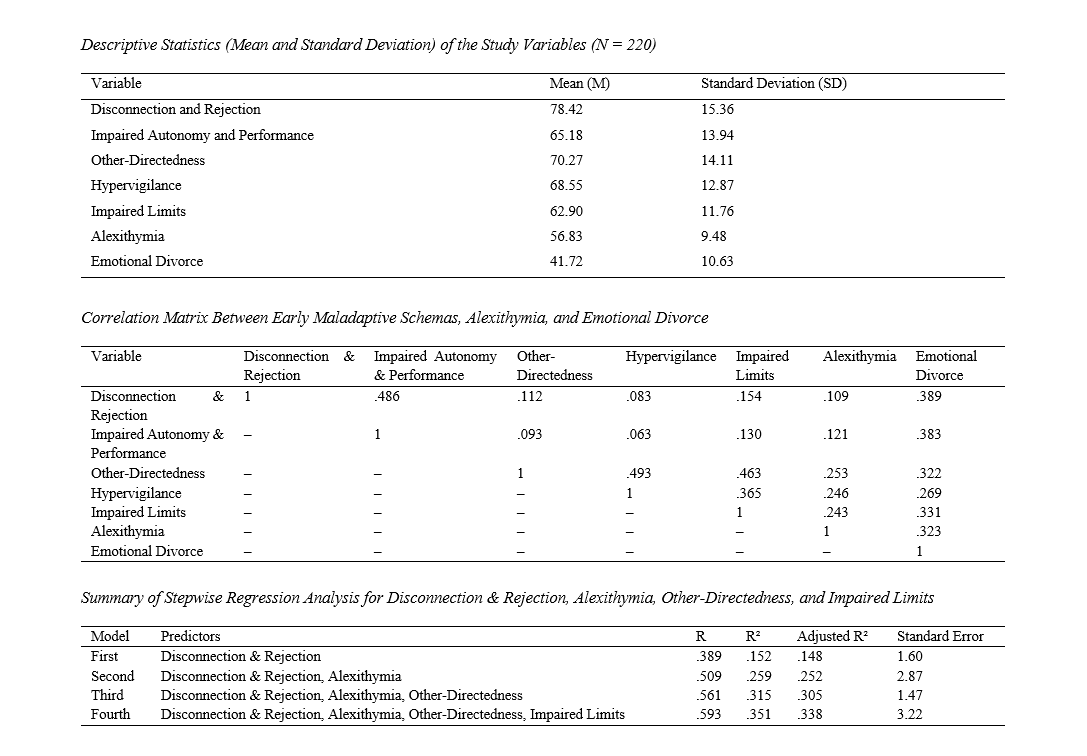
Methods and Materials: The study employed a descriptive-correlational design. The statistical population consisted of all married women who referred to counseling centers in Tonekabon city in 2025. Using convenience sampling, 232 participants were recruited; after excluding incomplete questionnaires, data from 220 participants were analyzed. Data collection instruments included the Young Schema Questionnaire–Short Form, the Toronto Alexithymia Scale, and the Gottman Emotional Divorce Questionnaire. Data were analyzed using Pearson correlation coefficients and stepwise multiple regression analysis with SPSS-26.
Findings: Inferential analyses indicated that early maladaptive schemas and alexithymia were positively and significantly correlated with emotional divorce (p < .01). Among schema domains, disconnection and rejection, other-directedness, and impaired limits showed significant associations with emotional divorce. Stepwise regression analysis revealed that disconnection and rejection entered the model first and significantly predicted emotional divorce. The addition of alexithymia significantly increased the explained variance, followed by other-directedness and impaired limits in subsequent steps. In the final regression model, disconnection and rejection, alexithymia, other-directedness, and impaired limits jointly accounted for approximately one-third of the variance in emotional divorce, with all predictors demonstrating statistically significant standardized regression coefficients (p < .01).
Conclusion: Early maladaptive schemas, particularly disconnection and rejection, together with alexithymia, play a central role in predicting emotional disengagement within marriage, underscoring the importance of integrative schema- and emotion-focused approaches in marital assessment and intervention.
Downloads
References
Al-shahrani, H. F., & Hammad, M. A. (2023). Relationship Between Emotional Divorce and Alexithymia Among Married Women in Saudi Arabia. BMC psychology, 11(1). https://doi.org/10.1186/s40359-023-01236-w
Alizadeh, S., Aryan, R., & Moradi, S. (2024). Investigating the relationship between emotional alexithymia and maladaptive schemas with marital conflict in married female students. Journal of Cognition, Behavior, and Learning, 1(4), 106-116. https://doi.org/10.61838/jcbl.1.4.9
Almardani, S. e. (2023). Comparing the effectiveness of acceptance and commitment therapy and schema therapy on alexithymia of divorced women referring to welfare organization. Journal of Family Relations Studies, 4(12), 4-14. https://jhrs.uma.ac.ir/article_2451_e395b36a2260cc8a84509b0cbe4818db.pdf
Bibak, M., Hossein Abasi, N., Eteshamzadeh, P., Alipour, H. G., & Aqa Amiri, M. (2025). The Efficacy of Schema Therapy on Emotion Regulation Styles, Emotional Expression, and Marital Satisfaction of Couples on the Brink of Divorce. Iranian Nursing Research Journal, 20(2), 64-78. https://ijnr.ir/browse.php?a_code=A-10-2074-6&sid=1&slc_lang=en
Esmaeili, F., Zamardi, S., & Vatankhah, H. R. (2023). The Effectiveness of Schema Therapy on Distress Tolerance, Emotional Divorce, and Marital Intimacy Among Couples. Tenth International Conference on Knowledge and Technology in Educational Sciences, Social Studies, and Psychology in Iran. https://civilica.com/doc/1966663/
Faramarzi Rad, B., Robatmili, S., Abolmali, K., & Zarehbaramabadi, M. (2023). A structural model for predicting alexithymia based on early maladaptive schemas with the mediation of emotional self-disclosure. Journal of Psychological Science, 22(123), 539-556. https://psychologicalscience.ir/browse.php?a_id=1823&sid=1&slc_lang=en
Ghanbari, Z., Mohseni Nasab, Z., Taati, M., Mohbi Aria, M., & Torabi, A. (2023). Comparing the effectiveness of schema therapy and mindfulness-based stress reduction on alexithymia, self-control, and psychological well-being in women victims of domestic violence. Research in Psychological Health, 17(4), 50-65. https://www.magiran.com/paper/2715846/
Izadi, F., Ashrafi, E., & Fathi Ashtiani, A. (2019). The Effectiveness of Emotional Schema Therapy on Reducing Negative Emotional Schemas, Alexithymia, and Symptoms in Patients with Somatic Symptoms. Journal of Behavioral Science Research, 17(2), 232-243. https://doi.org/10.52547/rbs.17.2.232
Karjouh, K., Azzaoui, F.-Z., Boulbaroud, S., Samlali, W. I., & Ahami, A. (2022). Role of Early Maladaptive Schemas and Alexithymia in the Relationship Between Perceived Parenting Styles in Moroccan Psychoactive Substance Users. International Journal of Nutrition, Pharmacology, Neurological Diseases, 12(3), 170-179. https://journals.lww.com/ijnp/fulltext/2022/12030/Role_of_Early_Maladaptive_Schemas_and_Alexithymia.12.aspx
Kashanifar, M., & Hadipour, M. (2023). The Mediating Role of Love Styles in the Relationship Between Early Maladaptive Schemas and Emotional Divorce. First International Conference on Psychology, Social Sciences, Educational Sciences, and Philosophy,
Malekimajd, M., Ameri, F., Pivastehgar, M., & Farahbijari, A. (2024). Examining the effectiveness of schema therapy on alexithymia, dysfunctional relationship beliefs, and sexual intimacy in married women with persistent depressive disorder. Disability Studies, 13(1), 1-10. https://jdisabilstud.org/browse.php?a_id=3130&slc_lang=en&sid=1&printcase=1&hbnr=1&hmb=1
Monjezi, F., Asadpour, E., Rasouli, M., & Zahrakar, K. (2023). Comparison of the Effect Schema and cognitive Behavioral Therapy on the Cognitive Regulation of Emotions in Girls Adolescent of Divorced. Quarterly of Applied psychology, 17(2), 91-113. https://apsy.sbu.ac.ir/index.php/article/view/article_102961_9aafd21a43af59f0f4cc449150a88630.pdf
Panahi, M., & Baramash, H. (2024). The effectiveness of schema therapy on resilience levels in women at risk of divorce in Tehran.
Panahifar, S., Mirderikvand, F., & Sadeghi, M. (2023). The comparison of the effectiveness of schema-based, emotional focused, and acceptance and commitment couple therapy on reducing the desire for divorce of couples among military families on the verge of divorce. EBNESINA, 25(2), 4-14. http://ebnesina.ajaums.ac.ir/article-1-1136-fa.html
Pilkington, P. D., Karantzas, G. C., Faustino, B., & Pizarro-Campagna, E. (2024). Early maladaptive schemas, emotion regulation difficulties and alexithymia: A systematic review and meta-analysis. Clinical Psychology & Psychotherapy, 31(1), e2914. https://doi.org/10.1002/cpp.2914
Rahiman, R. (2024). Development of a Structural Model With a Mediating Role of Maladaptive Schema in Relation to Personality Dimensions and Attachment Styles With Communication Skills and Marital Conflicts Among Couples Facing Divorce. PST, 48(2), 842-857. https://doi.org/10.52783/pst.599
Rasouli Rad, A., Rahmani, M. A., Shiroudi, S. G., & Zarbakhsh, M. R. (2023). Comparing the Effectiveness of Schema Therapy and Mutual Behavior Analysis on Marital Heartbreak, Marital Conflict and Communication Skills of Couples Applying for Divorce [Research]. Islamic Life Style, 6(4), 788-799. http://islamiclifej.com/article-1-1441-en.html
Talebi Zadeh, F., Ranjbar, M., Lotfi, P., & Barvarz Koucheh Galleh, Z. (2023). The role of early maladaptive schemas in emotional divorce among couples. Ninth Scientific Research Conference on the Development and Promotion of Educational and Psychological Sciences of Iran, Tehran.
Vakilian, L., Tarkhan, M., & Khalatbari, J. (2021). Predicting Alexithymia Based on Early Maladaptive Schemas and Emotional Expressiveness with the Mediating Role of Cognitive Flexibility in Patients with Chronic Pain. Knowledge & Research in Applied Psychology, 22(3), 32-46. https://sid.ir/paper/958456/en
Zahmatkesh, Y. Z. (2022). Prediction of Suicidal Thoughts Based on Alexithymia and Childhood Traumas of Divorced Women. PDMD, 1(2), 47-55. https://doi.org/10.61838/kman.pdmd.1.2.6
Downloads
Additional Files
Publication Timeline
- Submitted
- Revised
- Accepted