Causal Forest Estimation of Treatment Heterogeneity: Identifying Subgroups of Women Benefiting Most from Mindfulness-Based Stress Reduction for Chronic Pain
DOI:
https://doi.org/10.61838/kman.pwj.5192Keywords:
Chronic Pain, Mindfulness-Based Stress Reduction, Treatment HeterogeneityAbstract
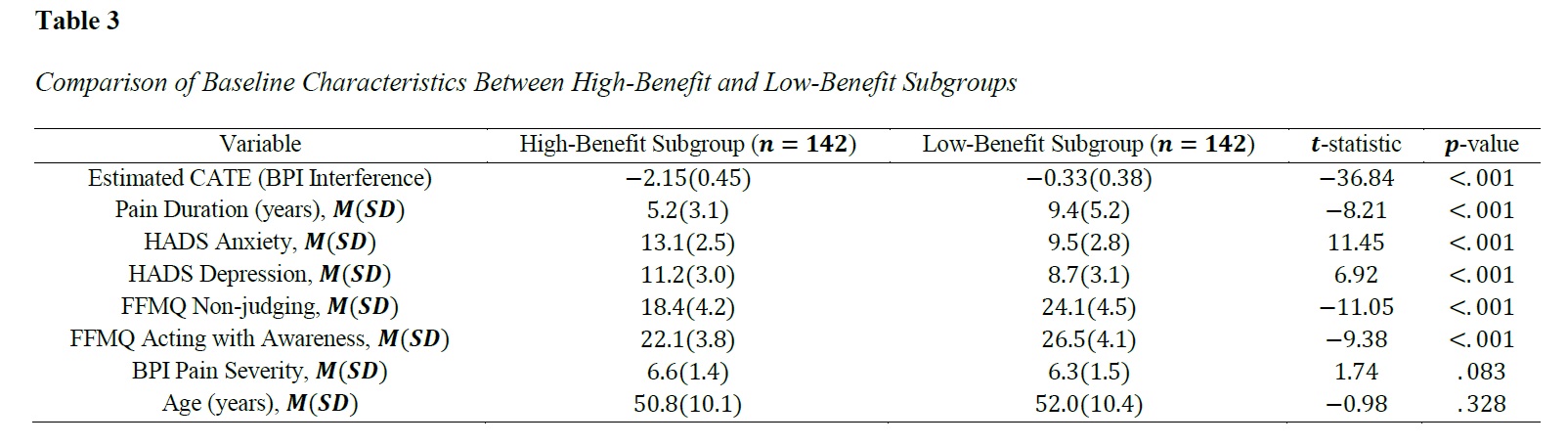
Objective: The objective of this study was to apply a causal forest machine learning algorithm to estimate the conditional average treatment effects of Mindfulness-Based Stress Reduction on pain interference and identify the specific baseline characteristics of women with chronic pain who derive the greatest therapeutic benefit. Methods and Materials: This randomized controlled trial included a sample of N=284adult women (mean age M=51.4years) residing in Spain and suffering from chronic non-malignant pain. Participants were randomly assigned to an 8-week Mindfulness-Based Stress Reduction program or a treatment-as-usual control group. Baseline sociodemographic and psychological covariates were assessed using standardized psychometric instruments, including the Brief Pain Inventory, Hospital Anxiety and Depression Scale, and the Five Facet Mindfulness Questionnaire. To move beyond the traditional Average Treatment Effect (ATE), a causal forest algorithm was utilized to estimate the Conditional Average Treatment Effect (CATE) for pain interference, allowing for the empirical identification of high-benefit and low-benefit patient subgroups based on their multidimensional baseline profiles. Findings: While the standard analysis revealed a statistically significant Average Treatment Effect for pain interference (ΔM=-1.24), the causal forest estimation uncovered substantial treatment heterogeneity, with individual CATEvalues ranging widely from -3.10to +0.45. Variable importance metrics derived from the machine learning model identified baseline anxiety as the strongest predictor of treatment benefit, followed closely by the non-judging of inner experience facet of dispositional mindfulness, and the total duration of the chronic pain condition. Specifically, the high-benefit subgroup—which experienced the most clinically significant reductions in pain interference (τ(x)≈-3.10)—was characterized by elevated baseline anxiety and depression, distinctly lower baseline scores in non-judging mindfulness, and a comparatively shorter history of chronic pain. Conclusion: Mindfulness-Based Stress Reduction is not uniformly effective for all chronic pain patients; rather, it yields the maximum reduction in pain interference specifically among women presenting with high emotional distress, highly judgmental psychological traits, and shorter pain durations, highlighting the critical necessity of precision behavioral medicine.
Downloads
References
Abotalebi Isazadegan, A., Yazdchi, N., & Akbarinejhad, H. (2022). Effectiveness of Mindfulness-based Cognitive Therapy on Resilience and Intensity of Pain Experience of Women With Chronic Headache. Journal of Applied Psychology, 13(1), 1-13.
Ahmadi, V., & Valizadeh, H. (2021). The Effectiveness of Acceptance and Commitment-Based Therapy on the Quality of Life and Death Anxiety in the Elderly. Aging Psychology, 7(2), 166-153. https://doi.org/10.22126/jap.2021.6370.1528
Alemi, S., Abolmaali Alhosseini, K., Malihialzackerini, S., & Khabiri, M. (2021). Effect of mindfulness therapy and aromatherapy massage on pain perception, quality of life and sleep quality in older women with chronic pain. Iranian Journal of Ageing, 16(2), 218-233. https://doi.org/10.32598/sija.16.2.3058.1
Barghi Irani, Z., & Dehghan Saber, L. (2021). The Comparison of the Effectiveness of Mindfulness Based Therapy and Spiritual Therapy on Irrational Beliefs and Anxiety in the Older Women. Aging Psychology, 6(4), 339-321. https://doi.org/10.22126/jap.2021.5945.1492
Bishop, M. E. R., Hamiduzzaman, M., & Veltre, A. (2023). Mindfulness Meditation Use in Chronic Pain Treatment in Rural Australia: Pitfalls and Potential – A Case Report. Journal of Neurosciences in Rural Practice, 14, 516-521. https://doi.org/10.25259/jnrp-2022-4-7
Burgess, D. J., Calvert, C., Campbell, E. M. H., Allen, K. D., Bangerter, A., Behrens, K., & Taylor, B. C. (2024). Telehealth Mindfulness-Based Interventions for Chronic Pain: The LAMP Randomized Clinical Trial. JAMA internal medicine. https://doi.org/10.1001/jamainternmed.2024.3940
Burns, J. W., Jensen, M. P., Thorn, B., Lillis, T. A., Carmody, J., Newman, A. K., & Keefe, F. (2022). Cognitive therapy, mindfulness-based stress reduction, and behavior therapy for the treatment of chronic pain: randomized controlled trial. Pain, 163(2), 376-389. https://doi.org/10.1097/j.pain.0000000000002357
Carvalho, S. A., Trindade, I. A., Duarte, J., Menezes, P., Patrão, B., Nogueira, M. R., Guiomar, R., Lapa, T., Pinto-Gouveia, J., & Castilho, P. (2021). Efficacy of an ACT and Compassion-Based eHealth Program for Self-Management of Chronic Pain (iACTwithPain): Study Protocol for a Randomized Controlled Trial [Study Protocol]. Frontiers in psychology, 12. https://doi.org/10.3389/fpsyg.2021.630766
Conti, Y., Vatine, J. J., Levy, S., Meltz, Y. L., Hamdan, S., & Elkana, O. (2020). Pain Catastrophizing Mediates the Association Between Mindfulness and Psychological Distress in Chronic Pain Syndrome. Pain Practice, 20(7), 714-723. https://doi.org/10.1111/papr.12899
Creswell, J. D., Lindsay, E. K., Villalba, D. K., & Chin, B. (2019). Mindfulness Training and Physical Health: Mechanisms and Outcomes. Psychosomatic Medicine, 81(3). https://journals.lww.com/psychosomaticmedicine/fulltext/2019/04000/mindfulness_training_and_physical_health_.2.aspx
Day, M. A., Ward, L. C., Ehde, D. M., Thorn, B. E., Burns, J., Barnier, A., & Jensen, M. P. (2019). A pilot randomized controlled trial comparing mindfulness meditation, cognitive therapy, and mindfulness-based cognitive therapy for chronic low back pain. Pain Medicine, 20(11), 2134-2148. https://doi.org/10.1093/pm/pny273
Demehri, F., Azizi, M., & Barghoun, R. (2020). Investigating the Effectiveness of Mindfulness Therapy on Psychological Well-Being and Reducing Pain Symptoms in Children with Chronic Diseases. Thoughts and Behavior in Clinical Psychology, 15(56), 37-46. https://sid.ir/paper/395609/en
Ebrahimi Sadr, F., Kashefi Mehr, N., & Esmkhani Akbarinejad, H. (2023). Comparing the Effectiveness of Mindfulness-Based Cognitive Therapy with Short-Term Solution-Focused Therapy on Pain Anxiety and Quality of Life in Patients with Chronic Headaches. Anesthesiology and Pain Quarterly, 13(4), 125-140. https://www.sid.ir/paper/1113513/en
Foulk, M., Montagnini, M., Fitzgerald, J., & Ingersoll-Dayton, B. (2023). Mindfulness-Based Group Therapy for Chronic Pain Management in Older Adults. Clinical Gerontologist, 1-10. https://doi.org/10.1080/07317115.2023.2229307
Harris, K., Jackson, J., Webster, H., Farrow, J., Zhao, Y., & Hohmann, L. (2023). Mindfulness-based stress reduction (mbsr) for chronic pain management in the community pharmacy setting: A cross-sectional survey of the general public's knowledge and perceptions. Pharmacy, 11(5), 150-159. https://doi.org/10.3390/pharmacy11050150
Hussain, N., & Said, A. S. (2019). Mindfulness-based meditation versus progressive relaxation meditation: Impact on chronic pain in older female patients with diabetic neuropathy. Journal of Evidence-Based Integrative Medicine, 24. https://doi.org/10.1177/2515690X19876599
Karimi, M., Belyad, M., Peymani, J., Havasi Somar, N., & Zhian Bagheri, M. (2023). Comparing the Effectiveness of Intensive Short-Term Dynamic Psychotherapy with Mindfulness-Based Cognitive Therapy on Anxiety Sensitivity and its Components in Women with Chronic Pain. Community Health, 17(3), 1-13. https://chj.rums.ac.ir/article_187141.html?lang=en
Mackey, S., Gilam, G., Darnall, B. D., Goldin, P. R., Kong, J.-T., Law, C.-T., Heirich, M. S., Karayannis, N. V., Kao, M.-C. J., Tian, L., Manber, R., & Gross, J. J. (2022). Mindfulness-Based Stress Reduction, Cognitive Behavioral Therapy, and Acupuncture in Chronic Low Back Pain: Protocol for Two Linked Randomized Controlled Trials. Jmir Research Protocols, 11(9), e37823. https://doi.org/10.2196/37823
Miragha Pour Tarrah, A., Asadian, K., & Esmkhani Akbari Nejad, H. (2024). Comparison of the Effectiveness of Mindfulness-Based Cognitive Therapy and Meaning Therapy on Pain Self-Efficacy and Quality of Life in Men with Chronic Headache. Anesthesia and Pain, 15(1), 1-12. https://www.sid.ir/paper/1604129/fa
Morone, N. E. (2019). Not Just Mind Over Matter: Reviewing With Patients How Mindfulness Relieves Chronic Low Back Pain. Journal of Evidence-Based Integrative Medicine, 24, 2515690X1983849. https://doi.org/10.1177/2515690x19838490
Norouzi, A., Hasannezhad Reskati, M., & Hosseini, H. (2020). Effectiveness of Mindfulness-Based Interventions on Pain Intensity in Patients with Chronic Low Back Pain: A Systematic Review. Iran J Psychiatry Behav Sci, 14(4), e102509. https://brieflands.com/articles/ijpbs-102509
Pardos-Gascón, E. M., Narambuena, L., Leal-Costa, C., & Van-der Hofstadt-Román, C. J. (2021). Differential efficacy between cognitive-behavioral therapy and mindfulness-based therapies for chronic pain: Systematic review. International Journal of Clinical and Health Psychology, 21(1), 100197. https://doi.org/10.1016/j.ijchp.2020.08.001
Pouryounes Abkenar, R., Ebrahimi Looyeh, M., & Shamsaldini, A. (2024). The Effectiveness of Mindfulness-Based Cognitive Therapy on Quality of Life and Resilience in Women with Chronic Pain. Applied Family Therapy Journal (AFTJ), 5(1), 187-194. https://doi.org/10.61838/kman.aftj.5.1.20
Robles, E., Blanco, I., Díez, G., & Vázquez, C. (2024). Mindfulness-based stress reduction for chronic pain: Enhancing psychological well-being without altering attentional biases towards pain faces. EJP: European Journal of Pain. https://doi.org/10.1002/ejp.4714
Shen, Q., Mu, Y., & Shin, P.-Y. (2024). Health Behavior Change in Post-Traumatic Stress Disorder: Patient Perspectives. Journal of Personality and Psychosomatic Research (JPPR), 2(3), 35-42. https://doi.org/10.61838/kman.jppr.2.3.6
Sherman, K. J., Bermet, Z. A., Palazzo, L., & Lewis, C. C. (2022). An Experimental Study to Inform Adoption of Mindfulness-Based Stress Reduction in Chronic Low Back Pain. Implementation Science Communications, 3(1). https://doi.org/10.1186/s43058-022-00335-w
Soukhtanlou, M., Pourhosein, R., & Afrooz, G. (2024). Developing and Compiling a Mindfulness-Based Stress Reduction Program and Evaluating its Effectiveness on Relieving Chronic Pain in the Elderly: A Case Series. Journal of Assessment and Research in Applied Counseling (JARAC). https://journals.kmanpub.com/index.php/jarac/article/view/3300
Verdú, M. L., & Marcos, Y. Q. (2022). Application of the Mindfulness-Based Stress Reduction Program to Patients With Borderline Personality Disorder and Chronic Pain: A Pilot Study. Behavioral Psychology/Psicología Conductual, 30(2), 373-390. https://doi.org/10.51668/bp.8322203n
Zgierska, A. E., Edwards, R. R., Barrett, B., Burzinski, C. A., Jamison, R. N., Nakamura, Y., & Garland, E. L. (2025). Mindfulness vs Cognitive Behavioral Therapy for Chronic Low Back Pain Treated With Opioids: A Randomized Clinical Trial. JAMA Network Open, 8(4), e253204-e253204. https://doi.org/10.1001/jamanetworkopen.2025.3204
Downloads
Additional Files
Publication Timeline
- Submitted
- Revised
- Accepted