The Relationship Between Emotional Intelligence, Job Satisfaction, and Life Satisfaction Among Female Nurses in Tehran
DOI:
https://doi.org/10.61838/Keywords:
Emotional Intelligence, Job Satisfaction, Life Satisfaction, Female Nurses, Occupational Well-Being, Tehran.Abstract
Objective: The present study aimed to investigate the relationship between emotional intelligence, job satisfaction, and life satisfaction among female nurses working in hospitals in Tehran.
Methods and Materials: This study was conducted using a descriptive-correlational design. The statistical population consisted of female nurses employed in public and private hospitals in Tehran during the 2025–2026 academic year, from which 312 participants were selected through convenience sampling. Data were collected using the Schutte Self-Report Emotional Intelligence Test (SSEIT), the Minnesota Satisfaction Questionnaire (MSQ), and the Satisfaction with Life Scale (SWLS). The validity and reliability of all instruments had been confirmed in previous studies. Data analysis was performed using SPSS version 27. Descriptive statistics, Pearson correlation coefficient analysis, and multiple regression analysis were used to analyze the data.
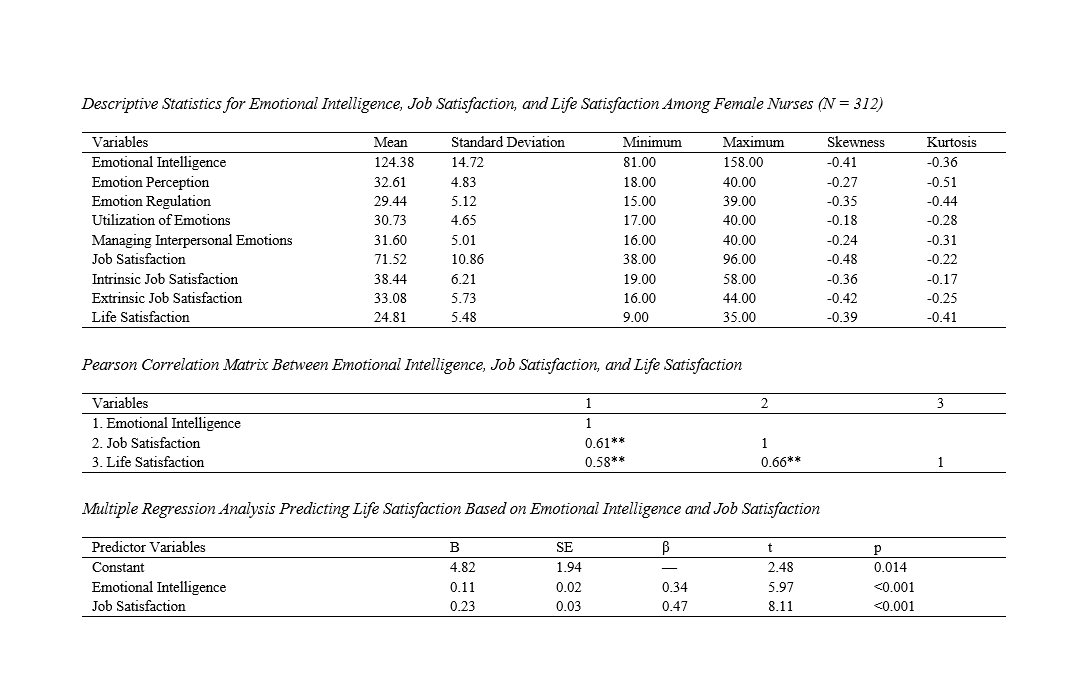
Findings: The results revealed significant positive correlations among emotional intelligence, job satisfaction, and life satisfaction. Emotional intelligence showed a significant positive relationship with job satisfaction (r = 0.61, p < 0.01) and life satisfaction (r = 0.58, p < 0.01). Additionally, job satisfaction was positively associated with life satisfaction (r = 0.66, p < 0.01). The findings of multiple regression analysis demonstrated that emotional intelligence and job satisfaction jointly predicted life satisfaction among female nurses. The regression model was statistically significant (F = 174.68, p < 0.001) and explained 53% of the variance in life satisfaction. Job satisfaction emerged as the stronger predictor (β = 0.47, p < 0.001), while emotional intelligence also significantly predicted life satisfaction (β = 0.34, p < 0.001).
Conclusion: The results suggest that healthcare organizations should implement emotional intelligence training programs and occupational support interventions to improve nurses’ mental health, professional functioning, and quality of life.
Downloads
References
Ali, A. (2025). Emotional Intelligence Nexus With Job Stress, and Burnout in Khyber Pakhtunkhwa Public Sector: Mediated Self-Efficacy. CRSSS, 3(1), 2432-2444. https://doi.org/10.59075/rhrr4r89
Dorta-Afonso, D., Cuéllar-Molina, D., Rodríguez-Robaina, C., & De Saá-Pérez, P. (2025). Servant leadership and HPWS for work-life balance and job satisfaction in the hotel industry: perspectives from conservation of resources theory. Journal of Hospitality and Tourism Insights, 8(5), 2011-2030. https://doi.org/10.1108/JHTI-06-2024-0631
Galanis, P., Katsiroumpa, A., Moisoglou, I., Kalogeropoulou, M., Gallos, P., & Vraka, I. (2024). Emotional Intelligence Protects Nurses Against Quiet Quitting, Turnover Intention, and Job Burnout. Aims Public Health, 11(2), 601. https://doi.org/10.3934/publichealth.2024030
García del Castillo-López, Á., & Pérez Domínguez, M. (2024). Employees’ emotional intelligence and job satisfaction: The mediating role of work climate and job stress. Administrative Sciences, 14(9), 205.
Gkliati, A., Saiti, A., Chletsos, M., & Bechlioulis, A. P. (2025). The Relationship of Minimum Wage on Employees’ Well–being, Job Satisfaction and Work–life Balance. International Journal of Organizational Analysis. https://doi.org/10.1108/ijoa-05-2024-4520
Hashemi, Z., Eyni, S., & Yavari, A. (2023). The Relationship Between Personality Traits and Life Satisfaction in the Elderly: The Mediating Role of Cultural Intelligence. Aging Psychology, 9(2), 119-103. https://doi.org/10.22126/jap.2023.9011.1694
Hasselbring, J. (2025). Teacher Emotional Intelligence and Job Satisfaction Trevecca Nazarene University].
Hulda, G., & Zhu, X. (2023). The Effects of Emotional Intelligence on Teachers’ Job Satisfaction: A Scoping Review. https://doi.org/10.20944/preprints202306.0533.v1
Ji, Y., & Han, J.-H. (2023). The Effects of Job Satisfaction on the Life Satisfaction of Individuals With Disabilities. The Institute of Management and Economy Research, 14(1), 427-437. https://doi.org/10.32599/apjb.14.1.202303.427
Kesselmayer, R. F., Mainella, A. M. K., Smedema, S. M., & Villanueva, P. C. (2025). The Mediating Effects of Disability Impact, Job Satisfaction, and Social Support in the Relationship Between Core Self-Evaluations and Life Satisfaction in Employed People With Disabilities. Journal of Applied Rehabilitation Counseling, 56(1), 42-56. https://doi.org/10.1891/jarc-2024-0024
Lai, Y., Gao, G., & Du, B. (2024). The Mediating Role of Perceived Emotional Intelligence: Examining the Impact of Affective Job Satisfaction on Organizational Identification Among Chinese Technological Workers. Frontiers in psychology, 15. https://doi.org/10.3389/fpsyg.2024.1285853
Lee, C. C., Yeh, W. C., Yu, Z., & Lin, X. C. (2023). The relationships between leader emotional intelligence, transformational leadership, and transactional leadership and job performance: A mediator model of trust. Heliyon, 9(8). https://doi.org/10.1016/j.heliyon.2023.e18007
Mohammadi, J., Nabiamjad, R., & Amiri, S. (2023). Evaluation of emotional intelligence and its relationship with job stress and the symptoms of post-traumatic stress disorder among Shiraz pre-hospital emergency technicians in 2020. International Archives of Health Sciences, 10(2), 84-90. https://iahsj.kaums.ac.ir/article_176367.html
Nik Akhtar, E. (2023). The Impact of Emotional Intelligence and Job Involvement on Job Performance of Employees at the Handicrafts and Cultural Heritage Organization of Bandar Abbas. 9th International Conference on New Perspectives in Management, Accounting, and Entrepreneurship, Tehran.
Othman, M. I., Khalifeh, A., Oweidat, I., & Nashwan, A. J. (2024). The relationship between emotional intelligence, job satisfaction, and organizational commitment among first‐line nurse managers in Qatar. Journal of nursing management, 2024(1), 5114659. https://doi.org/10.1155/2024/5114659
Refat, E., & Hassanpour, M. (2026). The Impact of Emotional Intelligence on Job Stress with Regard to the Mediating Role of Spirituality in the Workplace (Case Study: Persian Gulf Petrochemical Industries Company). The 11th National Conference on Interdisciplinary Research in Engineering Sciences and Management, Tehran.
Seo, K. B. (2023). The Relationship Between Job Values and College Life Satisfaction Among MZ Generation: Focusing on the Mediating Role of Career Planning. Korean Association for Learner-Centered Curriculum and Instruction, 23(13), 491-507. https://doi.org/10.22251/jlcci.2023.23.13.491
Setio, S. (2024). The Influence of Emotional Intelligence, Job Satisfaction, on Employee Performance With the Mediating Variable of Work Motivation. The International Journal Of Business & Management. https://doi.org/10.24940/theijbm/2023/v11/i10/bm2310-022
Winata, L. R. W. (2024). The Influence of Organizational Culture, Situational Leadership and Emotional Intelligence on Organizational Commitment Through Job Satisfaction at PDAM Tirta Ardhia Rinjani, Central Lombok Regency. Journal of Economics Finance and Management Studies, 07(05). https://doi.org/10.47191/jefms/v7-i5-17
Wonda, T. A. (2024). Does emotional intelligence have a contribution to employee performanc e enhancement? Empirical evidence from the public sectors. Cogent Business & Management, 11(1), 2415525. https://doi.org/10.1080/23311975.2024.2415525
Yusuf, M., Moein, A., & Zami, A. (2023). The Effect of Career Development and Emotional Intelligence on Organizational Citizenship Behavior Mediated by Job Satisfaction in Employees of Drinking Water Companies in Lingga District. International Journal of Social Science Education Communication and Economics (Sinomics Journal), 2(3), 481-496. https://doi.org/10.54443/sj.v2i3.156
Downloads
Additional Files
Publication Timeline
- Submitted
- Revised
- Accepted