Comparison of the Effectiveness of Intensive Short-Term Dynamic Psychotherapy (ISTDP) and Transference-Focused Psychotherapy (TFP) on Impulsivity and Cognitive Emotion Regulation in Patients with Borderline Personality Disorder
DOI:
https://doi.org/10.61838/Keywords:
Borderline Personality Disorder, impulsivity, cognitive emotion regulation, Intensive Short-Term Dynamic Psychotherapy, Transference-Focused Psychotherapy, psychodynamic psychotherapyAbstract
Objective: The present study aimed to compare the effectiveness of Intensive Short-Term Dynamic Psychotherapy (ISTDP) and Transference-Focused Psychotherapy (TFP) on impulsivity and cognitive emotion regulation in patients diagnosed with Borderline Personality Disorder.
Methods and Materials: This study employed a quasi-experimental design with a pretest–posttest control group and a three-month follow-up phase. The statistical population consisted of female patients diagnosed with Borderline Personality Disorder who were referred to psychiatric and psychological clinics in District 3 of Tehran during the first quarter of 2026. Forty-five participants were selected using purposive sampling and randomly assigned into three groups, including ISTDP, TFP, and a control group. The research instruments included the Cognitive Emotion Regulation Questionnaire (CERQ) and the Barratt Impulsiveness Scale (BIS-11), which were administered at the pretest, posttest, and follow-up stages. The TFP intervention was implemented in twelve weekly 60-minute sessions, whereas the ISTDP intervention was conducted in ten weekly 60-minute sessions. Data were analyzed using repeated-measures multivariate analysis of variance in IBM SPSS Statistics Version 26.
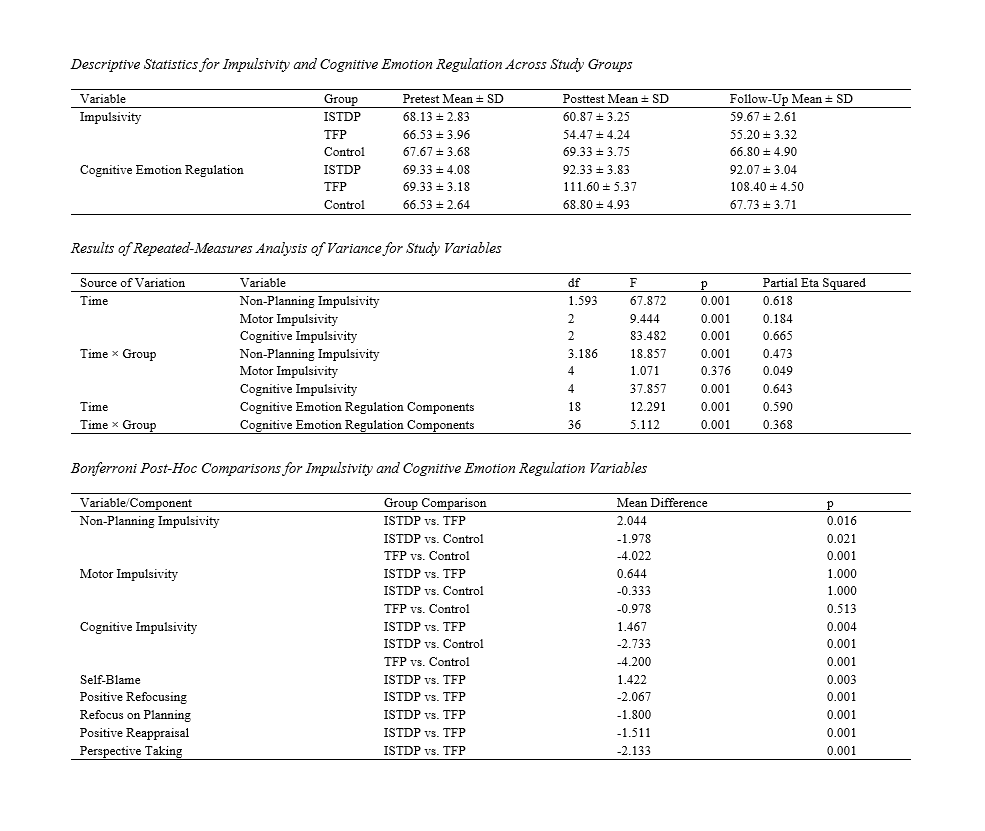
Findings: The findings demonstrated that both ISTDP and TFP significantly reduced impulsivity and improved cognitive emotion regulation compared to the control group (p < 0.001). Significant interaction effects between time and group membership were observed for non-planning impulsivity and cognitive impulsivity, while no significant interaction effect was found for motor impulsivity. Moreover, significant improvements were observed in most components of cognitive emotion regulation, including self-blame, rumination, positive refocusing, planning-focused refocusing, positive reappraisal, and perspective taking. Bonferroni post-hoc comparisons indicated that TFP was more effective than ISTDP in improving adaptive cognitive emotion regulation strategies and reducing cognitive dimensions of impulsivity. The treatment effects remained relatively stable during the three-month follow-up period.
Conclusion: The findings suggest that both Intensive Short-Term Dynamic Psychotherapy and Transference-Focused Psychotherapy are effective interventions for reducing impulsivity and improving cognitive emotion regulation in patients with Borderline Personality Disorder. However, TFP demonstrated superior effectiveness in enhancing reflective and cognitive aspects of emotional regulation. These results highlight the importance of psychodynamic interventions that focus on emotional processing, personality organization, and reflective functioning in the treatment of Borderline Personality Disorder.
Downloads
References
Abolpour, E., Yousefi, T., Kelidari, F., Kazemi Nafchi, R., & Firouzi, F. (2024). The effectiveness of acceptance and commitment therapy and intensive short-term dynamic psychotherapy on personality organization and emotion regulation in people with tension-type headache. Family and Health, 14(2), 118-131.
Ahmadvand Shahverdi, Z., Dehghani, M., Ashouri, A., Manouchehri, M., & Mohebi, N. (2024). Effectiveness of intensive short-term dynamic psychotherapy for tension-type headache (TTH): A randomized controlled trial of effects on emotion regulation, anger, anxiety, and TTH symptom severity. Acta Psychologica, 244, 104176.
Alfieri, M., Leucci, A. C., Bortolotti, B., Gibiino, L., & Menchetti, M. (2025). Dissociation and dysfunctional personality traits in patients with borderline personality disorder: A study based on DSM-5 alternative model. The European Journal of Psychiatry, 39(1), 100283.
Bateman, A., & Fonagy, P. (2016). Mentalization-based treatment for personality disorders: A practical guide. Oxford University Press. https://www.humanitas.lt/uploads/Products/product_246234/9780199680375.pdf
Cavicchioli, M., & Maffei, C. (2020). Rejection sensitivity in borderline personality disorder and the cognitive-affective personality system: A meta-analytic review. Personality Disorders: Theory, Research, and Treatment, 11(1), 1. https://psycnet.apa.org/buy/2019-51300-001
Clarkin, J., McMahon, K., & Sowislo, J. (2023). Transference focused psychotherapy: A transdiagnostic treatment for personality pathology. In Encyclopedia of mental health (3rd ed., pp. 482-491).
Diamond, D., Yeomans, F., & Keefe, J. R. (2021). Transference-focused psychotherapy for pathological narcissism and narcissistic personality disorder (TFP-N). Psychodynamic Psychiatry, 49(2), 244-272. https://doi.org/10.1521/pdps.2021.49.2.244
Diamond, G. M. (2024). The role of guilt in borderline personality disorder treatment: Implications for transference-focused psychotherapy. Clinical psychology review, 45(6), 123-135. https://doi.org/10.1016/j.cpr.2024.04.001
Ditrich, I., Philipsen, A., & Matthies, S. (2021). Borderline personality disorder (BPD) and attention deficit hyperactivity disorder (ADHD) revisited: A review-update on common grounds and subtle distinctions. Borderline personality disorder and emotion dysregulation, 8, 1-12.
Fakhraei Nejad, S., Bahrainian, S. A., Shahabizadeh, F., Mohseni, M., & Ghanifar, H. (2023). Determining the effectiveness of transference-focused psychotherapy on emotion regulation in patients with borderline personality disorder. Journal of Disability Studies, 13, 56-56.
Fathi, F., Vaziri, S., Pourasghar, M., & Nasri, M. (2023). Comparing the effectiveness of transference-focused analytic psychotherapy and acceptance and commitment therapy on neuroticism and impulsivity in patients with borderline personality disorder. Journal of Mazandaran University of Medical Sciences, 33(222), 109-123.
Gabbard, G. O., Gunderson, J. G., & Holmes, J. (2023). Transference-focused psychotherapy for borderline personality disorder. American Journal of Psychiatry, 180(1), 17-25. https://doi.org/10.1176/appi.ajp.2022.21060728
Gottlich, M., Westermair, A. L., Beyer, F., Bussmann, M. L., Schweiger, U., & Kramer, U. M. (2020). Neural basis of shame and guilt experience in women with borderline personality disorder. European Archives of Psychiatry and Clinical Neuroscience, 270(8), 979-992.
Khouryanian, M., Bakhshipour Roodsari, A., Mahmoudaliloo, M., & Hashemi, T. (2018). The effectiveness of transference-focused psychotherapy on reflective function and reduction of symptoms in patients with borderline personality disorder. Clinical Psychology, 10(4), 45-58.
Kleinknecht, R., Johnson, T., & Goldstein, M. (2023). Attachment patterns in borderline personality disorder and the efficacy of short-term dynamic psychotherapy. Psychodynamic Psychiatry, 51(3), 301-315. https://doi.org/10.1521/pdps.2023.51.3.301
Koenigsberg, H. W., Aronson, A., Delman, A., & Schwartz, K. A. (2023). Emotion regulation and impulsivity in borderline personality disorder: Treatment with TFP. Psychiatry research, 310(8), 35-44. https://doi.org/10.1016/j.psychres.2023.06.001
Linehan, M. M. (2024). DBT skills training manual (2nd ed.). Guilford Press.
Liu, R. J., Wang, S., Zhang, H., & Zhang, J. (2024). Cognitive emotion regulation strategies and their association with borderline personality disorder. Personality Disorders: Theory, Research, and Treatment, 15(2), 127-139. https://doi.org/10.1037/per0000547
Mahboudi, K., Mohammadi, N., Rahimi, C., & Sarafraz, M. R. (2022). The effectiveness of intensive short-term dynamic psychotherapy on self-esteem, emotion regulation, and defense mechanisms in men with social anxiety disorder. Psychological Science, 21(111), 461-474. https://doi.org/10.52547/JPS.21.111.461
Mahmoudaliloo, Hashemi, N., & Karimpour Vazifeh, K. (2018). The role of impulsivity, reward sensitivity, and anhedonia in differentiating individuals with borderline personality disorder symptoms from normal individuals. Iranian Journal of Psychiatry and Clinical Psychology, 24(2), 136-147.
Miller, A. L., Barlow, D. H., Reetz, D. R., & Bastian, L. D. (2023). Emotion regulation and borderline personality disorder: The role of cognitive biases. Journal of abnormal psychology, 132(3), 250-263. https://doi.org/10.1037/abn0000796
Otto, M. W., Sorrell, J. T., Bender, D. S., & Lieb, K. (2024). Cognitive-behavioral approaches in transference-focused psychotherapy for borderline personality disorder. Behavior therapy, 45(3), 89-101. https://doi.org/10.1016/j.beth.2023.11.001
Rossberg, J. I., Larsson, G., & Hummelen, B. (2024). Impulsivity and emotional dysregulation in borderline personality disorder: Current research and clinical interventions. European Psychiatry, 69, 80-90. https://doi.org/10.1016/j.eurpsy.2024.08.001
Sam, M., Pirkhaefi, A., & Asgharnezhad Farid, A. (2025). The role of behavioral activation and inhibition systems (BIS/BAS) in impulsive behaviors with the mediating role of difficulty in emotion regulation among female vocational adolescents with borderline personality disorder. Psychological Science, 24(145), 221-237.
Shapiro, A., Marx, L., & Brown, D. (2024). The role of intensive short-term dynamic psychotherapy in treating emotion dysregulation and impulsivity in borderline personality disorder. Psychiatric Services, 75(2), 228-234. https://doi.org/10.1176/appi.ps.2023.20210398
Skodol, A. E. (2023). The role of impulsivity in borderline personality disorder. Personality Disorders: Theory, Research, and Treatment, 14(4), 1-11. https://doi.org/10.1037/per0000545
Thoma, N. C., & Abbass, A. (2022). Intensive short-term dynamic psychotherapy (ISTDP) offers unique procedures for acceptance of emotion and may contribute to the process-based therapy movement. Journal of Contextual Behavioral Science, 25, 106-114.
Downloads
Additional Files
Publication Timeline
- Submitted
- Revised
- Accepted