The Relationship Between Cybervictimization and Depression Among Women: The Mediating Roles of Rumination, Self-Esteem, and Social Support
DOI:
https://doi.org/10.61838/kman.pwj.5441Keywords:
Cybervictimization, Depression, Rumination, Self-Esteem, Social Support, WomenAbstract
Objective: This study aimed to examine the relationship between cybervictimization and depression among women and to investigate the mediating roles of rumination, self-esteem, and perceived social support in explaining this association.
Methods and Materials: This cross-sectional correlational study was conducted among 612 adult women residing in Canada during 2025–2026. Participants were recruited through online platforms and community networks using voluntary participation procedures. Data were collected using the Cyber Victimization Scale, Beck Depression Inventory-II, Ruminative Responses Scale, Rosenberg Self-Esteem Scale, and Multidimensional Scale of Perceived Social Support. Descriptive statistics and Pearson correlation analyses were performed using SPSS version 29. Structural equation modeling was conducted using AMOS version 29 to test the hypothesized mediation model. Model fit was evaluated using χ²/df, CFI, TLI, GFI, AGFI, RMSEA, and SRMR indices. Indirect effects were examined through bootstrap analysis with 5,000 resamples and 95% confidence intervals.
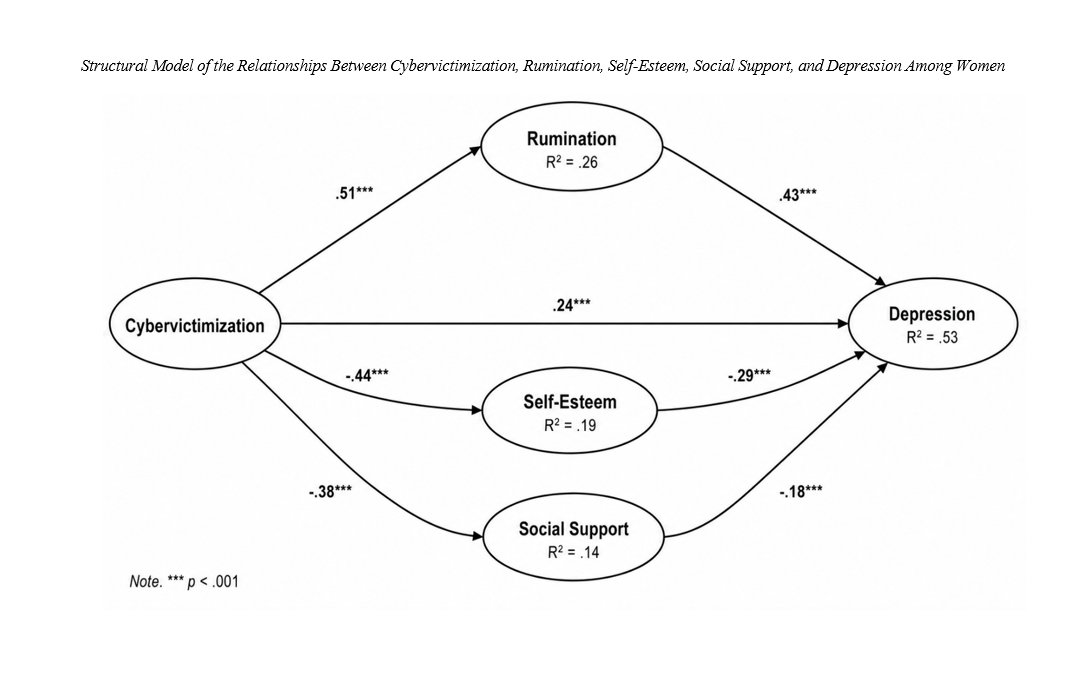
Findings: Cybervictimization demonstrated a significant positive association with depression (r = .54, p < .001) and rumination (r = .49, p < .001), while showing significant negative associations with self-esteem (r = −.46, p < .001) and social support (r = −.41, p < .001). The structural model exhibited excellent fit to the data (χ²/df = 2.41, CFI = .957, TLI = .951, GFI = .931, AGFI = .914, RMSEA = .048, SRMR = .041). Cybervictimization significantly predicted depression directly (β = .24, p < .001) and indirectly through rumination, self-esteem, and social support. Rumination emerged as the strongest mediator (indirect effect = .219, 95% CI [.167, .278]), followed by self-esteem (indirect effect = .128, 95% CI [.087, .176]) and social support (indirect effect = .068, 95% CI [.039, .103]). The total indirect effect was significant (β = .415, 95% CI [.351, .489]), indicating partial mediation.
Conclusion: The findings demonstrate that cybervictimization is a significant predictor of depressive symptoms among women and that this relationship operates through multiple psychological pathways. Rumination, self-esteem, and social support each contribute significantly to explaining how online victimization affects mental health, with rumination representing the most influential mechanism. Interventions targeting maladaptive cognitive processing, self-worth, and interpersonal support may help reduce the psychological burden associated with cybervictimization and improve mental health outcomes among women.
Downloads
References
Allaert, J., Bruecker, M. D., Raes, F., Raedt, R. D., Nagy, L. M., & Vanderhasselt, M. A. (2025). Validation of the Dutch Self-Critical Rumination Scale (SCRS-NL). European Journal of Psychological Assessment. https://doi.org/10.1027/1015-5759/a000889
Lee, J., Kim, J., & Lee, J.-E. (2025). Cybervictimization and Eating Disorders in University Sample in Singapore: A Moderated Mediation Model of Deviant Peer Association and Self-Esteem. BMC public health, 25(1). https://doi.org/10.1186/s12889-025-24493-3
Liu, Y., Feng, Q., & Guo, K. (2023). Physical Activity and Depression of Chinese College Students: Chain Mediating Role of Rumination and Anxiety. Frontiers in psychology, 14. https://doi.org/10.3389/fpsyg.2023.1190836
Lu, Y., Dang, L., & Yuan, T. (2025). The Longitudinal Influence of Cyberbullying Victimization on Depression, Self-Esteem and Academic Burnout Among Chinese Adolescents: Mindfulness as a Mediator. Frontiers in Psychiatry, 16. https://doi.org/10.3389/fpsyt.2025.1607473
Lu, Y., Gu, J., Xie, B., & Zhou, W. (2025). Transformation From ‘Suffering’ to ‘Perpetrating’ of Adolescent Bullying Behaviour: The Mediating Effect of Angry Rumination and the Moderating Effect of Sports Behaviour. Asian Journal of Social Psychology, 28(3). https://doi.org/10.1111/ajsp.70046
Nesi, J., Dredge, R., Maheux, A. J., Roberts, S. R., Fox, K. A., & Choukas‐Bradley, S. (2023). Peer Experiences via Social Media. 182-195. https://doi.org/10.1016/b978-0-12-818872-9.00046-7
Nesin, S. M., Sharma, K. R., Burghate, K. N., & Anthony, M. (2025). Neurobiology of Emotional Regulation in Cyberbullying Victims. Frontiers in psychology, 16. https://doi.org/10.3389/fpsyg.2025.1473807
Qin, Q., Yang, G., Li, Y., Wu, W., Wang, J., Chen, Z., Kong, X., Zhang, W., & Zou, H. (2024). The Relationship Between Major Life Events and Non-Suicidal Self-Injury Among College Students: The Effect of Rumination and Body Image. Frontiers in Public Health, 11. https://doi.org/10.3389/fpubh.2023.1308186
Quintana‐Orts, C., Mérida‐López, S., Rey, L., Chamizo‐Nieto, M. T., & Extremera, N. (2023). Understanding the Role of Emotion Regulation Strategies in Cybervictimization and Cyberaggression Over Time: It Is Basically Your Fault! Cyberpsychology Journal of Psychosocial Research on Cyberspace, 17(2). https://doi.org/10.5817/cp2023-2-1
Schunk, F., Zeh, F., & Trommsdorff, G. (2022). Cybervictimization and Well-Being Among Adolescents During the COVID-19 Pandemic: The Mediating Roles of Emotional Self-Efficacy and Emotion Regulation. Computers in human Behavior, 126, 107035. https://doi.org/10.1016/j.chb.2021.107035
Siah, P. C., Tee, X. Y., Tan, J. T. A., Tan, C. S., Lokithasan, K., Low, S. K., & Yap, C. C. (2022). Cybervictimization and Depression Among Adolescents: Coping Strategies as Mediators. International journal of environmental research and public health, 19(7), 3903. https://doi.org/10.3390/ijerph19073903
Sparks, B., Zidenberg, A. M., & Olver, M. E. (2023). One Is the Loneliest Number: Involuntary Celibacy (Incel), Mental Health, and Loneliness. Current Psychology, 43(1), 392-406. https://doi.org/10.1007/s12144-023-04275-z
Tariq, A., Gray, E., Gregory, A. M., & Chan, S. W. Y. (2025). Emotional Vulnerability in Adolescents (EVA) Study: Identifying Potential Biopsychosocial Markers for Adolescent Depressive Symptoms and Well‐Being. Mental Health Science, 3(2). https://doi.org/10.1002/mhs2.70010
Velez, B. L., Kim, S. Y., Cox, R. W., Manosalvas, K., & Daheim, J. (2023). A Test of the Integrative Mediation Model of Minority Stress With Sexual Minority Adults. Psychology of Sexual Orientation and Gender Diversity, 10(1), 56-69. https://doi.org/10.1037/sgd0000498
Wang, Y., Chen, Y., Lu, C., Kwan, A. T., McIntyre, R. S., Yang, F., & Cao, B. (2024). The Psychological Factors Mediating/Moderating the Association Between Body‐image Disturbance and Depression: A Systematic Review. PsyCh Journal, 13(4), 527-540. https://doi.org/10.1002/pchj.754
Xiao, X., Yu-xi, Z., & Zhou, S. (2023). Effects of Childhood Trauma on Adolescent Mental Health. Lecture Notes in Education Psychology and Public Media, 13(1), 207-215. https://doi.org/10.54254/2753-7048/13/20230895
Xu, W., & Zheng, S. (2022). Childhood Emotional Abuse and Cyberbullying Perpetration Among Chinese University Students: The Chain Mediating Effects of Self-Esteem and Problematic Social Media Use. Frontiers in psychology, 13. https://doi.org/10.3389/fpsyg.2022.1036128
Yang, X., Liu, Q., Gao, L., Wang, G., & Liu, T. (2024). Linking Self-Esteem to Problematic Mobile Phone Use: A Moderated Mediation Model of Fear of Missing Out and Ruminative Subtypes. Behavioral Sciences, 14(8), 683. https://doi.org/10.3390/bs14080683
Yin, X., Li, Y., Ye, Y., Wang, Y., Zha, Y., Xu, L., Qin, X., Wei, S., & Feng, X. (2024). Self-Esteem and Depressive Symptoms in Diagnosed Psychiatric Patients: A Longitudinal Mediation Model. https://doi.org/10.21203/rs.3.rs-4786121/v1
Zelaya, D. G., & DeBlaere, C. (2024). The Minority Stress Psychological Mediation Framework and Mental Health of Latinx Sexual Minority Men: Como Se Mete Debajo De La Piel (How It Gets Under the Skin). Psychology of Sexual Orientation and Gender Diversity. https://doi.org/10.1037/sgd0000725
Zhao, S., Ren, R., & Chen, W. (2023). A Mediated Moderation Model of Negative Life Events, Self-Esteem, Rumination and Parental Divorce on Depression Among Chinese Juvenile Delinquents. Scientific reports, 13(1). https://doi.org/10.1038/s41598-023-28626-9
Downloads
Additional Files
Publication Timeline
- Submitted
- Revised
- Accepted