CatBoost-Based Prediction of Marital Satisfaction in Women From Attachment Security, Emotional Regulation, Relationship Commitment, and Communication Patterns
DOI:
https://doi.org/10.61838/kman.pwj.5459Keywords:
Psychological Flourishing, Women, XGBoost, Machine Learning, Resilience, Self-Compassion, Emotional Intelligence, Social SupportAbstract
Objective: The present study aimed to develop and evaluate a CatBoost-based machine learning model for predicting marital satisfaction among married women using attachment security, emotional regulation, relationship commitment, and communication patterns as predictor variables.
Methods and Materials: This cross-sectional predictive study was conducted among 742 married women residing in Taiwan. Participants were recruited through community organizations, social networks, and online survey platforms. Data were collected using the Revised Dyadic Adjustment Scale (RDAS) to assess marital satisfaction, the Experiences in Close Relationships-Revised Questionnaire (ECR-R) to measure attachment security, the Emotion Regulation Questionnaire (ERQ) to evaluate emotional regulation, the Commitment Inventory to assess relationship commitment, and the Communication Patterns Questionnaire-Short Form (CPQ-SF) to examine communication patterns. Following data preprocessing and screening procedures, the dataset was divided into training (80%) and testing (20%) subsets. A CatBoost regression algorithm was developed using optimized hyperparameters identified through five-fold cross-validation. Model performance was evaluated using the coefficient of determination (R²), Root Mean Square Error (RMSE), Mean Absolute Error (MAE), and Mean Absolute Percentage Error (MAPE). Feature importance and SHapley Additive exPlanations (SHAP) analyses were performed to determine the relative contribution and interpretability of each predictor variable.
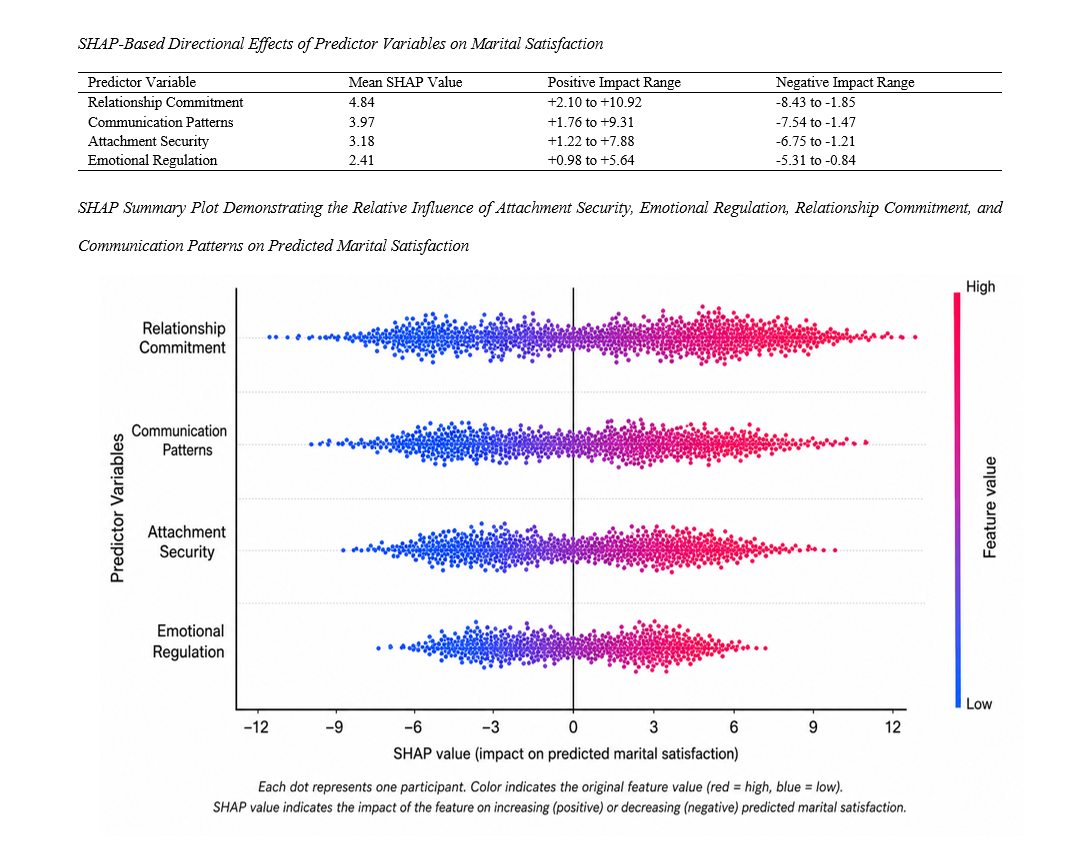
Findings: The CatBoost model demonstrated excellent predictive performance, explaining 84.7% of the variance in marital satisfaction within the testing dataset (R² = 0.847). Relationship commitment emerged as the most influential predictor (35.84%), followed by communication patterns (28.63%), attachment security (21.57%), and emotional regulation (13.96%). Correlation analyses revealed significant positive associations between marital satisfaction and attachment security (r = .68, p < .01), emotional regulation (r = .59, p < .01), relationship commitment (r = .76, p < .01), and communication patterns (r = .72, p < .01). SHAP analyses further indicated that higher levels of all predictor variables contributed positively to marital satisfaction predictions, while lower levels reduced predicted outcomes.
Conclusion: The findings demonstrate that marital satisfaction among women can be predicted with high accuracy using a CatBoost machine learning model. Relationship commitment, communication patterns, attachment security, and emotional regulation represent critical determinants of marital satisfaction, with commitment emerging as the strongest predictor. The study highlights the value of integrating relationship psychology with advanced machine learning techniques to improve understanding, prediction, and intervention planning for marital well-being.
Downloads
References
Adhikari, A., & Shilpa, K. S. (2025). Understanding Romantic Relationships Using Strength and Strain Model in the Context of COVID-19. Couple and Family Psychology Research and Practice, 14(4), 309-327. https://doi.org/10.1037/cfp0000267
Araghchi, E., & Saadati, N. (2023). Predicting the Desire for Remarriage Based on Family Relationships, Attachment Styles, and Personality Traits Among Married Men. KMAN Counseling and Psychology Nexus, 1(1), 34-42. https://doi.org/10.61838/kman.psychnexus.1.1.4
Castillo‐López, Á. G. d., Berenguer-Soler, M., Pineda, D., & José, A. G. d. C. (2024). Emotional Flooding in Couple Relationships: Psychosocial Aspects and Regulatory Strategies. https://doi.org/10.5772/intechopen.1006183
Chursina, A. (2023). The Impact of Romantic Attachment Styles on Jealousy in Young Adults. Psychology in Russia State of Art, 16(3), 222-232. https://doi.org/10.11621/pir.2023.0315
Fernandes, M. I. A., Sousa, C., Conde, A. R., Silva, F. F. d., & Ferreira, M. J. (2023). Exploring the Relationship Between Capacity to Love and Well-Being: A Comparative Study of Emerging Adults and Middle-Aged Adults. Sexuality & Culture, 28(4), 1424-1445. https://doi.org/10.1007/s12119-023-10184-x
G., M., & R., D. R. (2024). Exploring the Relationship Between Attachment Styles and Loneliness Levels in Young Adults. International Journal for Multidisciplinary Research, 6(3). https://doi.org/10.36948/ijfmr.2024.v06i03.19869
Geravandi, A. H., Asgari, P., & Yousefi, Z. (2023). Effectiveness of Narrative Attachment-Based Therapy on Emotional Experience Towards Spouse and Family Executive Functioning Among Married Women. PWJ, 4(2), 17-23. https://doi.org/10.61838/kman.pwj.4.2.3
Hasim, M. J. M., Hashim, N. H., & Mustafa, H. (2023). Married Life: Measuring Adult Romantic Attachment and Satisfaction. Couple and Family Psychology Research and Practice, 12(3), 119-131. https://doi.org/10.1037/cfp0000188
Huda, F. F., & Lestari, F. D. (2024). Attachment Styles and Coping Mechanisms in Solomon &Amp; Gaenor and Cin(T)A: A Comparative Study. Suar Betang, 19(1), 85-101. https://doi.org/10.26499/surbet.v19i1.14808
Ibrahim, M., Palit, M., & Matthews, R. (2023). Intergenerational Attachment Styles, Emotional Regulation and Relational Outcomes in Couples Therapy. https://doi.org/10.5772/intechopen.108492
Kusumawardhani, S. J., Mayangsari, A., Rustyawati, R., & Reswara, I. P. (2024). Staying in Marriage Is Not Enough: Influence of Marital Commitment and Adult Attachment Style on Marital Flourishing. Psympathic Jurnal Ilmiah Psikologi, 11(1), 99-106. https://doi.org/10.15575/psy.v11i1.33974
Muyang, R. E., Jamil, A. M., & Chan, S. L. (2023). Relationship Between Attachment Styles and Personal Resilience Among Malaysian Young Adults. International Journal of Academic Research in Business and Social Sciences, 13(5). https://doi.org/10.6007/ijarbss/v13-i5/17096
Ogwuche, C. H., Tyav-Tersoo, K. I., Onah, C., & Orafa, D. T. (2024). Marital Infidelity Among Married Couples: Roles of Emotional Intelligence and Narcissistic Personality Traits in Makurdi, Benue State. Journal of Innovation in Psychology Education and Didactics, 28(1), 27-26. https://doi.org/10.29081/jiped.2024.28.1.03
Okonkwo, K. (2024). The Role of Attachment Styles in Marital Stability: A Psychological Approach to Strengthening Relationships. American Journal of Psychology, 6(4), 35-50. https://doi.org/10.47672/ajp.2474
Ricafrente, G. R., Sumicad, R., Lirazan, M. E., & Gerzon, K. J. (2024). Correlations of Personality Traits and Romantic Relationship Satisfaction. Journal of Psychology and Behavior Studies, 4(1), 38-50. https://doi.org/10.32996/jpbs.2024.1.5
Šakotić-Kurbalija, J., Kurbalija, D., Trifunović, B., & Grabovac, B. (2022). Women's Attachment Style and Dyadic Adjustment: The Mediator Role of Perceived Efficacy in Solving Marital Conflicts. Drustvena Istrazivanja, 31(2), 301-320. https://doi.org/10.5559/di.31.2.06
Shahrier, M. A. (2025). Development and Validation of the Gift Reciprocation Anxiety Scale (GRAS) for Youths and Adults in Intimate Relationships. Heliyon, 11(2), e41956. https://doi.org/10.1016/j.heliyon.2025.e41956
Shrestha, P. S., Shaver, S. R., Perlman, T. T., & Walsham, W. (2023). Emotional Dimensions of Infidelity: An Analysis of Psychological and Emotional Factors Affecting Relationship Infidelity. Jurnal Sosial Sains Terapan Dan Riset (Sosateris), 11(2), 88-103. https://doi.org/10.35335/85rbw180
Tahrekhani, M., Roshandel, A., & Bagheri, M. (2025). Prediction Emotional Attachment Based on Relationship Maintenance Strategies and Psychological Hardiness Among Substance-Addicted Couples: A Cross-Sectional Study. https://doi.org/10.21203/rs.3.rs-6836675/v1
Uluyol, F. M., & Özen‐Çıplak, A. (2024). Dyadic Relationship of Adult Attachment Patterns and Interpersonal Schemas in Marital Adjustment: Actor–partner Effect Model. Family Relations, 73(3), 2152-2169. https://doi.org/10.1111/fare.13002
Wendołowska, A., Czyżowska, N., & Czyżowska, D. (2022). The Role of Attachment and Dyadic Coping in Shaping Relational Intimacy: Actor–Partner Interdependence Model. International journal of environmental research and public health, 19(23), 16211. https://doi.org/10.3390/ijerph192316211
Yousefpouri, M., Zomorodi, S., & Bazzāziān, S. (2024). Effectiveness of Acceptance and Commitment-Based Couples Therapy on Attitudes Towards Marital Infidelity and Emotional Regulation in Married Women. Aftj, 5(2), 103-111. https://doi.org/10.61838/kman.aftj.5.2.12
Downloads
Additional Files
Publication Timeline
- Submitted
- Revised
- Accepted