Random Forest Prediction of Maternal Burnout Based on Parenting Stress, Perfectionism, Emotional Dysregulation, and Family Functioning
DOI:
https://doi.org/10.61838/kman.pwj.5467Keywords:
Maternal Burnout, Parenting Stress, Perfectionism, Emotional Dysregulation, Family FunctioningAbstract
Objective: The present study aimed to predict maternal burnout among Malaysian mothers using a Random Forest machine learning model based on parenting stress, perfectionism, emotional dysregulation, and family functioning, and to determine the relative importance of these predictors in explaining maternal burnout risk.
Methods and Materials: This cross-sectional predictive study was conducted among 842 mothers residing in Malaysia who had at least one child under the age of 18 years. Participants were recruited through community organizations, parenting networks, educational institutions, and online platforms. Data were collected using the Parental Burnout Assessment (PBA), Parenting Stress Scale (PSS), Multidimensional Perfectionism Scale (MPS), Difficulties in Emotion Regulation Scale (DERS), and Family Assessment Device (FAD). Descriptive statistics and correlational analyses were initially performed. Subsequently, a Random Forest regression model was developed to predict maternal burnout. The dataset was divided into training (80%) and testing (20%) subsets. Hyperparameter tuning was performed using grid search and five-fold cross-validation. Model performance was evaluated using the coefficient of determination (R²), root mean square error (RMSE), mean absolute error (MAE), and mean squared error (MSE). Feature importance and SHAP analyses were conducted to identify the relative contribution of each predictor.
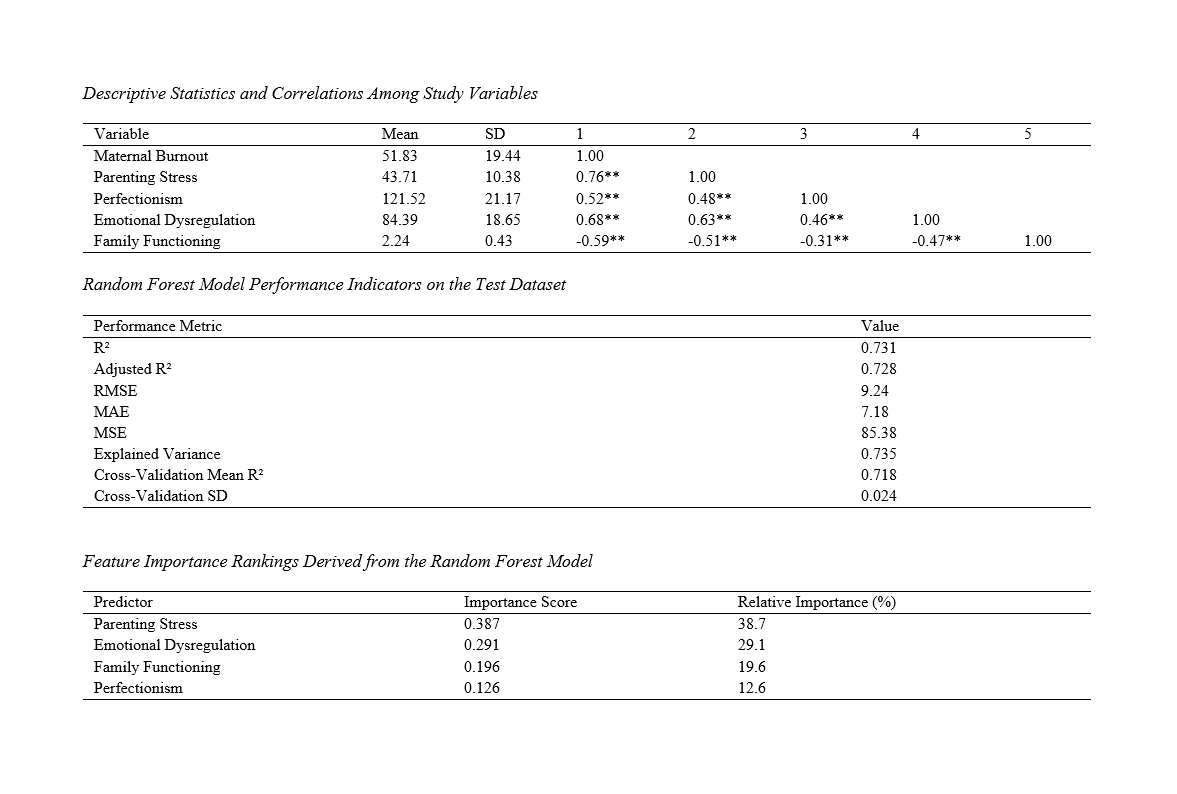
Findings: The Random Forest model demonstrated strong predictive performance, accounting for 73.1% of the variance in maternal burnout (R² = .731). Parenting stress emerged as the most influential predictor (38.7%), followed by emotional dysregulation (29.1%), family functioning (19.6%), and perfectionism (12.6%). Maternal burnout was positively associated with parenting stress (r = .76), emotional dysregulation (r = .68), and perfectionism (r = .52), while family functioning showed a significant negative association (r = −.59). Incremental model analyses indicated that each predictor contributed unique explanatory value, increasing predictive accuracy from R² = .579 to R² = .731. SHAP analyses further revealed nonlinear relationships and substantial interactions between parenting stress and emotional dysregulation.
Conclusion: The findings demonstrate that maternal burnout can be predicted with high accuracy using machine learning techniques and that parenting stress, emotional dysregulation, family functioning, and perfectionism are significant contributors to burnout risk. Parenting stress and emotional dysregulation emerged as the most influential determinants, highlighting the importance of psychological and family-based interventions aimed at reducing parenting burden, improving emotion regulation capacities, strengthening family functioning, and addressing maladaptive perfectionistic tendencies. The study supports the utility of Random Forest models for identifying mothers at elevated risk of burnout and informing targeted prevention strategies.
Downloads
References
Balogun, O., & Oyekola, A. (2024). Exploring the Prevalence, Risk, and Protective Factors of Parental Burnout Among Mothers in Ibadan Metropolis. Niu JSS, 10(1), 183-193. https://doi.org/10.58709/niujss.v10i1.1804
Bogdán, P. M., Varga, K., Tóth, L., Gróf, K., & Pakai, A. (2025). Parental Burnout: A Progressive Condition Potentially Compromising Family Well-Being—A Narrative Review. Healthcare, 13(13), 1603. https://doi.org/10.3390/healthcare13131603
Brandão, T., Diniz, E., Basto-Pereira, M., & Babore, A. (2024). Emotion Regulation and Parental Burnout: A Systematic Review and Meta-Analysis. Clinical Psychology Science and Practice, 31(1), 97-109. https://doi.org/10.1037/cps0000181
ÇAkmak, S., & Arıkan, G. (2024). From Burnout to Parental Burnout: How Does Caregiving Become a Burden? Psikiyatride Guncel Yaklasimlar - Current Approaches in Psychiatry, 16(1), 185-202. https://doi.org/10.18863/pgy.1267097
Carone, N., Tracchegiani, J., & Zagaria, A. (2025). Parental Burnout and Reflective Functioning in Regretful Parents: Associations With Childhood Maltreatment and Child Dysregulation. Journal of Social and Personal Relationships, 43(3), 911-937. https://doi.org/10.1177/02654075251391496
Çerkez, Y., & Sorakın, Y. (2023). Investigation of Burnout and Perfectionism Levels of Parents With Children Aged 0-18 During the Pandemic. Cyprus Turkish Journal of Psychiatry and Psychology, 5(4), 322. https://doi.org/10.35365/ctjpp.23.4.04
Chen, Y. W., Pan, L., Lu, F., Sun, D., Liao, C., & Na, M. (2025). Psychological Detachment in Chinese Higher Education: A Multitheoretical Model of Academic Stress, Cultural Pressure, and Coping Resources. Frontiers in psychology, 16. https://doi.org/10.3389/fpsyg.2025.1647184
Cheung, R. Y. M., & Vaydich, J. L. (2023). Depression and Anxiety Among Parents During the COVID-19 Pandemic: The Role of Cumulative Stress and Emotion Dysregulation. https://doi.org/10.21203/rs.3.rs-3373638/v1
Findling, Y., Itzhaki, M., & Barnoy, S. (2024). Parental Burnout—A Model of Risk Factors and Protective Resources Among Mothers of Children With/Without Special Needs. European Journal of Investigation in Health Psychology and Education, 14(11), 2883-2900. https://doi.org/10.3390/ejihpe14110189
Giordano, G., Caci, B., Alesi, M., Gentile, A., Burgio, S., & Polizzi, C. (2024). Personality Traits and Sociodemographic Variables’ Effects on Parental Burnout During the Second and Fourth COVID-19 Waves in Italian Parents. International journal of environmental research and public health, 21(11), 1520. https://doi.org/10.3390/ijerph21111520
Guo, Y., Xiao, X., Li, J., Pu, T., Yang, T., Zuo, H., Li, L., & Zhou, B. (2025). The Impact of Parenting Styles on Depression Among High-Risk Adolescents of Different Genders in Chinese Urban Samples: The Mediating Effects of Adverse Childhood Experiences and Learning Burnout. Frontiers in Psychiatry, 16. https://doi.org/10.3389/fpsyt.2025.1594584
Holly, L. E., Buchanan, M., & Bowling, A. (2024). Parental Burnout and Emotion Regulation in Context: Considerations for Science and Practice. Clinical Psychology Science and Practice, 31(1), 113-116. https://doi.org/10.1037/cps0000200
Kadosh‐Laor, T., Israeli‐Ran, L., Shalev, I., & Uzefovsky, F. (2023). Empathy and Parenthood: The Moderating Role of Maternal Trait Empathy on Parental Burnout. British Journal of Psychology, 114(3), 605-620. https://doi.org/10.1111/bjop.12640
Kira, I. A. (2025). The Dynamics of Mothers Burnout in Arab Countries. https://doi.org/10.21203/rs.3.rs-7423321/v1
Kpea, K. C. (2025). Sibling Rivalry in Dysfunctional Families and Its Toll on Maternal Mental Health. https://doi.org/10.21203/rs.3.rs-7511613/v1
Lee-Forsyth, S. H., Gabriel, J., Viechweg, N. D., Lee, M., Kim, S., Sowa, F., & Bainey, K. (2023). Postpartum Burnout Among Women of Childbearing Age: A Neglected Global Public Health Problem. International Journal of Multidisciplinary Research and Analysis, 06(09). https://doi.org/10.47191/ijmra/v6-i9-57
Mousavi, S. F., Dehshiri, G., Asghari, M., & Parastanpoor, M. (2025). Perfectionism and Burnout in Parents of Visually Impaired Offspring: The Mediating Role of Parenting Conflict and Resilient Coping. Journal of Visual Impairment & Blindness, 119(1), 47-60. https://doi.org/10.1177/0145482x251319329
Partington, L. C., Mashash, M., & Hastings, P. D. (2025). Children’s Problems Predicted Parents’ Mental Health via Parental Burnout During the COVID-19 Pandemic in a Sample of Predominantly White, Partnered Mothers. Developmental Psychology. https://doi.org/10.1037/dev0002076
Prino, L. E., Arace, A., Zonca, P., Agostini, P., & Scarzello, D. (2023). Preschool Emotional Problems in the Post-Pandemic Era Between Parental Risk and Protective Factors. Healthcare, 11(21), 2862. https://doi.org/10.3390/healthcare11212862
Ren, X., Cai, Y., Wang, J., & Chen, O. (2024). A Systematic Review of Parental Burnout and Related Factors Among Parents. BMC public health, 24(1). https://doi.org/10.1186/s12889-024-17829-y
Renati, R., Pfeiffer, S. I., & Bonfiglio, N. S. (2024). Predictors of Parental Stress in Families With Gifted Children: The Role of Cognitive and Emotional Challenges. Gifted Education International, 41(1), 112-136. https://doi.org/10.1177/02614294241300245
Sekułowicz, M., Kwiatkowski, P., Manor-Binyamini, I., Boroń-Krupińska, K., & Cieślik, B. (2022). The Effect of Personality, Disability, and Family Functioning on Burnout Among Mothers of Children With Autism: A Path Analysis. International journal of environmental research and public health, 19(3), 1187. https://doi.org/10.3390/ijerph19031187
Taştekin, E., Kaymaz, Ç., Işik‐Uslu, A. E., Yüksel‐Doğan, R., Bozkurt‐Yükçü, Ş., & Tok, A. İ. (2025). Coparenting and Mindful Parenting Partially Mediate the Relationship Between Mothers' Stress and Parental Burnout. Family Relations. https://doi.org/10.1111/fare.70027
Yakupova, V., & Suarez, A. (2023). Parental Burnout, Depression and Emotional Development of the Preschoolers. Frontiers in psychology, 14. https://doi.org/10.3389/fpsyg.2023.1207569
Zbrodska, I., Roskam, I., Dolynska, L., & Mikolajczak, M. (2022). Validation of the Ukrainian Version of the Parental Burnout Assessment. Frontiers in psychology, 13. https://doi.org/10.3389/fpsyg.2022.1059937
Zhao, G. (2026). Buffering Conflict-Burnout: The Context-Dependent Role of Perceived Social Support Among Chinese Preschool Parents. https://doi.org/10.21203/rs.3.rs-7881844/v1
Zuo, J. (2025). Emotion Regulation, Coping Strategies, and Burnout Among Chinese Competitive Athletes: A Mixed-Methods Study. BMC psychology, 13(1). https://doi.org/10.1186/s40359-025-03458-6
Downloads
Additional Files
Publication Timeline
- Submitted
- Revised
- Accepted