Development of a Predictive Model of Psychosocial Adjustment to Illness Based on Health-Promoting Lifestyle with the Mediating Role of Illness Perception in Female Patients with Systemic Lupus Erythematosus
DOI:
https://doi.org/10.61838/Keywords:
Illness perception, psychosocial adjustment, health-promoting lifestyle, systemic lupus erythematosus, female patientsAbstract
Objective: This study aimed to determine the mediating role of illness perception in the relationship between health-promoting lifestyle and psychosocial adjustment to illness among female patients with systemic lupus erythematosus.
Materials and Methods: The present study was a descriptive-correlational study using a structural equation modeling design. The statistical population included all female patients with systemic lupus erythematosus who referred to hospitals affiliated with Islamic Azad University in Tehran, including Bou-Ali, Farhikhtegan, and Amir-Al-Momenin hospitals, as well as the Lupus Association, during the first six months of 2025. Based on the inclusion criteria, 280 participants were selected through purposive sampling. Data were collected using the Psychosocial Adjustment to Illness Scale developed by Derogatis (1986), the Health-Promoting Lifestyle Profile developed by Walker (1990), and the Brief Illness Perception Questionnaire developed by Broadbent et al. (2006). Data were analyzed using regression analysis and structural equation modeling through SPSS and PLS software at a significance level of 0.05.
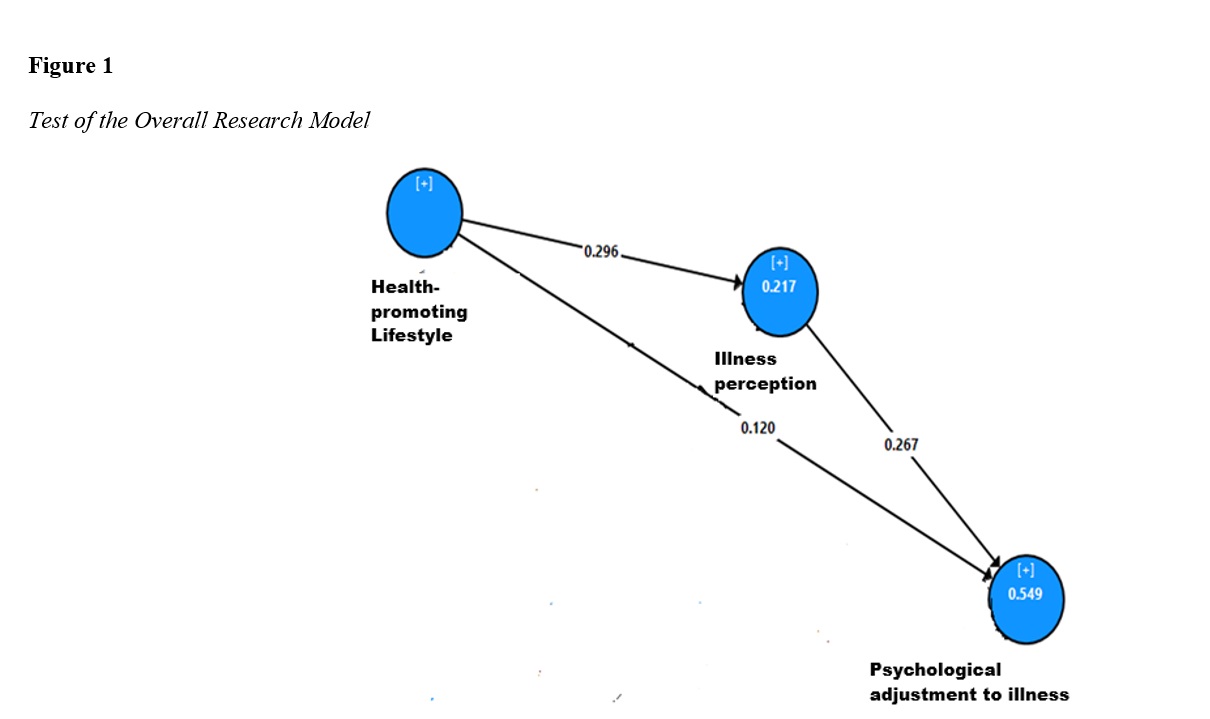
Findings: The inferential findings showed that health-promoting lifestyle had a significant relationship with psychosocial adjustment to illness in female patients with systemic lupus erythematosus. In addition, illness perception was significantly associated with psychosocial adjustment to illness. The results of structural equation modeling confirmed the mediating role of illness perception in the relationship between health-promoting lifestyle and psychosocial adjustment to illness. Accordingly, the indirect path from health-promoting lifestyle to psychosocial adjustment through illness perception was statistically significant, indicating that patients’ cognitive appraisal of their illness plays an important explanatory role in how health-related lifestyle behaviors affect psychosocial adaptation.
Conclusion: The findings highlight the importance of mediating cognitive processes in adaptation to chronic illness and indicate that promoting health-related behaviors alone may not be sufficient. Interventions for women with systemic lupus erythematosus should also focus on modifying patients’ illness perceptions and cognitive interpretations in order to improve psychosocial adjustment.
Downloads
References
Choi, Y., Kim, Y., & Kim, S. (2023). Epidemiology of systemic lupus erythematosus: A comprehensive review. Journal of autoimmunity, 75, 13-22.
Da Silva, P. H., Ferreira, R. D., & Rodrigues, P. S. (2024). Coping strategies and their effects on quality of life in systemic lupus erythematosus. Journal of Chronic Disease Management, 47(3), 150-158. https://doi.org/10.1002/jcdm.2024.03.004
Deng, M., Wen, M., Huebner, E., & Tian, L. (2024). Longitudinal bidirectional relations between psychological maltreatment by teachers and psychosocial adjustment during early adolescence. Social Science & Medicine, 362, 117475.
Fatima, I., Yaqoob, S., & Jamil, F. (2021). Relationship between loci of control and health-promoting behaviors in Pakistani women with polycystic ovary syndrome: Coping strategies as mediators. BMC Women's Health, 21, 356. https://doi.org/10.1186/s12905-021-01489-w
Goh, Y., Tan, L., Ng, R., & Lim, S. (2023). Epidemiological differences in lupus across ethnicities. Clinical Reviews in Allergy & Immunology, 55(4), 239-250.
Gomez, A., Rodriguez, M., & Perez, J. (2023). Illness perception and coping strategies in lupus patients: A longitudinal study. Psychology & Health, 38(1), 66-81. https://doi.org/10.1080/psychhealth.2023.0066
Hosseini, M., Shamsikhani, S., Jadidi, A., & Rafiei, F. (2025). The effects of Leventhal's self-regulation model-based educational intervention on stress, anxiety, and depression in women with multiple sclerosis: A randomized educational trial. Frontiers in Neurology, 16, 1521112. https://doi.org/10.3389/fneur.2025.1521112
Johnson, L. M., Kay, S. M., & Tayar, J. (2023). Stress and coping in patients with systemic lupus erythematosus: The role of family and social networks. Journal of psychosomatic research, 97, 142-149. https://doi.org/10.1016/j.jpsychores.2023.10.002
Johnson, R., Thomas, D., & White, A. (2024). Optimism and well-being in patients with chronic illnesses: The role of psychological resilience. International Journal of Behavioral Medicine, 31(2), 128-137. https://doi.org/10.1007/ijbm.2024.128
Kumar, S., Sharma, P., & Gupta, N. (2023). Impact of lifestyle modifications on psychological health in lupus patients. Journal of Clinical Rheumatology, 29(3), 230-237. https://doi.org/10.1056/jcr.2023.0128
Li, Q., Li, L., Dong, Y., & Cao, H. (2025). Thyroid hormones in systemic lupus erythematosus: The catalyst for disease progression? American Journal of the Medical Sciences, 14.
Lotfi-Tokaldany, M., Shahmansouri, N., Karimi, A., Sadeghian, S., Saadat, S., Abbasi, S. H., & Jalali, A. (2019). Association between illness perception and health-related quality of life in patients with preexisting premature coronary artery disease. Journal of psychosomatic research, 120, 118-123. https://doi.org/10.1016/j.jpsychores.2019.03.001
Mayo, C. (2023). Lupus: Symptoms and causes. Mayo Clinic. https://www.mayoclinic.org/diseases-conditions/lupus/symptoms-causes
Mazzolani, B. C., Smaira, F. I., Sieczkowska, S. M., Romero, M., Pasoto, S. G., de Sa Pinto, A. L., Lima, F. R., Benatti, F. B., Roschel, H., & Gualano, B. (2025). A randomized controlled trial of a lifestyle intervention on wellbeing in patients with systemic lupus erythematosus: Results from Living well with lupus. Lupus, 34(3), 394-423. https://doi.org/10.1177/09612033251394423
Padhy, M., & Valli, A. S. K. (2022). Illness perceptions and quality of life of diabetic patients. In. https://doi.org/10.4324/9781003360858-15
Park, S. H., Park, H., & Faith, M. (2022). Body weight perception and health-related behaviors among US adolescents: Mediating effects of body weight control behaviors. The Journal of School Nursing, 38(4), 397-409. https://doi.org/10.1177/10598405211003800
Soltanian, N., Rahimian Boogar, E., & Taleapasand, S. (2022). Comparing the effectiveness of acceptance and commitment therapy with a health-promoting lifestyle intervention on illness perception and adjustment to illness in type 2 diabetes. Psychological Achievements, 29(1), 139-160. https://doi.org/10.22055/psy.2021.36614.2669
Swaak, T. P., van Vollenhoven, R. F., & Jacobs, J. W. (2023). Social and psychological consequences of systemic lupus erythematosus. Clinical and Experimental Rheumatology, 41(1), 61-67. https://doi.org/10.5555/ceps.2023.01.009
Tselios, K., Gladman, D. D., Urowitz, M. B., & Costigan, D. A. (2023). The impact of systemic lupus erythematosus on health outcomes: A global perspective. Rheumatology, 62(7), 2045-2057.
Uzun, G., Abida, R., & Isenberg, D. (2024). Advances in systemic lupus erythematosus. Medicine, 52(12), 737-745.
Zhang, X., Li, Y., & Wang, Z. (2025). Psychological effects of stress management in lupus patients: A longitudinal study. Journal of psychosomatic research, 58(2), 140-147. https://doi.org/10.1016/j.jpsychores.2024.12.001
Zhou, J., Li, H., & Wang, L. (2024). Coping strategies and emotional well-being in lupus patients: An integrative review. Journal of Clinical Psychology in Medical Settings, 31(6), 460-472. https://doi.org/10.1007/s10880-024-09732-6
Downloads
Additional Files
Publication Timeline
- Submitted
- Revised
- Accepted