Predicting Body Dissatisfaction Among Young Women Using Random Forest Based on Social Media, Appearance, and Self-Evaluation Features
Keywords:
body dissatisfaction, social media, appearance comparison, self-esteem, self-evaluation, Random Forest, machine learning, young womenAbstract
Objective: This study aimed to predict body dissatisfaction among young women in Armenia using a Random Forest model based on social media-related, appearance-related, self-evaluation, demographic, and body-related features.
Methods and Materials: This quantitative cross-sectional predictive study included 412 young women aged 18–29 years residing in Armenia. Participants were recruited through universities, workplaces, community settings, and online platforms. Body dissatisfaction was assessed using the Body Shape Questionnaire-16A, while predictor variables included daily social media use, appearance-focused content exposure, social media appearance comparison, photograph editing and filtering, importance of online feedback, general appearance comparison, perceived attractiveness, body-shape satisfaction, current–ideal appearance discrepancy, appearance-related social pressure, global self-esteem, appearance-contingent self-evaluation, and body mass index. A Random Forest regression model was developed using an 80% training and 20% independent test split. Five-fold cross-validation was used for hyperparameter optimization. Model performance was evaluated using R², mean absolute error (MAE), and root mean squared error (RMSE), and permutation feature importance was used to identify the strongest predictors.
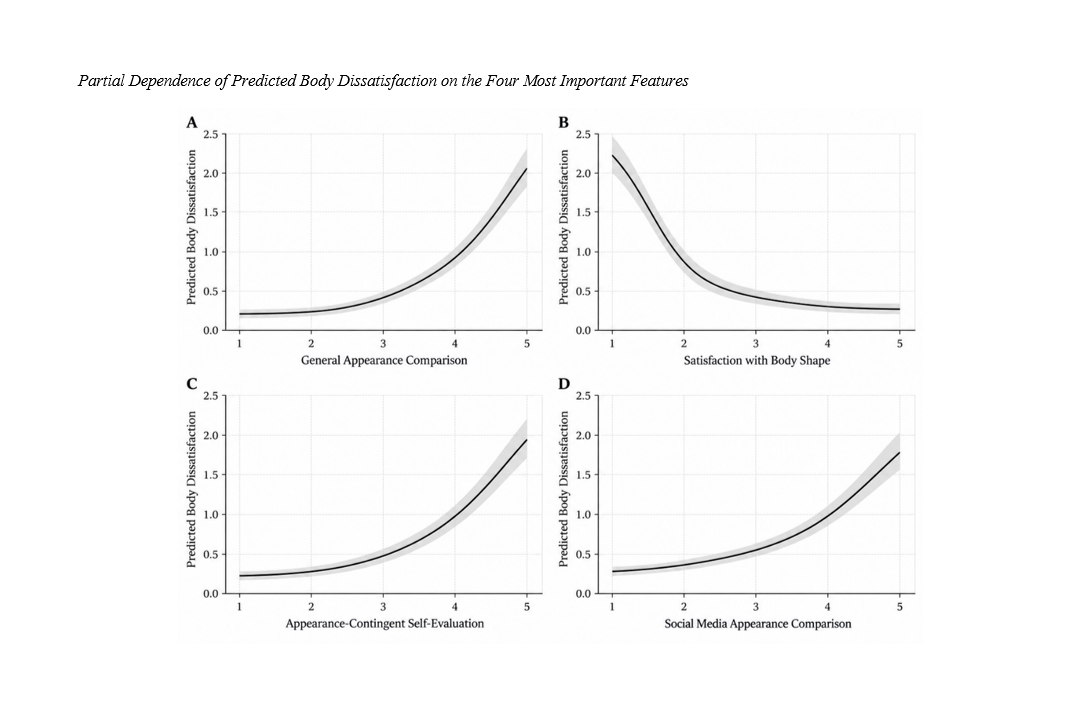
Findings: The Random Forest model demonstrated satisfactory predictive accuracy, explaining 61% of the variance in body dissatisfaction during cross-validation and 64% in the independent test sample (R² = .64, MAE = 7.21, RMSE = 9.36). General appearance comparison was the strongest predictor, producing a .119 decrease in R² after permutation, followed by body-shape satisfaction (.104), appearance-contingent self-evaluation (.092), social media appearance comparison (.081), current–ideal appearance discrepancy (.069), and global self-esteem (.057). Partial dependence analyses indicated nonlinear increases in predicted body dissatisfaction at moderate-to-high levels of appearance comparison, appearance-contingent self-evaluation, and social media appearance comparison, while greater body-shape satisfaction was associated with lower predicted dissatisfaction.
Conclusion: Body dissatisfaction in women can be predicted with substantial accuracy from an integrated set of appearance, self-evaluation, and social media-related characteristics, with psychological comparison and subjective appearance evaluation contributing more strongly than general social media exposure or body size alone.
Downloads
References
Álvarez-Mon, M. Á., Sánchez‐Villegas, A., Gutiérrez-Rojas, L., & Martínez‐González, M. Á. (2024). Screen Exposure, Mental Health and Emotional Well-Being in the Adolescent Population: Is It Time for Governments to Take Action?. Journal of Epidemiology & Community Health, 78(12), 759-763. https://doi.org/10.1136/jech-2023-220577
Awopetu, R. G., Olabimitan, B. A., Kolawole, S. O., Newton, R., Odok, A. A., & Awopetu, A. (2024). The Systematic Review of Social Media Addiction and Mental Health of Nigerian University Students: The Good, the Bad and the Ugly. European Journal of Theoretical and Applied Sciences, 2(1), 767-788. https://doi.org/10.59324/ejtas.2024.2(1).69
Beos, N., Kemps, E., & Prichard, I. (2025). Relationships Between Social Media, Body Image, Physical Activity, and Anabolic-Androgenic Steroid Use in Men: A Systematic Review. Psychology of Men & Masculinity, 26(1), 105-128. https://doi.org/10.1037/men0000487
Blackburn, M. R., & Hogg, R. (2024). #ForYou? The Impact of Pro-Ana TikTok Content on Body Image Dissatisfaction and Internalisation of Societal Beauty Standards. PLoS One, 19(8), e0307597. https://doi.org/10.1371/journal.pone.0307597
Dajches, L., Gahler, H., Terán, L., Yan, K., Zeng, J., & Aubrey, J. S. (2025). “I Made You Look”… and Comment: Exploring the Role of TikTok on Body Image and Acceptance of Cosmetic Surgery. Psychology of Popular Media, 14(4), 530-538. https://doi.org/10.1037/ppm0000566
Dane, A., & Bhatia, K. (2023). The Social Media Diet: A Scoping Review to Investigate the Association Between Social Media, Body Image and Eating Disorders Amongst Young People. Plos Global Public Health, 3(3), e0001091. https://doi.org/10.1371/journal.pgph.0001091
Digennaro, S., & Tescione, A. (2024). Scrolls and Self-Perception, Navigating the Link Between Social Networks and Body Dissatisfaction in Preadolescents and Adolescents: A Systematic Review. Frontiers in Education, 9. https://doi.org/10.3389/feduc.2024.1390583
Fatima, R. (2025). Understanding Body Image Issues Among Young Pakistani Adults in the Age of Social Media. https://doi.org/10.21203/rs.3.rs-7578713/v1
Gao, M. (2023). Social Media's Influence on Eating Disorders. Modern Economics & Management Forum, 4(4), 107. https://doi.org/10.32629/memf.v4i4.1489
Goyal, D. K. R., & G., S. K. (2024). Impact of Social Media on Body Image Perception and Self Esteem Among Young Women. International Journal for Multidisciplinary Research, 6(2). https://doi.org/10.36948/ijfmr.2024.v06i02.17285
Hajat, E. (2024). Impact of Social Media Usage on Body Image Perception Among Adolescents in Malawi. American Journal of Arts Social and Humanity Studies, 4(1), 11-21. https://doi.org/10.47672/ajashs.2064
Hu, Y., Hou, Y., Zhu, M., & Gao, X. (2026). Social Networking Sites Use Exacerbates Appearance Anxiety in Young Chinese Women: The Moderating Role of Self-Concept Clarity. Psychology of Popular Media, 15(2), 227-239. https://doi.org/10.1037/ppm0000600
Jeevar, V., Chapman-Little, B., & Jackson, S. E. (2022). Current Challenges to Adolescent Well-Being. https://doi.org/10.21203/rs.3.rs-1447988/v1
Koh, G. K., Jenna Qing Yun Ow, Y., Ainsley Ryan Yan Bin, L., Ong, B. S. Y., Yau, C. E., Ho, C. S. H., & Goh, Y. S. (2024). Social Media Use and Its Impact on Adults' Mental Health and Well‐being: A Scoping Review. Worldviews on Evidence-Based Nursing, 21(4), 345-394. https://doi.org/10.1111/wvn.12727
Kruger, M., Pruscino, I., Martin, C., & Velkoff, E. A. (2026). Tick‐Tock, the Time Has Come: Leveraging TikTok to Understand, Prevent, and Treat Eating Disorders. International Journal of Eating Disorders, 59(7), 1469-1501. https://doi.org/10.1002/eat.70091
Kudlová, K., Hollá, K., Turzík, J., & Hrkotáčová, N. (2024). Body Shaming in Online Space: Systematic Review. Journal of Ecohumanism, 3(8). https://doi.org/10.62754/joe.v3i8.4728
Malhotra, K., Miles, S., Tan, E. J., & Phillipou, A. (2025). Examining the Relationship Between Time Spent on Social Media Platforms and Body Image Concerns. European Eating Disorders Review, 34(2), 313-320. https://doi.org/10.1002/erv.70030
Manjanatha, D., Pippard, N., & Bloss, C. S. (2025). Self-Compassion as a Protective Factor Against Adverse Consequences of Social Media Use: A Scoping Review. PLoS One, 20(5), e0322227. https://doi.org/10.1371/journal.pone.0322227
Markey, C. N., August, K. J., Gillen, M. M., & Rosenbaum, D. L. (2025). An Examination of Youths’ Social Media Use and Body Image. Journal of Media Psychology Theories Methods and Applications, 37(1), 52-59. https://doi.org/10.1027/1864-1105/a000420
Naji, B., Naji, M., & Fredericks, S. (2025). Investigating the Impact of Social Media on Body Image and Eating Disorders Among Individuals in Arab Countries: A Literature Review. Cureus. https://doi.org/10.7759/cureus.95309
Orsolini, L., Longo, G., Cantarini, T., Reina, S., & Volpe, U. (2026). TikTok and Instagram as Putative Social Media in Promoting Healthy Eating Habits in Youths at-Risk for Eating/Feeding Disorders and Body Image Dissatisfaction. Brain Sciences, 16(4), 379. https://doi.org/10.3390/brainsci16040379
Pan, W., Mu, Z., & Tang, Z. (2022). Social Media Influencer Viewing and Intentions to Change Appearance: A Large Scale Cross-Sectional Survey on Female Social Media Users in China. Frontiers in psychology, 13. https://doi.org/10.3389/fpsyg.2022.846390
Perveen, S. (2024). Sociocultural Attitudes Towards Appearance and Social Networking Addiction Among Young Adults. The Critical Review of Social Sciences Studies, 2(2), 799-808. https://doi.org/10.59075/e0vm6831
Pop, L., Iorga, M., & Iurcov, R. (2022). Body-Esteem, Self-Esteem and Loneliness Among Social Media Young Users. International journal of environmental research and public health, 19(9), 5064. https://doi.org/10.3390/ijerph19095064
Pop, L., Iorga, M., Șipoș, L.-R., & Iurcov, R. (2021). Gender Differences in Healthy Lifestyle, Body Consciousness, and the Use of Social Networks Among Medical Students. Medicina, 57(7), 648. https://doi.org/10.3390/medicina57070648
Rafiq, A., & Linden, B. (2024). Social Media and Self-Concept Among Postsecondary Students: A Scoping Review. Cyberpsychology Behavior and Social Networking, 27(3), 194-201. https://doi.org/10.1089/cyber.2023.0451
Ruiz-Centeno, C., Cueto-Galán, R., Pena-Andreu, J. M., & Fontalba-Navas, A. (2025). Problematic Internet Use and Its Relationship With Eating Disorders. Frontiers in Public Health, 13. https://doi.org/10.3389/fpubh.2025.1464172
Sharma, A. A., & Vidal, C. (2023). A Scoping Literature Review of the Associations Between Highly Visual Social Media Use and Eating Disorders and Disordered Eating: A Changing Landscape. Journal of eating disorders, 11(1). https://doi.org/10.1186/s40337-023-00898-6
Siddegowda, S., Sharma, M. K., & Thakur, P. C. (2022). Making the Body Public: Implications of the New Standards of Body-Image. International Journal of Social Psychiatry, 69(3), 799-802. https://doi.org/10.1177/00207640221109163
Wang, Z., Kasimon, D., Abas, W. A. W., Ma, Y., & Ruan, Q. (2023). Research Trends in Different Social Media Platform and Body Image. International Journal of Academic Research in Business and Social Sciences, 13(5). https://doi.org/10.6007/ijarbss/v13-i5/16937
Xia, M. (2024). Social, Celebrity, and Appearance Anxiety in Adolescent. Lecture Notes in Education Psychology and Public Media, 49(1), 157-163. https://doi.org/10.54254/2753-7048/49/20231957
Xiao-long, G. U. (2023). The Impact of Negative Evaluations on Women's Mental Health on Social Media. Journal of Education Humanities and Social Sciences, 22, 306-314. https://doi.org/10.54097/ehss.v22i.12455
Xu, Y. (2024). Fitspiration, Related Risks, and Coping Strategies: Recent Trends and Future Directions. Psychology of Popular Media, 13(4), 748-754. https://doi.org/10.1037/ppm0000491
Zaharia, A., & Gonța, I. (2024). The Healthy Eating Movement on Social Media and Its Psychological Effects on Body Image. Frontiers in Nutrition, 11. https://doi.org/10.3389/fnut.2024.1474729
Downloads
Additional Files
Publication Timeline
- Submitted
- Revised
- Accepted