Developing a Model of Codependency Based on Addictive Behaviors Among Women in Families Affected by Addiction
Keywords:
addictive behaviors, Intervention model, Women , addictionAbstract
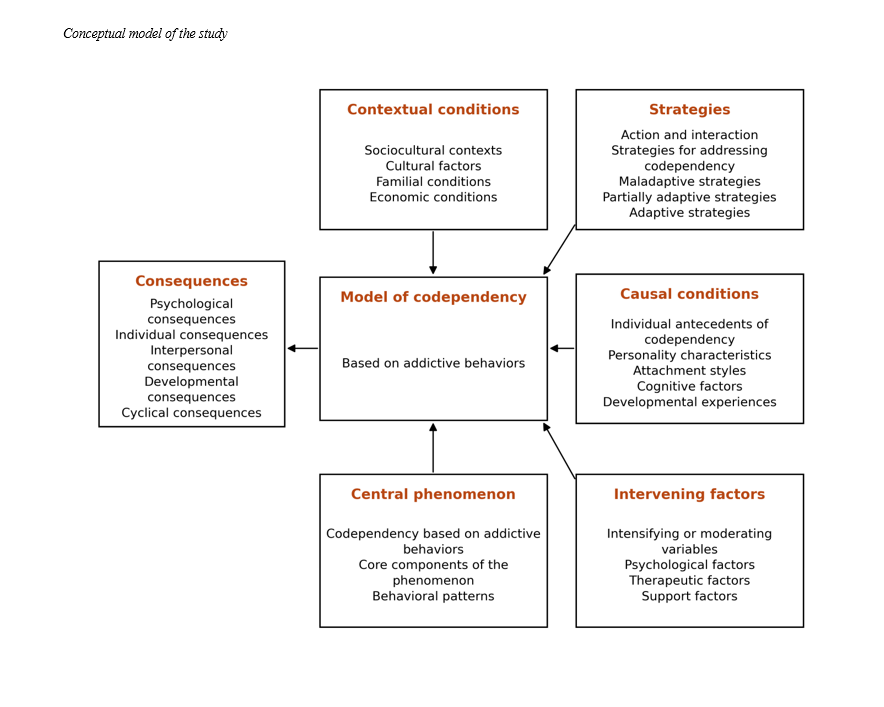
Objective: This study aimed to develop and explain a comprehensive model of codependency based on addictive behaviors among women in families affected by addiction and to identify its principal antecedents, contextual and intervening factors, coping strategies, and psychological and interpersonal consequences.
Methods and Materials: This applied qualitative study employed qualitative content analysis. Participants were experts in psychology, counseling, psychiatry, addiction, and related clinical fields who were selected through purposive sampling until theoretical saturation was achieved. Data were collected using semi-structured interviews lasting approximately 30–40 minutes. The interview transcripts were repeatedly reviewed and analyzed through open, axial, and selective coding using constant comparison. Credibility, transferability, dependability, and confirmability criteria were used to establish the trustworthiness of the qualitative findings.
Findings: Qualitative analysis identified codependency based on addictive behaviors as a multidimensional, interactive, and cyclical phenomenon. Causal conditions included low self-esteem, negative self-concept, emotional dependency, insecure attachment, dysfunctional beliefs regarding responsibility and self-sacrifice, and adverse developmental experiences. The central phenomenon was characterized by excessive emotional dependency, pathological focus on the person exhibiting addictive behaviors, controlling behaviors, excessive rescuing, self-neglect, and tolerance of emotional harm. Contextual conditions comprised cultural, familial, and economic factors, whereas psychological, therapeutic, and social-support factors functioned as intervening conditions. Coping responses ranged from maladaptive control, monitoring, emotional suppression, and conflict avoidance to adaptive boundary setting, self-care, treatment seeking, and identity reconstruction. Major consequences included depression, chronic anxiety, psychological exhaustion, reduced self-esteem and differentiation of self, disturbed emotional intimacy, marital conflict, impaired trust, and reproduction of the codependency cycle.
Conclusion: Codependency among women in families affected by addiction is best understood as a complex process produced by interactions among individual vulnerabilities, family dynamics, sociocultural pressures, and available psychological and social resources.
Downloads
References
Abouei Mehrizi, V., Shafiabadi, A., Khodabakhshi-Koolaee, A., & Khalatbari, J. (2021). Comparing the effectiveness of group schema therapy and acceptance and commitment therapy on differentiation of self in adolescent girls. Journal of Pediatric Nursing(3), 7-12.
Alonso, M. M., Oliver, J., & Berastegui, A. (2022). Differentiation of self and its relationship with marital satisfaction, and parenting styles in a Spanish sample of adolescents parents. PLoS One, 17(3), e0265436. https://doi.org/10.1371/journal.pone.0265436
Aryaei Azar, A., Sadeghi, M. S., & Mootabi, F. (2021). Couples' differentiation from their families of origin and its role in predicting communication patterns and marital satisfaction among different Iranian ethnic groups. Family Research, 17(3), 353-368. https://doi.org/10.52547/JFR.17.3.353
Butera, C., Kaplan, J., Kilroy, E., Harrison, L., Jayashankar, A., Loureiro, F., & Aziz-Zadeh, L. (2023). The relationship between alexithymia, interoception, and neural functional connectivity during facial expression processing in autism spectrum disorder. Neuropsychologia, 108469. https://doi.org/10.1016/j.neuropsychologia.2023.108469
Chaplin, T. M., Curby, T. W., Gonçalves, S. F., Kisner, M. A., Niehaus, C. E., & Thompson, J. C. (2023). Sex differences in emotion- and reward-related neural responses predicting increases in substance use in adolescence. Behavioural Brain Research, 450, 114499. https://doi.org/10.1016/j.bbr.2023.114499
Del Bianco, C., Ulivi, M., Liguori, C., Pisani, A., Mercuri, N. B., Placidi, F., & Izzi, F. (2023). Alexithymia, impulsiveness, emotion, and eating dyscontrol: Similarities and differences between narcolepsy type 1 and type 2. Sleep and Biological Rhythms, 21(1), 39-50. https://doi.org/10.1007/s41105-022-00414-4
Enrique, A., Eilert, N., Wogan, R., Earley, C., Duffy, D., Palacios, J., & Richards, D. (2021). Are changes in beliefs about rumination and in emotion regulation skills mediators of the effects of internet-delivered cognitive-behavioral therapy for depression and anxiety? Results from a randomized controlled trial. Cognitive therapy and research, 45, 805-816. https://doi.org/10.1007/s10608-020-10200-6
Farhangi, M., Khosropour, F., & Bahrampour, A. (2022). A structural model of the mediating role of differentiation in the relationship between sexual satisfaction and general health among married female teachers in Kerman. Quarterly Journal of Health Promotion Management, 11(3), 81-90.
Fitzsimmons-Craft, E. E., Laboe, A. A., McGinnis, C., Firebaugh, M. L., Shah, J., Wallendorf, M., & Wilfley, D. E. (2023). A pilot randomized controlled trial of a cognitive-behavioral therapy-guided self-help mobile app for the post-acute treatment of anorexia nervosa: A registered report. International Journal of Eating Disorders, 56(3), 654-661. https://doi.org/10.1002/eat.23891
Garke, M. Å., Isacsson, N. H., Sörman, K., Bjureberg, J., Hellner, C., & Gratz, K. (2021). Emotion dysregulation across levels of substance use. Psychiatry research, 296, 113662. https://doi.org/10.1016/j.psychres.2020.113662
Gökalp, Z. Ş., Saritepeci, M., & Durak, H. Y. (2023). The relationship between self-control and procrastination among adolescent: The mediating role of multi screen addiction. Current Psychology, 42(15), 13192-13203. https://doi.org/10.1007/s12144-021-02472-2
Hamidi, O., Mirzapour, H., Fallahzadeh, H., & Mostafa, V. (2021). The mediating role of differentiation of self in the relationship between codependency and emotional abuse among married female university students. Women and Family Studies, 9(1).
Han, N. S., & Won, M. H. (2022). Association between Social Support and Physical Activity in Patients with Coronary Artery Disease: Multiple Mediating Roles of Self-Efficacy and Autonomous Motivation. Healthcare, 10(3), 425. https://doi.org/10.3390/healthcare10030425
Heidari Sarban, V., & Saeb, S. (2021). Analyzing factors influencing the reduction of rural youths' tendency toward drug use: A case study of Ardabil County. Studies of Human Settlements Planning(54).
Henden, E. (2023). Addiction and autonomy: Why emotional dysregulation in addiction impairs autonomy and why it matters. Frontiers in psychology, 14, 1081810. https://doi.org/10.3389/fpsyg.2023.1081810
Hosseini, M., & Karimi, N. (2023). Examining the effect of mindfulness exercises on reducing anxiety and increasing self-esteem among university students. Quarterly Journal of Contemporary Psychology, 18(2), 45-62.
Jafari Soltanabadi, A., Monirpour, N., & Mirzahosseini, H. (2021). The relationship of couples' happiness with differentiation of self and early object relations, with religious marital satisfaction as a mediator. Applied Family Therapy, 2(1), 159-176. https://doi.org/10.61838/kman.aftj.2.1.9
Karnieli-Miller, O., Divon-Ophir, O., Sagi, D., Pessach-Gelblum, L., Ziv, A., & Rozental, L. (2023). More than just an entertainment show: Identification of medical clowns' communication skills and therapeutic goals. Qualitative Health Research, 33(1-2), 25-38. https://doi.org/10.1177/10497323221139781
Kazemian Moghaddam, K., Mehrabizadeh Honarmand, M., Kiamanesh, A., & Hosseinian, S. (2021). The role of differentiation, meaning in life, and forgiveness in predicting marital satisfaction. Biannual Journal of Family Psychology, 3(2), 71-82.
Klussman, K., Curtin, N., Langer, J., & Nichols, A. L. (2020). Examining the effect of mindfulness on well-being: Self-connection as a mediator. Journal of Pacific Rim Psychology, 14, e5. https://doi.org/10.1017/prp.2019.29
Krauss, S., Orth, U., & Robins, R. W. (2020). Family environment and self-esteem development: A longitudinal study from age 10 to 16. Journal of personality and social psychology, 119(2), 457. https://doi.org/10.1037/pspp0000263
Lee, Y., Meins, E., & Larkin, F. (2020). Translation and preliminary validation of a Korean version of the parental reflective functioning questionnaire. Infant Mental Health Journal, 1-13. https://doi.org/10.1002/imhj.21883
Mamsalehi, H., & Moradi, O. (2020). Developing a model to predict sexual satisfaction based on sexual schemas and differentiation of self among couples. Psychiatric Nursing, 8(1), 49-59.
Mason, E. C., Grierson, A. B., Sie, A., Sharrock, M. J., Li, I., Chen, A. Z., & Newby, J. M. (2023). Co-occurring insomnia and anxiety: A randomized controlled trial of internet cognitive behavioral therapy for insomnia versus internet cognitive behavioral therapy for anxiety. Sleep, 46(2), zsac205. https://doi.org/10.1093/sleep/zsac205
Mazzeo, F., Meccariello, R., & Guatteo, E. (2023). Molecular and Epigenetic Aspects of Opioid Receptors in Drug Addiction and Pain Management in Sport. International Journal of Molecular Sciences, 24(9), 7831. https://doi.org/10.3390/ijms24097831
McNair, R., Monaghan, M., & Montgomery, P. (2023). Heroin assisted treatment for key health outcomes in people with chronic heroin addictions: A context-focused systematic review. Drug and Alcohol Dependence, 109869. https://doi.org/10.1016/j.drugalcdep.2023.109869
Mohagheghi, H., & Khaghani, P. (2021). The effectiveness of schema therapy on anxiety, depression, and early maladaptive schemas in individuals with substance use disorder. Research on Addiction, 15(60), 299-324. https://doi.org/10.52547/etiadpajohi.15.60.299
Movahedrad, F., Seyed Alitabar, S. H., Mohammadi, A., & Hoseinifard, V. (2023). The effectiveness of strength-based counseling on the tendency toward marital infidelity and self-compassion of conflicted couples. Journal of Assessment and Research in Applied Counseling, 11-22. https://doi.org/10.61838/kman.jarac.5.2.2
Rahal, D., Shirtcliff, E. A., Fuligni, A., Kogut, K., Gonzales, N., Johnson, M., Eskenazi, B., & Deardorff, J. (2023). Dampened psychobiological responses to stress and substance use in adolescence. Development and Psychopathology, 35, 1497-1514. https://doi.org/10.1017/S0954579422000244
Sadeghi, N., & Abbasi, M. (2024). The effect of school-based religious programs on students' self-esteem and resilience. Journal of Islamic Education, 16(2), 55-72.
Sansoni, M., Scarzello, G., Serino, S., Groff, E., & Riva, G. (2022). A New Cognitive Approach to Psycho-oncology: Buffering Negative Emotions through Virtual Reality and Embodiment. Frontiers in human neuroscience, 490. https://doi.org/10.3389/fnhum.2022.916227
Stellern, J., Xiao, K. B., Grennell, E., Sanches, M., Gowin, J. L., & Sloan, M. E. (2022). Emotion regulation in substance use disorders: A systematic review and meta-analysis. Addiction, 118, 30-47. https://doi.org/10.1111/add.16001
Stellern, J., Xiao, K. B., Grennell, E., Sanches, M., Gowin, J. L., & Sloan, M. E. (2023). Emotion regulation in substance use disorders: A systematic review and meta-analysis. Addiction, 118(1), 30-47. https://doi.org/10.1111/add.16001
Sundah, A. J. (2022). Improved Ability to Reduce Academic Procrastination Through Counseling Cognitive Behavior. Journal of Positive Psychology and Wellbeing, 6(1), 3872-3880.
Talebpour, A. (2023). Explaining the effect of social exclusion on women's tendency toward drug use. Women's Social-Psychological Studies(77).
Verywell Mind, E. (2025). 5 Healthy Ways to Live a Longer, Happier Life, According to Blue Zone Communities. Verywell Mind. https://www.verywellmind.com/blue-zone-secrets-11714202
Zare, M., & Varaei, P. (2021). Predicting women's sexual functioning based on loneliness, individual differentiation, and psychological distress Seventh National Conference on Recent Developments in Positive Psychology, Bandar Abbas.
Zarrinkafsh, F., & Alizadeh, S. (2020). The relationship between a healthy lifestyle and self-esteem among university students. Journal of Positive Psychology Research, 16(2), 112-130.
Downloads
Additional Files
Publication Timeline
- Submitted
- Revised
- Accepted