Cosmetic Surgery as a Strategy for Preventing Marital Infidelity: A Paradigm Model
Keywords:
Cosmetic surgery, marital infidelity, body management, mate-retention strategy, grounded theory, married womenAbstract
Objective: The present study aimed to understand cosmetic surgery as a strategy for preventing marital infidelity and to develop a paradigm model explaining this phenomenon.
Materials and Methods: This study employed a qualitative methodology using a grounded theory strategy. Participants were married women residing in Isfahan who had undergone at least one cosmetic surgery motivated by concerns related to their marital relationships. Participants were initially selected through purposive sampling and subsequently, as the analysis progressed, through theoretical sampling assisted by snowball recruitment. Data collection was ultimately completed with 16 women after theoretical saturation had been achieved across all six dimensions of the paradigm model. Data were collected through in-depth semi-structured interviews. Following audio recording and verbatim transcription, the interviews were analyzed concurrently with data collection using the constant comparative method in MAXQDA. Analysis involved three stages of open, axial, and selective coding, accompanied by analytic memo writing.
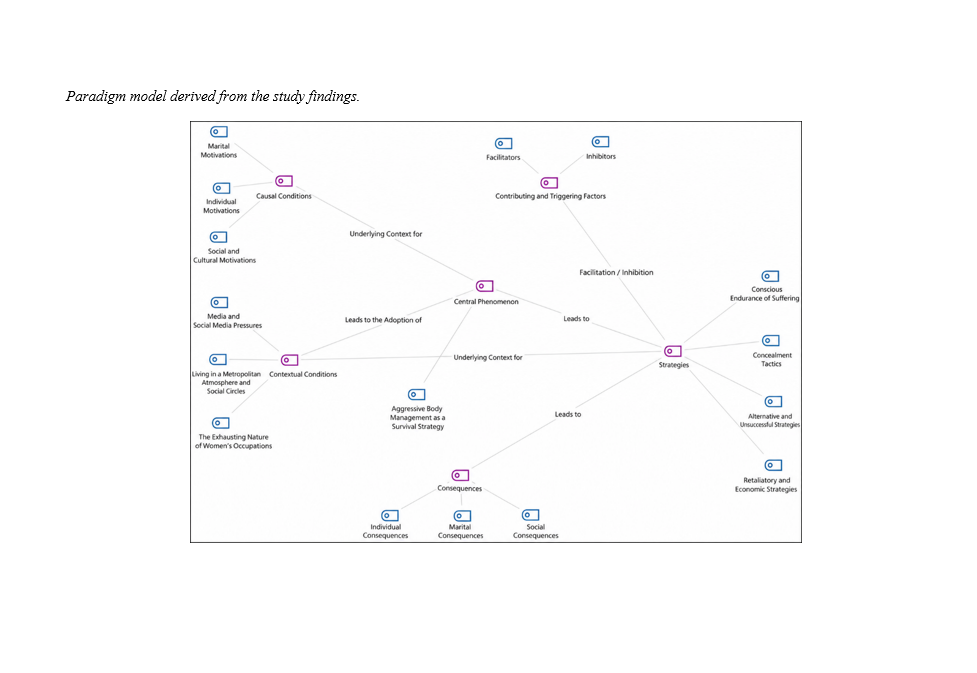
Findings: Data analysis resulted in the identification of six principal dimensions of the paradigm model. Causal conditions comprised three interconnected layers: marital and relational motivations, individual and psychological motivations, and social and cultural motivations. Contextual conditions included media and social-media pressures, the metropolitan social atmosphere, and the exhausting nature of women’s occupations. Intervening conditions were classified into facilitators—financial independence, spousal support, and access to informational networks—and inhibitors, including the husband’s refusal to provide financial support, fear of judgment, and involvement in maternal responsibilities. Strategies included concealment tactics, retaliatory and economic strategies, unsuccessful alternative strategies, and the conscious endurance of suffering. Consequences were identified at three levels: individual consequences, including regret over previous sacrifices, temporary restoration of self-confidence, entrapment in a continuous cycle of bodily repair, and the commodification of the self; marital consequences, including the predominance of appearance-based criteria over personality-related values, reversal of the power equation, and the conditionalization of love; and social consequences, including membership in an informal “club” of women who had undergone cosmetic procedures and the reproduction of appearance-related pressure. The study’s core category was formulated as “aggressive body management as a survival strategy within the insecure field of marital and social life.”
Conclusion: By proposing a context-sensitive model, this study contextualizes mate-retention theory within Iranian culture and demonstrates that mate-retention strategies in this context are deliberate, calculated, and deeply shaped by media discourses and family-based norms.
Downloads
References
Adhami, A., & Emami, M. (2021). The relationship between fear of spousal infidelity and body management among married women in Tehran. Social Sciences Quarterly, Islamic Azad University, Shoushtar Branch, 15(3), 1-23.
Akbari Sari, A., Babashahy, S., Olyaeimanesh, A., & Rashidian, A. (2012). Estimating the frequency and rate of first 50 common types of invasive procedures in Iran healthcare system. Iranian Journal of Public Health, 41(10), 60-64.
Amin Kazemi, N., Akbarinejad, H., & Faroughi, P. (2024). Comparing the five personality dimensions, body image, and self-esteem among women seeking and not seeking cosmetic surgery. Interdisciplinary Studies of Women, 6(4), 19-34. https://civilica.com/doc/2161727
Arif, M., Nazeer, J., & Naseem, Z. (2022). Role of social media for the adoption of cosmetic procedures among young Pakistani women. Journal of Development and Social Sciences, 3(II), 996-1006. https://doi.org/10.47205/jdss.2022(3-ii)89
Arnocky, S., & Locke, A. (2020). Jealousy mediates the link between women's upward physical appearance comparison and mate retention behavior. Evolutionary Psychology, 18(4). https://doi.org/10.1177/1474704920973990
Atari, M., Barbaro, N., Sela, Y., Shackelford, T. K., & Chegeni, R. (2017). Consideration of cosmetic surgery as part of women's benefit-provisioning mate retention strategy. Frontiers in psychology, 8, 1389. https://doi.org/10.3389/fpsyg.2017.01389
Brunet, J., Price, J., & Harris, C. (2022). Body image in women diagnosed with breast cancer: A grounded theory study. Body Image, 41, 417-431.
Corbin, J., & Strauss, A. (2015). Basics of qualitative research: Techniques and procedures for developing grounded theory (4 ed.). Sage.
Davai, N. R., Kalantar-Hormozi, A., Ganji, K., & Abbaszadeh-Kasbi, A. (2018). The impact of cosmetic surgery on women's marital satisfaction and self-concept. World Journal of Plastic Surgery, 7(3), 171-178. https://doi.org/10.29252/wjps.7.3.337
Dharsheni, S. T. S., & Sivakami, B. (2025). Experiences of trans women who have undergone gender affirmation surgery: A constructivist grounded theory. Frontiers in Sociology, 10, 1544906.
Enayat, H., & Hajian, B. (2015). Factors associated with trust in a spouse's fidelity: A study of married men and women in Isfahan. Applied Sociology (Research Journal of Humanities, University of Isfahan), 26(4), 69-86. https://sid.ir/paper/513884/fa
Farhan, S., & Ismail, Y. (2022). The relationship of body shape satisfaction with personal intimacy and sexual satisfaction among married females. Pakistan Journal of Gender Studies, 22(1), 135-156. https://doi.org/10.46568/pjgs.v22i1.597
Heydarpour, G., & Zayer, M. (2024). Comparison of body image attitudes, self-esteem, and quality of life in married women before and after cosmetic surgery. Psychology of Woman Journal, 5(4), 149-156. https://doi.org/10.61838/kman.pwj.5.4.17
Kalantar Motamedi, M. H., Ebrahimi, A., Shams, A., & Nejadsarvari, N. (2016). Health and social problems of rhinoplasty in Iran. World Journal of Plastic Surgery, 5(1), 75-76.
Lekakis, G., Picavet, V. A., Gabriels, L., Grietens, J., & Hellings, P. W. (2016). Body dysmorphic disorder in aesthetic rhinoplasty: Validating a new screening tool. The Laryngoscope, 126(4), 1739-1745. https://doi.org/10.1002/lary.25963
Masoudi, F., & Karamalian Sichani, H. (2024). Relationships of attitudes toward cosmetic procedures with body image, life expectancy, and perfectionism among upper secondary school girls Payame Noor University, Isfahan Province, Natanz Center].
Meltzer, A. L., & McNulty, J. K. (2010). Body image and marital satisfaction: Evidence for the mediating role of sexual frequency and sexual satisfaction. Journal of Family Psychology, 24(2), 156-164. https://doi.org/10.1037/a0019063
Nikpour, N., Nazari, Z., & Khezri Moghaddam, N. (2023). Predicting marital satisfaction based on perfectionism, body image, and sexual satisfaction among married women First National Conference on the Ideal Family, Ardabil, Iran. https://civilica.com/doc/1969241
Pew Research, C. (2023). Marriage and divorce statistics in the United States. https://www.pewresearch.org
Shaheen, A., Ali, U., Kumar, H., & Makhija, P. M. (2016). Association between body image and marital satisfaction in married adults. Journal of Basic & Applied Sciences, 12, 420-425. https://doi.org/10.6000/1927-5129.2016.12.65
Talebi Dalir, M. (2023). A meta-analysis of psychological and social factors affecting the tendency toward cosmetic surgery in Iran. Cultural and Educational Studies of Women and Family, 18(63), 49-82.
Vahab, M., Navabakhsh, M., & Fathi, S. (2023). A sociological explanation of factors affecting women's adoption of body management: A study of women in Tehran's Districts 1 and 17. Social-Cultural Development Studies, 11(4), 140-153.
Vaseghi, S., Asadi, J., Badaleh Shamoushaki, M. T., & Khajavand Khoshli, A. (2025). A structural model of cosmetic surgery acceptance based on body image satisfaction and fear of negative evaluation with the mediating role of cultural informational attitudes. Journal of Psychological Science, 24(146), 191-211.
Downloads
Additional Files
Publication Timeline
- Submitted
- Revised
- Accepted