A Comparison of a Psychodynamic Emotion-Focused Therapy Package with Dialectical Behavior Therapy: Emphasizing the Reduction of Aggression and Rumination in Women with Comorbid Depression and Social Anxiety
Keywords:
Aggression, Comorbid Depression, Dialectical Behavior Therapy, Psychodynamic Emotion-Focused Therapy, Rumination, Social AnxietyAbstract
Objective: This study aimed to compare the effectiveness of a psychodynamic emotion-focused therapy package and dialectical behavior therapy in reducing aggression and rumination among women with comorbid depression and social anxiety.
Methods and Materials: The study employed a mixed-methods qualitative-quantitative design. In the qualitative phase, the components of the psychodynamic emotion-focused therapy package were developed through deductive thematic analysis. In the quantitative phase, a quasi-experimental pretest-posttest design with a two-month follow-up and a control group was implemented. The statistical population comprised single women aged 20–40 years with comorbid depression and social anxiety who were referred to counseling centers in Isfahan, Iran. A total of 45 eligible participants were selected through purposive sampling and randomly assigned to psychodynamic emotion-focused therapy, dialectical behavior therapy, and control groups. Data were collected using the Beck Depression Inventory, Connor Social Anxiety Inventory, Rumination Response Scale, and Eysenck and Glenn Wilson Aggression Questionnaire. Repeated-measures analysis of variance and Bonferroni post-hoc comparisons were used for inferential analysis.
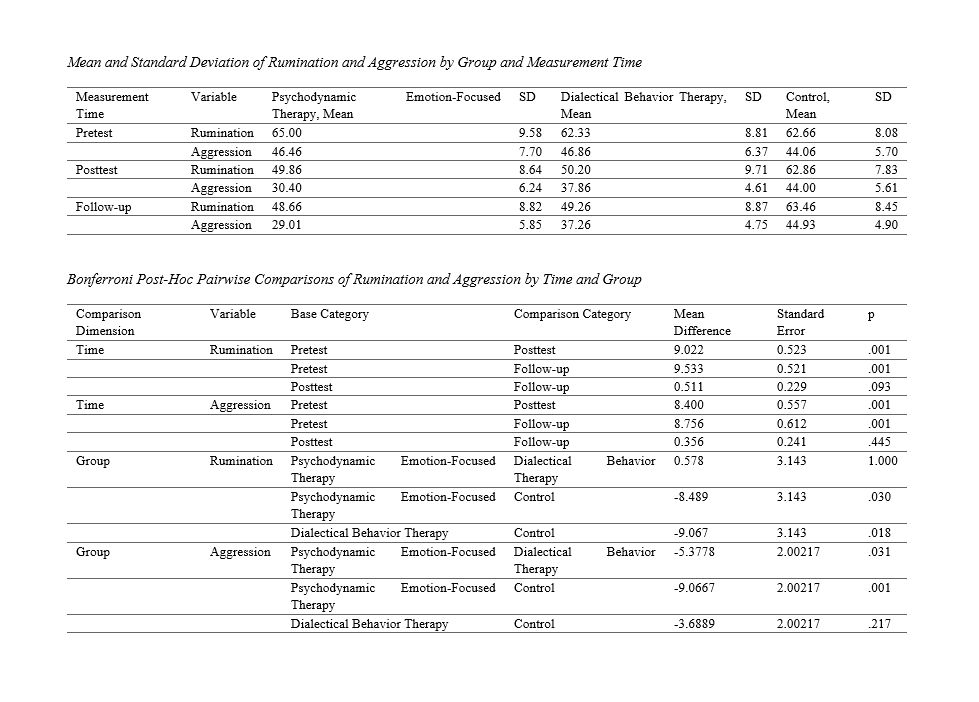
Findings: Repeated-measures analysis revealed significant time-by-group effects for rumination, indicating that both psychodynamic emotion-focused therapy and dialectical behavior therapy significantly reduced rumination compared with the control condition, with treatment effects maintained at the two-month follow-up (p < .001). For aggression, significant between-group differences were observed, with psychodynamic emotion-focused therapy producing a significantly greater reduction than both dialectical behavior therapy and the control condition (p < .001). Dialectical behavior therapy did not significantly differ from the control group in reducing aggression.
Conclusion: Both psychodynamic emotion-focused therapy and dialectical behavior therapy appear effective for reducing rumination in women with comorbid depression and social anxiety. However, psychodynamic emotion-focused therapy demonstrates superior efficacy for aggression, suggesting that its emphasis on deeper emotional processing and underlying intrapsychic conflicts may provide additional therapeutic benefits when aggression constitutes a prominent clinical symptom.
Downloads
References
Amighi, H., Ebrahimi Moghadam, H., & Kashani Vahid, L. (2025). Effectiveness of dialectical behavior therapy (DBT) on aggression, anxiety, and attention in girls with obsessive-compulsive disorder: A quasi-experimental study. Journal of Rafsanjan University of Medical Sciences, 23(11), 973-989. https://doi.org/10.61186/jrums.23.11.973
Barani, H., & Fooladchang, M. (2022). Effectiveness of Dialectical Behavior Therapy Skills Training on Anxiety and Depression Symptoms in Students. Applied Psychological Research Quarterly, 13(1), 287-304.
Cherati, M. G., Mohammadipour, M., & Azizi, A. (2023). Effectiveness of Dialectical Behavior Therapy on the Difficulty of Emotional Regulation and Aggression in Female Adolescents with Depressive Symptoms. Islamic lifestyle with a focus on health, 6(4), 392-402.
Christensen, M. C., Schmidt, S. N., & Grande, I. (2023). Effectiveness of Vortioxetine in Patients with Major Depressive Disorder and Early-Stage Dementia: The MEMORY Study. Journal of affective disorders, 338, 423-431. https://doi.org/10.1016/j.jad.2023.06.024
Damavandian, A., Armaghan, M., Golshani, F., Saffarinia, M., & Baghdasarians, A. (2021). Comparison of the Effectiveness of Compassion-Based Therapy and Dialectical Behavior Therapy on Aggression, Self-Harming Behaviors, and Emotional Self-Regulation of Delinquent Adolescents in Correction and Rehabilitation Center of Tehran. Social Psychology Research, 11(41), 31-58.
Farajinia, Z., Karimi, F., & Jalili, E. (2020). Predicting Social Anxiety Based on Anger Rumination, Aggression, and Problem-Solving Styles. Family & Health, 23(10), 25-37.
Ghaffari, H., Manee, F. M., & Masoudi, S. (2022). The Effectiveness of Emotion-Oriented Therapy on Feelings of Inferiority, Sensation-Seeking and Attachment Styles of Married Women with Experience of Extramarital Relationships. Iranian Journal of Rehabilitation Research, 9(2), 62-76.
Hassan, F., & Feng, C. (2026). Distinct and Shared Risk Factors for Mood, Anxiety and Comorbid Disorders among Canadians: Evidence from the 2019-2020 Canadian Community Health Survey. Health Promotion and Chronic Disease Prevention in Canada: Research, Policy and Practice, 46(5), 198-212. https://doi.org/10.24095/hpcdp.46.5.03
Heshmati, R., Bayrami, M., & Norouzi, H. (2023). The Role of Lived Childhood Trauma Experience and Self-Destruction on Suicidal Ideation: The Mediating Effect of Emotional Suppression. Journal of Modern Psychological Researches, 18(69), 113-121.
Hoviatdoost, P. (2022). Understanding Mechanisms of Change of Intensive Short Term Dynamic Psychotherapy
Koyuncu, A., İnce, E., Ertekin, E., & Tükel, R. (2019). Comorbidity in Social Anxiety Disorder: Diagnostic and Therapeutic Challenges. Drugs in context, 8, 212573. https://doi.org/10.7573/dic.212573
Kuzminskaite, E., Penninx, B. W., Van Harmelen, A. L., Elzinga, B. M., Hovens, J. G., & Vinkers, C. H. (2021). Childhood Trauma in Adult Depressive and Anxiety Disorders: An Integrated Review on Psychological and Biological Mechanisms in the NESDA Cohort. Journal of affective disorders, 283, 179-191. https://doi.org/10.1016/j.jad.2021.01.054
Linehan, M. M. (2020). Dialectical Behavior Therapy in Clinical Practice. Guilford Publications.
Liu, S. I., Chang, C. H., Lin, C. J., Chen, S. C., Huang, H. C., & Lin, Y. (2024). Modified Dialectical Behavior Therapy-Informed Transdiagnostic Intervention for Emotional Disorders: Protocol for a Randomized Controlled Trial. BMC psychiatry, 24(1), 771. https://doi.org/10.1186/s12888-024-06069-4
Mahmoudi, A., & Amini, N. (2025). The Effectiveness of Dialectical Behavior Therapy on Depressive Symptoms and Self-Harming Behaviors in Adolescent Girls with Suicidal Tendency. Eslamshahr.
Mellat, N., Ebrahimi Ghavam, S., Gholamali Lavasani, M., & Saadipour, E. (2022). The Effect of Stress and Self-Centeredness on Depression and Aggression in Adults: The Mediating Role of Emotion Regulation Difficulties. Knowledge & Research in Applied Psychology, 33(3), 64-77.
Rahmani, F., Abbass, A., Hemmati, A., Ghaffari, N., & Rezaei Mirghaed, S. (2020). Challenging the Role of Challenge in Intensive Short-Term Dynamic Psychotherapy for Social Anxiety Disorder: A Randomized Controlled Trial. Journal of Clinical Psychology, 76(12), 2123-2132. https://doi.org/10.1002/jclp.22993
Rigi Koteh, M., Mehdinezhad, V., & Shirazi, M. (2020). The Effect of Empowerment Based on Life Skills on Reducing Social Anxiety among Adolescents Who Use Social Networks Extensively. Islamic Life Style Centered on Health, 4(4), 16-22.
Saito, E., Tebbett-Mock, A. A., & McGee, M. (2020). Dialectical Behavior Therapy Decreases Depressive Symptoms among Adolescents in an Acute-Care Inpatient Unit. Journal of Child and Adolescent Psychopharmacology, 30(4), 244-249. https://doi.org/10.1089/cap.2019.0149
Shahar, B. (2020). New Developments in Emotion-Focused Therapy for Social Anxiety Disorder. Journal of clinical medicine, 9(9), 2918. https://doi.org/10.3390/jcm9092918
Shapiro, E. L. (2024). Aggression in Psychodynamic Psychotherapy and Supervision: Becoming a More Effective Therapist. Psychodynamic Psychiatry, 52(1), 96-113. https://doi.org/10.1521/pdps.2024.52.1.96
Sharif Ara, B., Khosropour, F., & Molayi Zarandi, H. (2023). Effectiveness of Acceptance and Commitment Therapy (ACT) on Emotional Processing, Irrational Beliefs and Rumination in Patients with Generalized Anxiety Disorder. Journal of Adolescent and Youth Psychological Studies, 4(4), 34-44. https://doi.org/10.61838/kman.jayps.4.4.5
Shayegh, M., Barzegar Bafrooei, K., & Rahimi, M. (2021). The Role of Family Factors in Aggression of Preschool Children by Social Skills Intermediation. Toloo-e Behdasht, 20(1), 38-54. https://doi.org/10.18502/tbj.v20i1.6183
Slocum, S. K., Donaldson, J. M., Vollmer, T. R., & Miller, M. (2023). Aggression and Crying as Side Effects of Time-Out. Behavior Analysis: Research and Practice, 23(1), 15. https://doi.org/10.1037/bar0000256
Town, J. M., Abbass, A., Stride, C., Nunes, A., Bernier, D., & Berrigan, P. (2020). Efficacy and Cost-Effectiveness of Intensive Short-Term Dynamic Psychotherapy for Treatment Resistant Depression: 18-Month Follow-Up of the Halifax Depression Trial. Journal of affective disorders, 273, 194-202. https://doi.org/10.1016/j.jad.2020.04.035
Watkins, E. R., & Roberts, H. (2020). Reflecting on Rumination: Consequences, Causes, Mechanisms and Treatment of Rumination. Behaviour Research and Therapy, 127, 103573. https://doi.org/10.1016/j.brat.2020.103573
Wehde, A. T. (2020). Anxiety and Aggression: The Role of Social Threat, Intent Attribution, and Emotion Regulation
Zhang, C., Zhang, Q., Zhuang, H., & Xu, W. (2023). The Reciprocal Relationship between Depression, Social Anxiety and Aggression in Chinese Adolescents: The Moderating Effects of Family Functioning. Journal of affective disorders, 329, 379-384. https://doi.org/10.1016/j.jad.2023.02.134
Downloads
Additional Files
Publication Timeline
- Submitted
- Revised
- Accepted