Loneliness Among Women in Emerging Adulthood: The Roles of Relational Expectations, Social Comparison, and Perceived Belonging
Keywords:
Loneliness, Emerging Adulthood, Women, Relational Expectations, Social Comparison, Perceived BelongingAbstract
Objective: This study aimed to examine the roles of relational expectations, social comparison, and perceived belonging in loneliness among women in emerging adulthood.
Methods and Materials: This descriptive-correlational, cross-sectional study was conducted among 384 women aged 18 to 29 years residing in Tabriz, Iran, in 2026. Participants were recruited from educational, vocational, cultural, and community-based settings using a multistage sampling procedure. Data were collected using the UCLA Loneliness Scale, a relational expectations questionnaire, the Iowa-Netherlands Comparison Orientation Measure, and the General Belongingness Scale. Data were analyzed in IBM SPSS Statistics version 27. Pearson correlation coefficients were used to examine bivariate relationships among the main variables, and multiple linear regression analysis was performed to determine the unique and combined contributions of relational expectations, social comparison, and perceived belonging to loneliness. Statistical significance was set at p < .05.
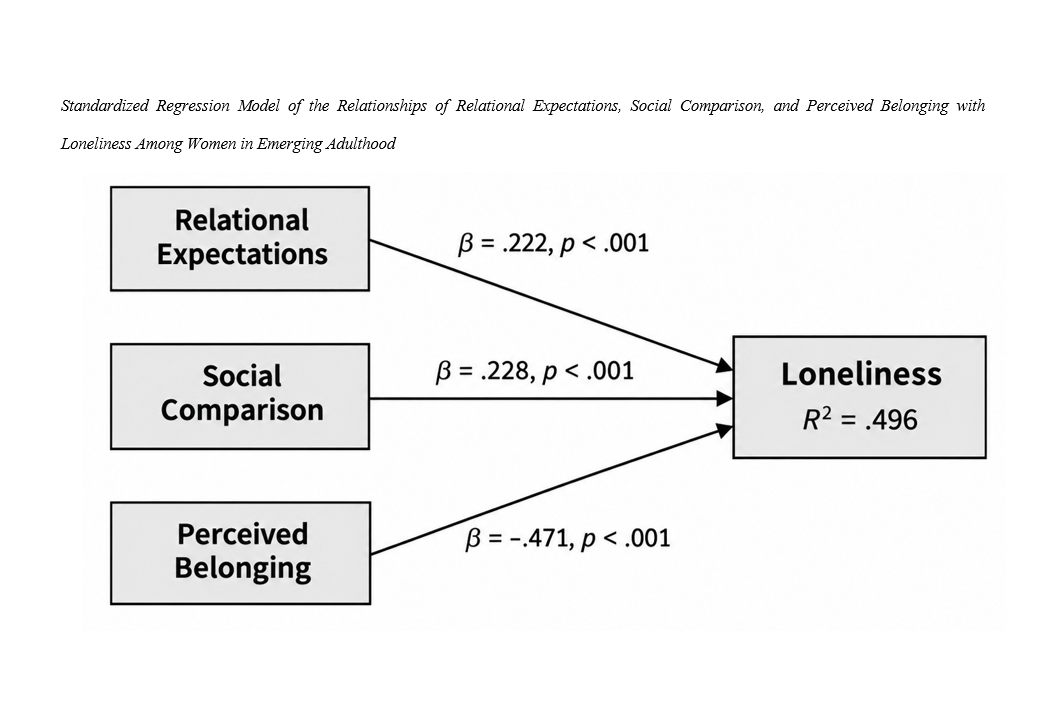
Findings: Loneliness was positively correlated with relational expectations (r = .42, p < .001) and social comparison (r = .48, p < .001), whereas it was negatively correlated with perceived belonging (r = -.63, p < .001). The multiple regression model was statistically significant, F(3, 380) = 124.69, p < .001, and explained 49.6% of the variance in loneliness (R² = .496, adjusted R² = .492). Relational expectations significantly and positively predicted loneliness (β = .222, p < .001), as did social comparison (β = .228, p < .001). Perceived belonging significantly and negatively predicted loneliness (β = -.471, p < .001) and emerged as the strongest independent predictor in the model.
Conclusion: Loneliness among women in emerging adulthood appears to be meaningfully associated with interpersonal standards, comparative self-evaluation, and subjective social inclusion, with perceived belonging representing the strongest protective factor.
Downloads
References
Adlington, K., Vasquez, C., Pearce, E., Wilson, C. A., Nowland, R. A., Taylor, B. L., & Johnson, S. (2023). ‘Just Snap Out of It’ – The Experience of Loneliness in Women With Perinatal Depression: A Meta-Synthesis of Qualitative Studies. BMC psychiatry, 23(1). https://doi.org/10.1186/s12888-023-04532-2
Barreto, M., Breen, J. A. v., Victor, C. R., Hammond, C., Eccles, A. M., Richins, M. T., & Qualter, P. (2022). Exploring the Nature and Variation of the Stigma Associated With Loneliness. Journal of Social and Personal Relationships, 39(9), 2658-2679. https://doi.org/10.1177/02654075221087190
Barreto, M., Doyle, D. M., & Maes, M. (2025). Researching Gender and Loneliness Differently. Annals of the New York Academy of Sciences, 1544(1), 55-64. https://doi.org/10.1111/nyas.15283
Chiu, C. J., Hou, S. Y., Kobayashi, E., Lin, Y. C., Chen, Y. A., Murayama, H., Okamoto, S., & Chen, Y. H. (2025). Reversed Loneliness Development After Age 65 for Men and Women: Modeling of the Age Trajectories of Loneliness Using National Cohorts in Taiwan and Japan. Geriatrics and Gerontology International, 25(4), 620-627. https://doi.org/10.1111/ggi.70022
Fernández‐Carro, C., & Gumà, J. (2022). A Life-Course Approach to the Relationship Between Education, Family Trajectory and Late-Life Loneliness Among Older Women in Europe. Social Indicators Research, 162(3), 1345-1363. https://doi.org/10.1007/s11205-022-02885-x
Field, T. M. (2023). Loneliness in Aging Adults: A Narrative Review. International Journal of Psychological Research and Reviews. https://doi.org/10.28933/ijprr-2022-12-2105tfd
Huang, P. H., Wu, H.-l., Chi, M. J., Yu, M. I., & Chuang, Y. C. (2026). Gender Differences in Loneliness Among Older Adults: An 8-Year Longitudinal Study. Research in Gerontological Nursing, 19(4), 177-190. https://doi.org/10.3928/19404921-20260415-01
Immel, D., Mallick, E., Linz, N., Barton, S., Hurlemann, R., & Scheele, D. (2025). The Sound of Loneliness: Prediction of Perceived Social Isolation Using Automatic Speech Analysis. https://doi.org/10.21203/rs.3.rs-7868485/v1
Immel, D., Mallick, E., Linz, N., Barton, S., Hurlemann, R., & Scheele, D. (2026). Automatic Speech Analysis Can Predict Loneliness. Scientific reports, 16(1). https://doi.org/10.1038/s41598-026-45965-5
Iwasaki, S., Deguchi, Y., & Inoue, K. (2025). Loneliness and Psychological Stress in Japanese University Students: A Cross‐sectional Gender‐based Comparative Study. Psychiatry and Clinical Neurosciences Reports, 4(3). https://doi.org/10.1002/pcn5.70153
Kuang, J., Zhong, J., Arnett, J. J., Chen, E., Markwart, M., Yeung, A., & Zou, L. (2022). Conceptions of Adulthood Among Chinese Emerging Adults. https://doi.org/10.31234/osf.io/d4b6y
Langenkamp, A., & Schobin, J. (2024). Revealing Loneliness: Disentangling the Interaction of Gender and Community Stigma. Social Science Quarterly. https://doi.org/10.1111/ssqu.13434
Morr, M., Noell, J., Sassin, D., Daniels, J., Philipsen, A., Becker, B., Stoffel‐Wagner, B., Hurlemann, R., & Scheele, D. (2022). Lonely in the Dark: Trauma Memory and Sex‐Specific Dysregulation of Amygdala Reactivity to Fear Signals. Advanced Science, 9(15). https://doi.org/10.1002/advs.202105336
Murtazina, I., Krupina, K., & Strizhitskaya, O. (2025). Loneliness in Middle-Aged and Older Adults: Effects of Social Environments. Behavioral Sciences, 15(1), 71. https://doi.org/10.3390/bs15010071
Nicolaisen, M., & Thorsen, K. (2023). Gender Differences in Loneliness Over Time: A 15-Year Longitudinal Study of Men and Women in the Second Part of Life. The International Journal of Aging and Human Development, 98(1), 103-132. https://doi.org/10.1177/00914150231194243
Öğütle, V. S., ÖĞÜTle, F. S., SevlÜ, H., & SarimuratoĞLu, D. (2022). Comparison of the Pandemic Experiences of British and Syrian Old Women Living Alone in Turkey. Msgsü Akademi Dergisi, 2(26), 318-334. https://doi.org/10.56074/msgsusbd.1165062
Ojembe, B. U., Oyinlola, O., Kalu, M. E., Eugene, E., & Aninma, A. (2025). Loneliness, Family Devotion, Care Provision, and Gendered Façades Among Black Older Adults in Canada: A Narrative Qualitative Study. Research on Aging, 48(3-4), 240-252. https://doi.org/10.1177/01640275251357848
Ong, W. J. (2022). Gender-Contingent Effects of Leadership on Loneliness. Journal of Applied Psychology, 107(7), 1180-1202. https://doi.org/10.1037/apl0000907
Qiu, Z., Huang, Y., Kan, J., & Xu, L. (2026). Incremental Information From Repeated Loneliness Assessments in Middle-Aged and Older Adults. Healthcare, 14(18), 3058. https://doi.org/10.3390/healthcare14183058
Reine, I., Miķelsone, M., Guðmundsson, H., Ivanovs, A., Tomsone, S., & Guðmundsson, H. S. (2023). Loneliness, Social Isolation and Ageing: A Methodological Approach to Compare Latvian and Icelandic Older Populations in the Course of COVID-19 Pandemic. https://doi.org/10.21203/rs.3.rs-2870118/v1
Rogowska, A. M., & Libera, P. (2022). Life Satisfaction and Instagram Addiction Among University Students During the COVID-19 Pandemic: The Bidirectional Mediating Role of Loneliness. International journal of environmental research and public health, 19(14), 8414. https://doi.org/10.3390/ijerph19148414
Rokach, A. (2023). The Effects of Loneliness on the Aged: A Review. Obm Geriatrics, 07(02), 1-31. https://doi.org/10.21926/obm.geriatr.2302236
Ryś, M., Kalu, F. A., Seroczyńska, K., & Tataj–Puzyna, U. (2023). Forms of Showing Love in Relationships With Loved Ones Versus Feelings of Loneliness in Young Adults. Kwartalnik Naukowy Fides et Ratio, 53(1), 101-111. https://doi.org/10.34766/fetr.v53i1.1155
Shin, O., Park, S., Lee, H., & Kang, J. Y. (2022). Gender Differences in the Mechanism of Involuntary Retirement Affecting Loneliness Through Vulnerability and Coping Resources. Ageing and Society, 44(2), 247-268. https://doi.org/10.1017/s0144686x21001914
Simon, Y., Minagawa, Y., Robine, J. M., Ojima, T., Brouard, N., & Pérès, K. (2026). Impact of Loneliness on Disability-Free Life Expectancy Among Older Adults: A Comparative Study of France and Japan. https://doi.org/10.21203/rs.3.rs-10372018/v1
Vedder, A., Stroebe, M., Stokes, J. E., Schut, H. A. W., Schut, B., Boerner, K., & Boelen, P. A. (2024). Exploring Loneliness Across Widowhood and Other Marital Statuses: A Systematic Review Integrating Insights From Grief Research. Journal of Social and Personal Relationships, 41(12), 3741-3769. https://doi.org/10.1177/02654075241277229
Wilson-Genderson, M., Heid, A. R., Cartwright, F. P., & Pruchno, R. A. (2021). Change in Loneliness Experienced by Older Men and Women Living Alone and With Others at the Onset of the COVID-19 Pandemic. Research on Aging, 44(5-6), 369-381. https://doi.org/10.1177/01640275211026649
Yu, Q., & Wu, J. (2024). Loneliness Shapes Disparities in Healthy Life Expectancy: A Multi-State Analysis From China. BMC public health, 24(1). https://doi.org/10.1186/s12889-024-18975-z
Zhou, Z., Liu, C.-x., Zhang, Q.-p., Ji, W., & Kou, Y. (2026). The Developmental Trajectories of Loneliness in Emerging Adulthood and the Associations With Worldview. Emerging Adulthood, 14(3), 450-463. https://doi.org/10.1177/21676968261428335
Downloads
Additional Files
Publication Timeline
- Submitted
- Revised
- Accepted