The Effectiveness of Acceptance and Commitment Therapy on Reducing Post-Traumatic Stress Disorder Symptoms and Enhancing Post-Traumatic Growth in Adolescent Survivors of Sexual Assault
DOI:
https://doi.org/10.61838/kman.hn.5146Keywords:
acceptance and commitment therapy; post-traumatic stress disorder; post-traumatic growth; sexual assault; adolescence; trauma therapy.Abstract
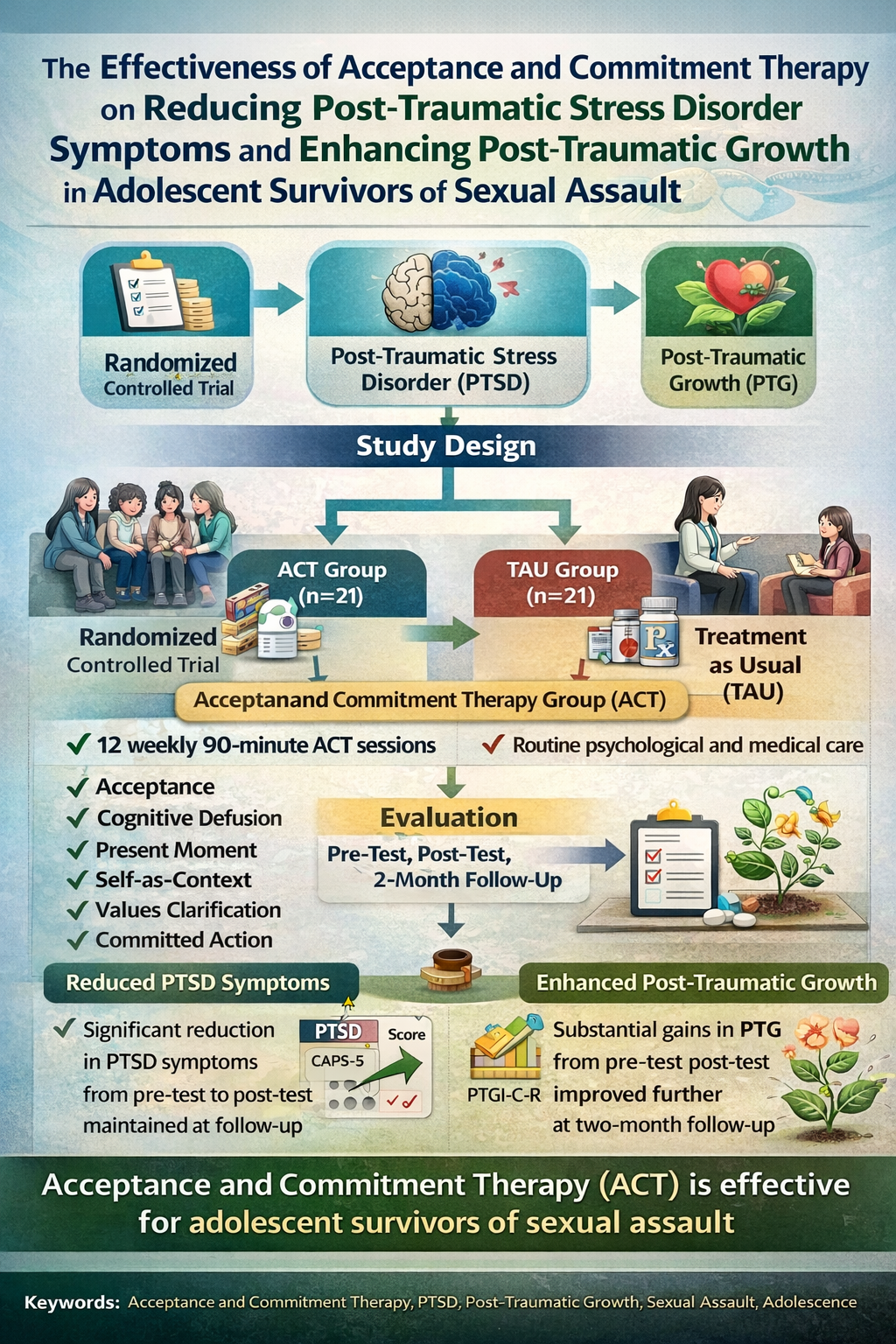
Sexual assault during adolescence is associated with profound psychological sequelae, particularly post-traumatic stress disorder (PTSD), yet traumatic exposure may also be followed by post-traumatic growth (PTG). This study evaluated whether Acceptance and Commitment Therapy (ACT) could simultaneously reduce PTSD symptoms and strengthen PTG in adolescent survivors of sexual assault. The study used a randomized controlled, pre-test/post-test/follow-up design. Forty-two adolescent girls aged 13–18 years who met diagnostic criteria for PTSD after sexual assault were recruited from counseling centers, forensic medicine clinics, and welfare-related services in Tehran and randomly assigned to ACT or treatment as usual (TAU). The ACT condition involved 12 weekly 90-minute sessions adapted for trauma-exposed adolescents and focused on acceptance, cognitive defusion, present-moment awareness, self-as-context, values clarification, and committed action. Outcomes were assessed using the Clinician-Administered PTSD Scale for DSM-5 (CAPS-5), the Child PTSD Symptom Scale for DSM-5 (CPSS-5), and the Posttraumatic Growth Inventory for Children–Revised (PTGI-C-R). Data were analyzed with mixed-design analysis of variance. Thirty-nine participants completed the study (ACT, n=19; TAU, n=20). A significant Time × Group interaction was found for PTSD symptoms, F(2,74)=45.32, p<0.001, ηp2=0.55, showing a marked reduction in the ACT group from pre-test to post-test that was maintained at follow-up. A similarly significant Time × Group interaction emerged for PTG, F(2,74)=38.91, p<0.001, ηp2=0.51, indicating substantial gains in growth-related outcomes in the ACT group, with further improvement at the two-month follow-up. The control group showed no significant change in either outcome. ACT appears to be an effective intervention for adolescent survivors of sexual assault. Beyond symptom reduction, it may also support constructive post-traumatic adaptation by helping adolescents respond more flexibly to trauma-related thoughts and emotions and re-engage with personally meaningful life directions.
Downloads
References
1. Danaeifar M, Arshi M, Moghanibashi-Mansourieh A, et al. Child sexual abuse in Iran: a systematic review of the prevalence, risk factors, consequences, interventions and laws. J Inj Violence Res. 2022;14(3):225-236. https://doi.org/10.5249/jivr.v14i3.1754
2. Dworkin ER, Menon SV, Bystrynski J, Allen NE. Sexual assault victimization and psychopathology: a review and meta-analysis. Clin Psychol Rev. 2017;56:65-81. https://doi.org/10.1016/j.cpr.2017.06.002
3. Hébert M, Lavoie F, Blais M. Post-traumatic stress disorder/PTSD in adolescent victims of sexual abuse: resilience and social support as protection factors. Cien Saude Colet. 2014;19(3):685-694. https://doi.org/10.1590/1413-81232014193.15972013
4. McLean CP, Morris SH, Conklin P, Jayawickreme N, Foa EB. Trauma characteristics and posttraumatic stress disorder among adolescent survivors of childhood sexual abuse. J Fam Violence. 2014;29(5):559-566. https://doi.org/10.1007/s10896-014-9613-6
5. McLaughlin KA, Weissman D, Bitrán D. Childhood adversity and neural development: a systematic review. Annu Rev Dev Psychol. 2019;1:277-312. https://doi.org/10.1146/annurev-devpsych-121318-084950
6. Alves AC, Leitão M, Sani AI, Moreira D. Impact of sexual abuse on post-traumatic stress disorder in children and adolescents: a systematic review. Soc Sci. 2024;13(4):189. https://doi.org/10.3390/socsci13040189
7. Morina N, Koerssen R, Pollet TV. Interventions for children and adolescents with posttraumatic stress disorder: a meta-analysis of comparative outcome studies. Clin Psychol Rev. 2016;47:41-54. https://doi.org/10.1016/j.cpr.2016.05.006
8. Thompson RW, Arnkoff DB, Glass CR. Conceptualizing mindfulness and acceptance as components of psychological resilience to trauma. Trauma Violence Abuse. 2011;12(4):220-235. https://doi.org/10.1177/1524838011416375
9. Hayes SC, Levin ME, Plumb-Vilardaga J, Villatte JL, Pistorello J. Acceptance and commitment therapy and contextual behavioral science: examining the progress of a distinctive model of behavioral and cognitive therapy. Behav Ther. 2013;44(2):180-198. https://doi.org/10.1016/j.beth.2009.08.002
10. Tull MT, Gratz KL, Salters K, Roemer L. The role of experiential avoidance in posttraumatic stress symptoms and symptoms of depression, anxiety, and somatization. J Nerv Ment Dis. 2004;192(11):754-761. https://doi.org/10.1097/01.nmd.0000144694.30121.89
11. Vujanovic AA, Youngwirth NE, Johnson KA, Zvolensky MJ. Mindfulness-based acceptance and posttraumatic stress symptoms among trauma-exposed adults without axis I psychopathology. J Anxiety Disord. 2009;23(2):297-303. https://doi.org/10.1016/j.janxdis.2008.08.005
12. Meyer EC, Morissette SB, Kimbrel NA, Kruse MI, Gulliver SB. Acceptance and Action Questionnaire-II scores as a predictor of posttraumatic stress disorder symptoms among war veterans. Psychol Trauma. 2013;5(6):521-528. https://doi.org/10.1037/a0030178
13. Dutra SJ, Sadeh N. Psychological flexibility mitigates effects of PTSD symptoms and negative urgency on aggressive behavior in trauma-exposed veterans. Personal Disord. 2018;9(4):315-323. https://doi.org/10.1037/per0000251
14. Tedeschi RG, Calhoun LG. The Posttraumatic Growth Inventory: measuring the positive legacy of trauma. J Trauma Stress. 1996;9(3):455-471. https://doi.org/10.1002/jts.2490090305
15. Cryder CH, Kilmer RP, Tedeschi RG, Calhoun LG. An exploratory study of posttraumatic growth in children following a natural disaster. Am J Orthopsychiatry. 2006;76(1):65-69. https://doi.org/10.1037/0002-9432.76.1.65
16. Kilmer RP, Gil-Rivas V, Tedeschi RG, Cann A. Use of the revised Posttraumatic Growth Inventory for Children. J Trauma Stress. 2009;22(3):248-253. https://doi.org/10.1002/jts.20410
17. Salter E, Stallard P. Posttraumatic growth in child survivors of a road traffic accident. J Trauma Stress. 2004;17(4):335-340. https://doi.org/10.1023/B:JOTS.0000038482.53911.01
18. Meyerson DA, Grant KE, Carter JS, Kilmer RP. Posttraumatic growth among children and adolescents: a systematic review. Clin Psychol Rev. 2011;31(6):949-964. https://doi.org/10.1016/j.cpr.2011.06.003
19. Ferris C, O'Brien K. The ins and outs of posttraumatic growth in children and adolescents: a systematic review of factors that matter. J Trauma Stress. 2022;35(5):1305-1317. https://doi.org/10.1002/jts.22845
20. Daigneault I, Dion J, Hébert M, Bourgeois C. Mindfulness as mediator and moderator of post-traumatic symptomatology in adolescence following childhood sexual abuse or assault. Mindfulness (N Y). 2016;7(6):1306-1315. https://doi.org/10.1007/s12671-016-0571-3
21. Foa EB, Asnaani A, Zang Y, et al. Psychometrics of the Child PTSD Symptom Scale for DSM-5 for trauma-exposed children and adolescents. J Clin Child Adolesc Psychol. 2018;47(1):38-46. https://doi.org/10.1080/15374416.2017.1350962
22. Weathers FW, Bovin MJ, Lee DJ, et al. The Clinician-Administered PTSD Scale for DSM-5 (CAPS-5): development and initial psychometric evaluation in military veterans. Psychol Assess. 2018;30(3):383-395. https://doi.org/10.1037/pas0000486
23. Lang AJ, Schnurr PP, Jain S, et al. Randomized controlled trial of acceptance and commitment therapy for distress and impairment in OEF/OIF/OND veterans. Psychol Trauma. 2017;9(S1):74-84. https://doi.org/10.21236/ada554539
24. Spidel A, Lecomte T, Kealy D, Daigneault I. Acceptance and commitment therapy for psychosis and trauma: improvement in psychiatric symptoms, emotion regulation, and treatment compliance following a brief group intervention. Psychol Psychother. 2018;91(2):248-261. https://doi.org/10.1111/papt.12159
25. Spidel A, Daigneault I, Kealy D, Lecomte T. Acceptance and commitment therapy for psychosis and trauma: investigating links between trauma severity, attachment and outcome. Behav Cogn Psychother. 2019;47(2):230-243. https://doi.org/10.1017/S1352465818000413
26. Kelly MM, Reilly ED, Ameral V, Richter S, Fukuda S. A randomized pilot study of acceptance and commitment therapy to improve social support for veterans with PTSD. J Clin Med. 2022;11(12):3482. https://doi.org/10.3390/jcm11123482
27. Tourigny M, Hébert M, Daigneault I, Simoneau AC. Efficacy of group therapy for sexually abused adolescent girls. J Child Sex Abus. 2005;14(4):71-93. https://doi.org/10.1300/J070v14n04_04
28. An Y, Yuan G, Zhang N, Xu W, Liu Z, Zhou F. Longitudinal cross-lagged relationships between mindfulness, posttraumatic stress symptoms, and posttraumatic growth in adolescents following the Yancheng tornado in China. Psychiatry Res. 2018;264:304-310. https://doi.org/10.1016/j.psychres.2018.03.034
Downloads
Additional Files
Publication Timeline
- Submitted
- Revised
- Accepted