The Effectiveness of Emotionally Focused Couple Therapy on Marital Commitment, Marital Intimacy, and Marital Forgiveness Among Couples Affected by Extramarital Relationships: A Quasi-Experimental Study
DOI:
https://doi.org/10.61838/kman.hn.5328Keywords:
Emotionally Focused Couple Therapy; extramarital relationships; marital commitment; marital intimacy; marital forgiveness; attachment injury; infidelityAbstract
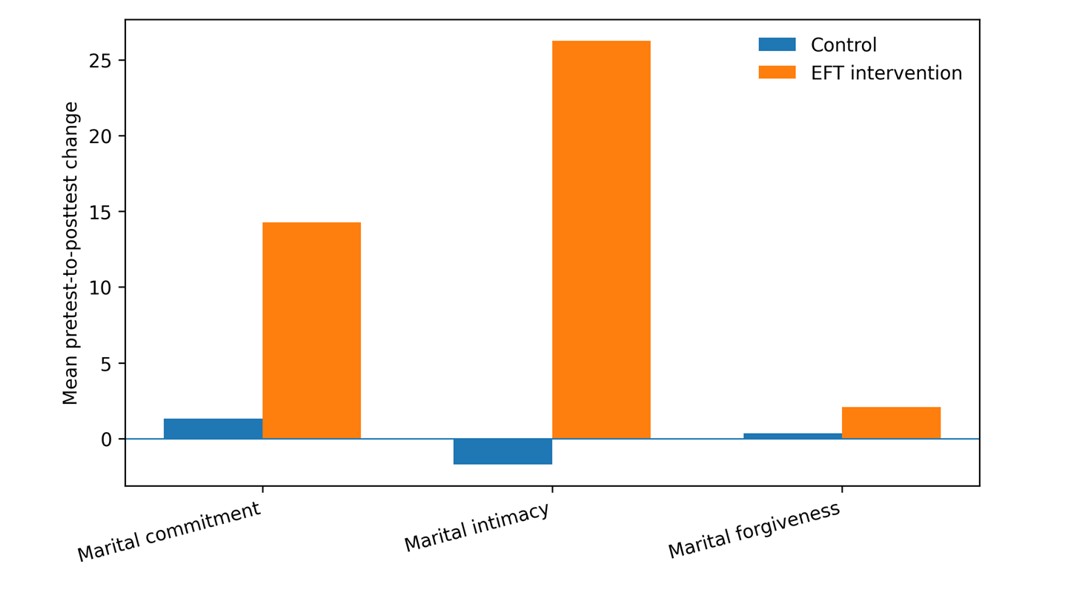
Background: Extramarital relationships can produce a severe relational rupture that weakens trust, emotional accessibility, marital commitment, intimacy, and the capacity to forgive. Emotionally Focused Couple Therapy (EFT) is an attachment-oriented intervention designed to restructure negative interaction cycles and restore emotional responsiveness between partners. Objective: This study examined the effectiveness of EFT on marital commitment, marital intimacy, and marital forgiveness among couples affected by extramarital relationships. Methods: A quasi-experimental pretest-posttest design with an experimental group and a control group was used. Thirty-two participants who had attended family counseling clinics in Tehran because of distress related to a spouse's extramarital relationship were selected through purposive sampling and assigned equally to an EFT intervention group or a control group. The intervention group received eight 90-minute EFT sessions, whereas the control group received no EFT intervention during the study period. Data were collected using the Marital Commitment Questionnaire, the Walker-Thompson Marital Intimacy Scale, and the Rye Forgiveness Scale. Descriptive statistics, assumption testing, multivariate analysis of covariance, and follow-up univariate analyses of covariance were applied. Results: After controlling for pretest scores, a significant multivariate difference was observed between groups at posttest, Wilks' Lambda = .489, F = 37.49, p = .008, partial eta squared = .56. Follow-up analyses indicated significant posttest improvements in marital commitment, marital intimacy, and marital forgiveness in the EFT group compared with the control group. Conclusion: EFT appears to be a useful intervention for couples experiencing injury after extramarital relationships, particularly when clinical work targets attachment needs, emotional disclosure, responsiveness, and reconstruction of safe interaction cycles.
Downloads
Downloads
Publication Timeline
- Submitted
- Accepted