
Parental Emotional Intelligence and Emotion Regulation in Children Aged 6–12: A Cross-Sectional Study
DOI:
https://doi.org/10.61838/kman.hn.5351Keywords:
emotional intelligence; emotion regulation; parents; children; family; psychological adjustmentAbstract
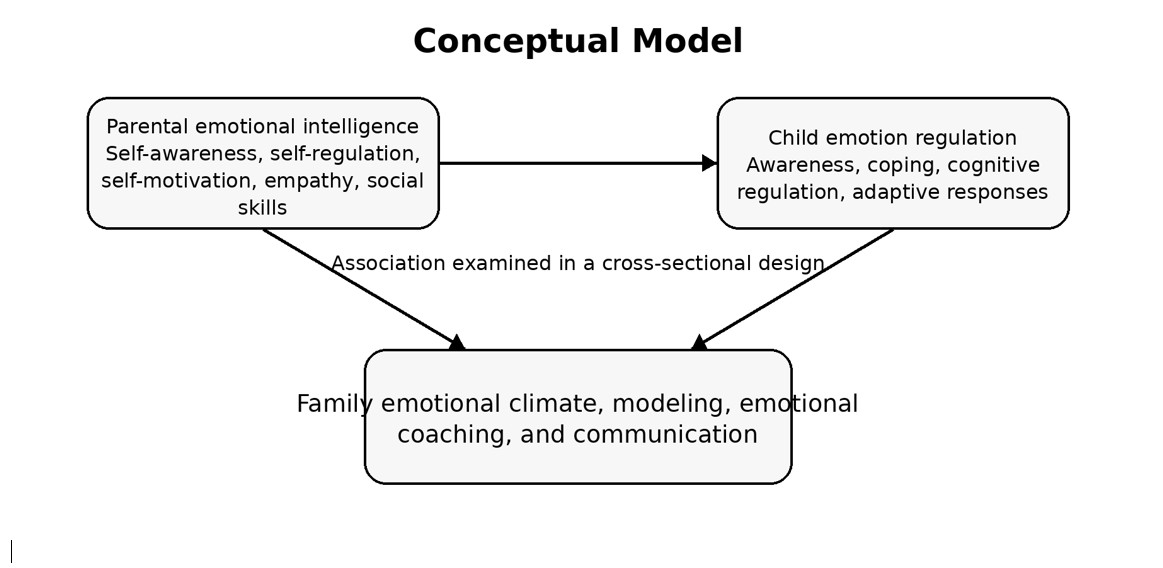
Emotion regulation is a central developmental capacity during childhood and is closely related to children’s psychological adjustment, interpersonal functioning, and behavioral adaptation. Parents play a major role in children’s emotional development through modeling, emotional communication, parenting responses, and the emotional climate of the family. Parental emotional intelligence may therefore be associated with children’s ability to understand, manage, and regulate emotional experiences. This study examined the relationship between parental emotional intelligence and emotion regulation in children aged 6–12 years. Specifically, it investigated whether the main components of parental emotional intelligence—self-awareness, self-regulation, self-motivation, empathy, and social skills—were positively associated with children’s emotion regulation. This applied, descriptive, cross-sectional survey study was conducted among parents of children aged 6–12 years in Tehran, Iran. Based on Cochran’s formula for an unlimited population, 384 parents were included. Data were collected using the Schering Emotional Intelligence Questionnaire and the Cognitive Emotion Regulation Questionnaire developed by Garnefski and Kraaij. Internal consistency coefficients for the parental emotional intelligence components ranged from .76 to .80 in the present sample. Data were analyzed in SPSS using descriptive statistics, bivariate correlation coefficients, and multiple regression model summary statistics. The findings showed positive and statistically significant associations between all parental emotional intelligence components and child emotion regulation. The strongest reported correlation was observed for parental self-awareness (r = .50), followed by parental social skills (r = .45), self-motivation (r = .41), self-regulation (r = .38), and empathy (r = .37). The combined model showed a multiple correlation of R = .470. Because the originally reported R² value was not mathematically compatible with the reported R value, R² was corrected to .221, indicating that the parental emotional intelligence components jointly explained approximately 22.1% of the variance in children’s emotion regulation. The results suggest that higher parental emotional intelligence is associated with better emotion regulation in children aged 6–12 years. The findings support the importance of strengthening parents’ emotional skills as part of family-based educational and preventive mental health programs.
Downloads
Downloads
Publication Timeline
- Revised
- Accepted