
Effectiveness of Acceptance and Commitment Therapy on Pain Catastrophizing, Pain Self-Efficacy, and Psychological Flexibility in Individuals with Chronic Pain: A Quasi-Experimental Study
DOI:
https://doi.org/10.61838/kman.hn.5352Keywords:
Acceptance and Commitment Therapy; chronic pain; pain catastrophizing; pain self-efficacy; psychological flexibility; online interventionAbstract
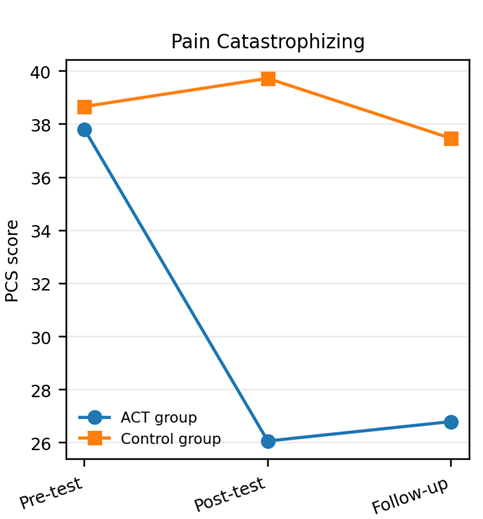
Background: Chronic pain is a persistent biopsychosocial condition in which pain-related thoughts, behavioral avoidance, emotional distress, and perceived coping ability can interact to maintain disability and suffering. Acceptance and Commitment Therapy (ACT) is designed to increase psychological flexibility and help individuals engage in valued action even when pain and distress are present. Objective: This study examined the effectiveness of ACT on pain catastrophizing, pain self-efficacy, and psychological flexibility in adults with chronic pain. Methods: A quasi-experimental pretest-posttest control group design with a two-month follow-up was used. Thirty adults with chronic pain were recruited through online platforms and purposively selected according to eligibility criteria. Participants were randomly assigned to an ACT group (n = 15) or a control group (n = 15). The ACT group received eight weekly 90-minute online group sessions, whereas the control group received no intervention during the active study period. Measures included the Pain Catastrophizing Scale, Pain Self-Efficacy Questionnaire, and Acceptance and Action Questionnaire-II. Data were analyzed using repeated-measures ANOVA and Bonferroni comparisons. Results: The ACT group showed marked improvement from pretest to posttest and follow-up. Pain catastrophizing decreased from 37.80 to 26.07 at posttest and 26.80 at follow-up. Pain self-efficacy increased from 30.40 to 42.27 at posttest and 43.47 at follow-up. Psychological flexibility improved as AAQ-II scores decreased from 31.33 to 19.80 at posttest and 19.20 at follow-up. Significant time, group, and time by group effects were reported for all outcomes. Conclusion: ACT was associated with sustained reductions in pain catastrophizing and improvements in pain self-efficacy and psychological flexibility among individuals with chronic pain. Larger randomized trials with active controls and longer follow-up periods are recommended.
Downloads
References
1. Raja SN, Carr DB, Cohen M, Finnerup NB, Flor H, Gibson S, et al. The revised International Association for the Study of Pain definition of pain: Concepts, challenges, and compromises. Pain. 2020;161(9):1976-82. [PMID: 32694387] [PMCID: PMC7680716] [DOI]
2. Treede RD, Rief W, Barke A, Aziz Q, Bennett MI, Benoliel R, et al. Chronic pain as a symptom or a disease: The IASP Classification of Chronic Pain for the International Classification of Diseases ICD-11. Pain. 2019;160(1):19-27. [PMID: 30586067] [PMCID: PMC11438724] [DOI]
3. Gatchel RJ, Peng YB, Peters ML, Fuchs PN, Turk DC. The biopsychosocial approach to chronic pain: scientific advances and future directions. Psychological Bulletin. 2007;133(4):581-624. [PMID: 17592957] [DOI]
4. Sullivan MJL, Bishop SR, Pivik J. The Pain Catastrophizing Scale: Development and validation. Psychological Assessment. 1995;7(4):524-32. [DOI]
5. Bandura A. Self-efficacy: The exercise of control: W. H. Freeman; 1997.
6. Nicholas MK. The pain self-efficacy questionnaire: taking pain into account. European journal of pain. 2007;11(2):153-63. [PMID: 16446108] [DOI]
7. Hayes SC, Luoma JB, Bond FW, Masuda A, Lillis J. Acceptance and commitment therapy: Model, processes and outcomes. Behaviour Research and Therapy. 2006;44(1):1-25. [PMID: 16300724] [DOI]
8. Bond FW, Hayes SC, Baer RA, Carpenter KM, Guenole N, Orcutt HK, et al. Preliminary psychometric properties of the Acceptance and Action Questionnaire-II: A revised measure of psychological inflexibility and experiential avoidance. Behavior Therapy. 2011;42(4):676-88. [PMID: 22035996] [PMCID: PMC8527996] [DOI]
9. Fang S, Ding D. Which outcome variables are associated with psychological inflexibility/flexibility for chronic pain patients? A three-level meta-analysis. Frontiers in Psychology. 2022;13:1069748. [PMID: 36562078] [PMCID: PMC9767366] [DOI]
10. Hayes SC, Strosahl KD, Wilson KG. Acceptance and commitment therapy: The process and practice of mindful change. 2nd ed: Guilford Press; 2012. [DOI]
11. Martinez-Calderon J, García-Muñoz C, Rufo-Barbero C, Matias-Soto J, Cano-García FJ. Acceptance and commitment therapy for chronic pain: An overview of systematic reviews with meta-analysis of randomized clinical trials. The Journal of Pain. 2024;25(3):595-617. [PMID: 37748597] [DOI]
12. McCracken LM, Vowles KE, Eccleston C. Acceptance-based treatment for persons with complex, long standing chronic pain: a preliminary analysis of treatment outcome in comparison to a waiting phase. Behaviour Research and Therapy. 2005;43(10):1335-46. [PMID: 16086984] [DOI]
13. Wetherell JL, Afari N, Rutledge T, Sorrell JT, Stoddard JA, Petkus AJ, et al. A randomized, controlled trial of acceptance and commitment therapy and cognitive-behavioral therapy for chronic pain. Pain. 2011;152(9):2098-107. [PMID: 21683527] [DOI]
14. A-Tjak JGL, Davis ML, Morina N, Powers MB, Smits JAJ, Emmelkamp PMG. A meta-analysis of the efficacy of acceptance and commitment therapy for clinically relevant mental and physical health problems. Psychotherapy and Psychosomatics. 2015;84(1):30-6. [PMID: 25547522] [DOI]
15. Hughes LS, Clark J, Colclough JA, Dale E, McMillan D. Acceptance and Commitment Therapy (ACT) for chronic pain: A systematic review and meta-analyses. Clinical Journal of Pain. 2017;33(6):552-68. [PMID: 27479642] [DOI]
16. Veehof MM, Oskam MJ, Schreurs KMG, Bohlmeijer ET. Acceptance-based interventions for the treatment of chronic pain: A systematic review and meta-analysis. Pain. 2011;152(3):533-42. [PMID: 21251756] [PMCID: PMC11438724] [DOI]
17. Veehof MM, Trompetter HR, Bohlmeijer ET, Schreurs KMG. Acceptance- and mindfulness-based interventions for the treatment of chronic pain: A meta-analytic review. Cognitive Behaviour Therapy. 2016;45(1):5-31. [PMID: 26818413] [DOI]
18. Ding D, Zheng M. Associations between six core processes of psychological flexibility and functioning for chronic pain patients: A three-level meta-analysis. Frontiers in Psychiatry. 2022;13:893150. [PMID: 35898622] [PMCID: PMC9309299] [DOI]
19. Trompetter HR, Bohlmeijer ET, Fox JP, Schreurs KMG. Psychological flexibility and catastrophizing as associated change mechanisms during online Acceptance and Commitment Therapy for chronic pain. Behaviour Research and Therapy. 2015;74:50-9. [PMID: 26409158] [DOI]
Downloads
Additional Files
Publication Timeline
- Submitted
- Revised
- Accepted