Comparison of the Effectiveness of Short-Term Psychodynamic Therapy and Integrated Acceptance and Commitment Therapy with Schema Therapy on Sleep Quality and Disability Caused by Tension-Type Headache in Insecurely Attached Nurses with Anxiety Symptoms
DOI:
https://doi.org/10.61838/kman.hn.5505Keywords:
short-term psychodynamic therapy, intensive short-term dynamic psychotherapy, acceptance and commitment therapy, schema therapy, sleep quality, tension-type headache, insecure attachment, nurses, anxietyAbstract
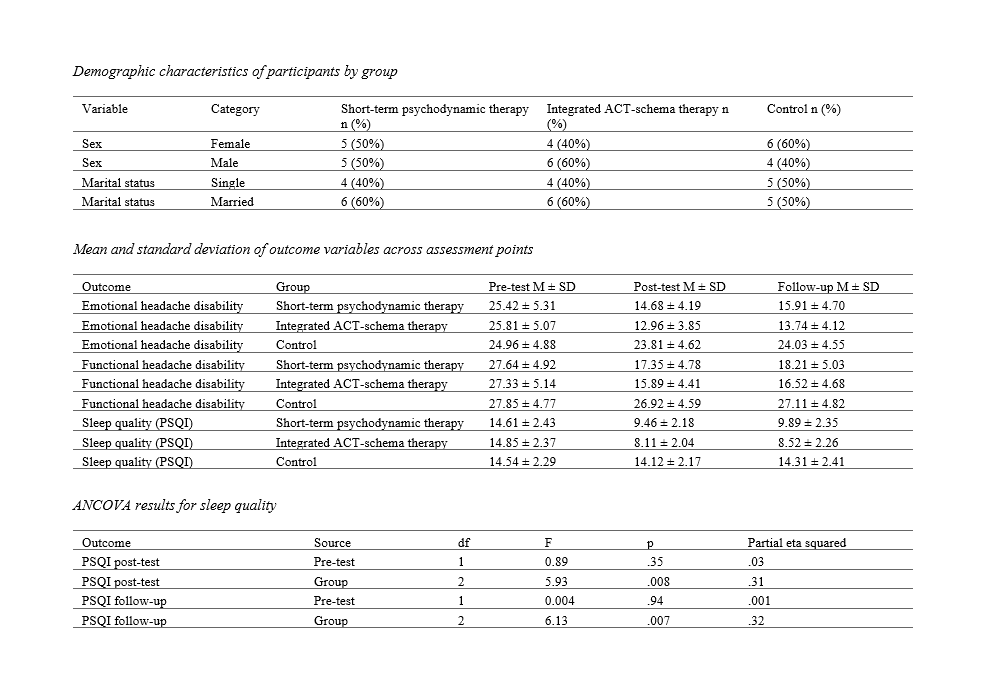
Nurses working in intensive, emergency, and oncology settings are exposed to persistent emotional, cognitive, and physical demands. In nurses with insecure attachment and anxiety symptoms, these demands may be expressed through sleep disturbance and disabling tension-type headache. This study compared the effectiveness of short-term psychodynamic therapy and an integrated acceptance and commitment therapy with schema therapy intervention on sleep quality and tension-type headache-related disability in insecurely attached nurses with anxiety symptoms. A quasi-experimental pre-test-post-test design with a wait-list control group and one-month follow-up was used. The population consisted of nurses employed in ICU, CCU, emergency, and oncology wards of Imam Reza Hospital, Mashhad, Iran, during the second half of 1403 SH. From 420 eligible nurses, 180 volunteered for screening; 70 had anxiety scores above the cut-off on DASS-21, 40 also showed predominant insecure attachment, and 30 met all inclusion criteria. Participants were randomly assigned to short-term psychodynamic therapy (n = 10), integrated acceptance and commitment therapy with schema therapy (n = 10), or wait-list control (n = 10). Both active interventions were delivered in eight 70-minute sessions. Outcome measures were the Pittsburgh Sleep Quality Index and the Headache Disability Inventory. Data were analyzed using multivariate and univariate analysis of covariance and Bonferroni post hoc tests. Results: After controlling for pre-test scores, the overall multivariate group effect was significant for sleep quality, Wilks' Lambda = .49, F(4, 50) = 5.43, p = .001, partial eta squared = .30, and for headache disability, Wilks' Lambda = .30, F(8, 44) = 4.50, p = .001, partial eta squared = .45. Group effects were significant for sleep quality at post-test and follow-up and for both emotional and functional dimensions of headache disability at post-test and follow-up. Adjusted Bonferroni comparisons indicated significant advantages of the psychodynamic group over the control group for sleep quality at post-test and follow-up, and significant advantages of both active interventions over control for headache disability. For headache disability, the adjusted pairwise comparisons indicated larger reductions in the psychodynamic condition than in the integrated treatment condition across post-test and follow-up. Both active interventions were associated with improvements in sleep quality and tension-type headache-related disability; however, the adjusted inferential results suggested a stronger effect of short-term psychodynamic therapy on headache-related disability in this sample. The findings support the clinical relevance of emotion-focused and schema/acceptance-based interventions for anxious, insecurely attached nurses, while emphasizing the need for replication with larger samples and longer follow-up.
Downloads
References
1. Headache Classification Committee of the International Headache Society. The International Classification of Headache Disorders, 3rd edition. Cephalalgia. 2018;38(1):1-211. [DOI]
2. Fernandez-de-las-Penas C, Fernandez-Munoz JJ, Palacios-Cena M, Parás-Bravo P, Cigarán-Méndez M, Navarro-Pardo E. Sleep disturbances in tension-type headache and migraine. Therapeutic Advances in Neurological Disorders. 2018;11:1756285617745444. [PMID: 29399051] [PMCID: PMC5784553] [DOI]
3. Buysse DJ, Reynolds CF, III, Monk TH, Berman SR, Kupfer DJ. The Pittsburgh Sleep Quality Index: a new instrument for psychiatric practice and research. Psychiatry Research. 1989;28(2):193-213. [PMID: 2748771] [DOI]
4. Kang J, Noh W, Lee Y. Sleep quality among shift-work nurses: A systematic review and meta-analysis. Applied Nursing Research. 2020;52:151227. [PMID: 31902652] [DOI]
5. Bowlby J. A secure base: Parent-child attachment and healthy human development: Basic Books; 1988.
6. Bartholomew K, Horowitz LM. Attachment styles among young adults: A test of a four-category model. Journal of Personality and Social Psychology. 1991;61(2):226-44. [PMID: 1920064] [PMCID: PMC9284718] [DOI]
7. Abbass A, Town J, Driessen E. Intensive short-term dynamic psychotherapy: A systematic review and meta-analysis of outcome research. Harvard Review of Psychiatry. 2012;20(2):97-108. [PMID: 24984083] [PMCID: PMC11129844] [DOI]
8. Abbass AA, Kisely SR, Town JM, Leichsenring F, Driessen E, De Maat S, et al. Short-term psychodynamic psychotherapies for common mental disorders. Cochrane Database of Systematic Reviews. 2014;2014(7):CD004687. [PMID: 25547522] [DOI]
9. Hayes SC, Strosahl KD, Wilson KG. Acceptance and commitment therapy: The process and practice of mindful change. 2nd ed: Guilford Press; 2012.
10. A-Tjak JGL, Davis ML, Morina N, Powers MB, Smits JAJ, Emmelkamp PMG. A meta-analysis of the efficacy of acceptance and commitment therapy for clinically relevant mental and physical health problems. Psychotherapy and Psychosomatics. 2015;84(1):30-6. [PMID: 22512743] [DOI]
11. Young JE, Klosko JS, Weishaar ME. Schema therapy: A practitioner's guide: Guilford Press; 2003.
12. Lovibond SH, Lovibond PF. Manual for the Depression Anxiety Stress Scales. 2nd ed: Psychology Foundation of Australia; 1995. [DOI]
13. Kakemam E, Navvabi E, Albelbeisi AH, Saeedikia F, Rouhi A, Majidi S, et al. Psychometric properties of the Persian version of Depression Anxiety Stress Scale-21 Items (DASS-21) in a sample of health professionals: A cross-sectional study. BMC Health Services Research. 2022;22:111. [PMID: 35078477] [PMCID: PMC8789546] [DOI]
14. Jacobson GP, Ramadan NM, Aggarwal SK, Newman CW. The Henry Ford Hospital Headache Disability Inventory (HDI). Neurology. 1994;44(5):837-42. [PMID: 8190284] [DOI]
15. Jabbari S, Hashemi M, Bazrafshan A, Rezaei M. Validity and reliability of Persian version of Henry Ford Hospital Headache Disability Inventory Questionnaire. Archives of Iranian Medicine. 2021;24(10):752-8. [PMID: 34816697] [DOI]
16. Farrahi Moghaddam J, Nakhaee N, Sheibani V, Garrusi B, Amirkafi A. Reliability and validity of the Persian version of the Pittsburgh Sleep Quality Index (PSQI-P). Sleep and Breathing. 2012;16(1):79-82. [PMID: 21614577] [DOI]
17. Davanloo H. Intensive short-term dynamic psychotherapy: Selected papers of Habib Davanloo, MD: John Wiley & Sons; 2000 2000.
18. Chavooshi B, Saberi M, Tavallaie SA, Sahraei H. Psychotherapy for medically unexplained pain: A randomized clinical trial comparing intensive short-term dynamic psychotherapy and cognitive-behavior therapy. Psychosomatics. 2017;58(5):506-18. [PMID: 28279495] [DOI]
Downloads
Additional Files
Publication Timeline
- Submitted
- Revised
- Accepted