The Effectiveness of an Integrated Emotion-Focused Therapy and Music Therapy Package in Reducing Stress, Anxiety, and Depression among Adults with High-Functioning Autism Spectrum Disorder
DOI:
https://doi.org/10.61838/Keywords:
autism spectrum disorder, high-functioning autismhigh-functioning autism, emotion-focused therapy, music therapy, stress, anxiety, depressionAbstract
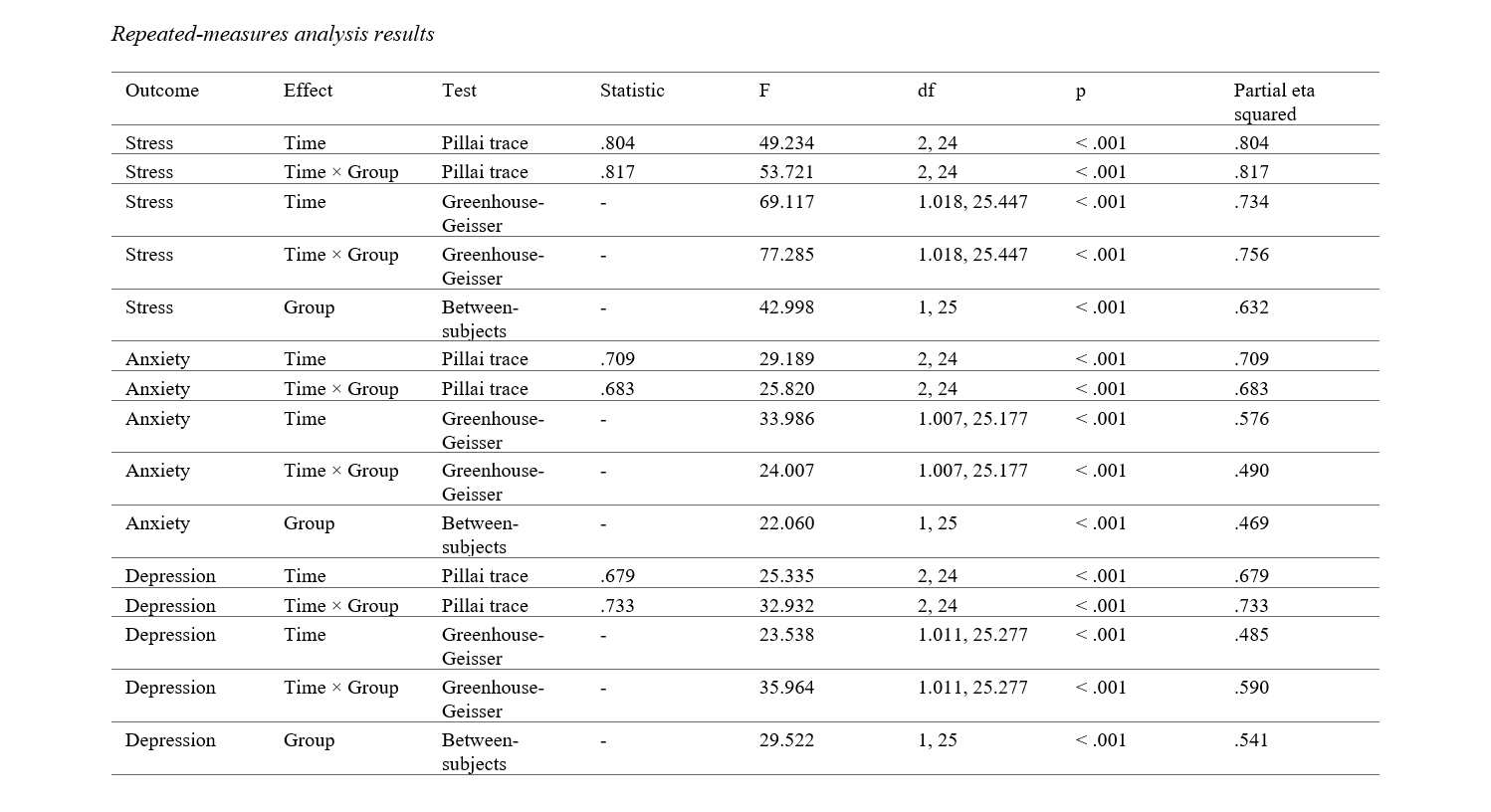
This study examined the preliminary effectiveness of an integrated therapeutic package combining emotion-focused therapy and music therapy in reducing stress, anxiety, and depression among adults with high-functioning autism spectrum disorder. A quasi-experimental pretest-posttest-follow-up design with a control group was used; after purposive eligibility screening, participants were allocated to groups using a simple random procedure. The population consisted of adults aged 18-45 years with autism spectrum disorder level 1, without intellectual disability, who attended psychological centers and private or semi-private clinics in Tehran, Iran, in 2025. Thirty adults were screened, and 27 eligible participants were selected through purposive sampling and allocated by simple random procedure to an experimental group (n = 14) or a control group (n = 13). The experimental group received 12 sessions of the integrated intervention over six weeks, with two 90-minute sessions per week; the control group received no study-delivered active psychological intervention during this period, while access to stable usual care was not restricted. Outcomes were measured using the Depression Anxiety Stress Scales-21 (DASS-21). Mixed-design repeated-measures analyses of variance showed significant time × group interactions for stress, F(1.018, 25.447) = 77.285, p < .001, partial eta squared = .756; anxiety, F(1.007, 25.177) = 24.007, p < .001, partial eta squared = .490; and depression, F(1.011, 25.277) = 35.964, p < .001, partial eta squared = .590. The experimental group showed substantial reductions from pretest to posttest, and these gains were observed at the six-month follow-up, although maintenance should be interpreted cautiously because treatments received during follow-up were not experimentally controlled. The findings suggest that an integrated emotion-focused and music-based intervention may be a useful structured approach for reducing internalizing symptoms in adults with high-functioning autism spectrum disorder.
Downloads
References
1. Schweizer T, Endres D, Dziobek I, Tebartz van Elst L. Psychosocial therapeutic approaches for high-functioning autistic adults. Frontiers in Psychiatry. 2024;14(Article 1265066). [PMID: 38274434] [PMCID: PMC10808656]
2. Posar A, Visconti P. Autism spectrum disorder and the Diagnostic and Statistical Manual of Mental Disorders-Fifth Edition (DSM-5): The experience of 10 years. Turkish Archives of Pediatrics. 2023;58(6):658-9.
3. Zeidan J, Fombonne E, Scorah J, Ibrahim A, Durkin MS, Saxena S, et al. Global prevalence of autism: A systematic review update. Autism Research. 2022;15(5):778-90. [PMID: 35238171] [PMCID: PMC9310578]
4. Hossain MM, Khan N, Sultana A, Ma P, McKyer ELJ, Ahmed HU, et al. Prevalence of comorbid psychiatric disorders among people with autism spectrum disorder: An umbrella review of systematic reviews and meta-analyses. Psychiatry Research. 2020;287(Article 112922). [PMID: 32203749]
5. Speyer R, Chen YW, Kim JH, Wilkes-Gillan S, Nordahl-Hansen AJ, Wu HC, et al. Non-pharmacological interventions for adults with autism: A systematic review of randomised controlled trials. Review Journal of Autism and Developmental Disorders. 2022;9:249-79.
6. McQuaid GA, Weiss CH, Said AJ, Pelphrey KA, Lee NR, Wallace GL. Increased perceived stress is negatively associated with activities of daily living and subjective quality of life in younger, middle, and older autistic adults. Autism Research. 2022;15(8):1535-49. [PMID: 35790082] [PMCID: PMC9545671]
7. McQuaid GA, Lee NR, Wallace GL. An examination of perceived stress and emotion regulation challenges as mediators of associations between camouflaging and internalizing symptomatology among autistic adults. Autism in Adulthood. 2024;6(3):345-61. [PMID: 39371362] [PMCID: PMC11447396]
8. Hoeberichts K, Roke Y, Niks I, van Harten PN. The effect of the Stress Autism Mate app on perceived stress, coping, and resilience in adults with autism: A single-case experimental design. Frontiers in Psychiatry. 2024;15(Article 1347947). [PMID: PMC11210387]
9. Menezes M, Harkins C, Robinson MF, Pappagianopoulos J, Cross R, Vasa RA, et al. Treatment of anxiety in autistic adults: A systematic review. Research in Autism Spectrum Disorders. 2022;99(Article 102068).
10. Da Silva AB, Berry E, Craig S, Doumas M. A systematic review of autistic adults' experiences of anxiety from a qualitative perspective. Journal of Autism and Developmental Disorders. 2025.
11. Thiel T, Riedelbauch S, Gaigg SB, Roessner V, Ring M. The impact of depressive and anxious symptoms on quality of life in adults on the autism spectrum. Autism Research. 2024;17(6):1161-74. [PMID: 38783834]
12. Hinze E, Paynter J, Dargue N, Adams D. The presentation of depression in depressed autistic individuals: A systematic review. Review Journal of Autism and Developmental Disorders. 2024.
13. Mazefsky CA, Herrington J, Siegel M, Scarpa A, Maddox BB, Scahill L, et al. The role of emotion regulation in autism spectrum disorder. Journal of the American Academy of Child & Adolescent Psychiatry. 2013;52(7):679-88. [PMID: 23800481] [PMCID: PMC3719386]
14. Samson AC, Phillips JM, Parker KJ, Shah S, Gross JJ, Hardan AY. Emotion dysregulation and the core features of autism spectrum disorder. Journal of Autism and Developmental Disorders. 2014;44(7):1766-72. [PMID: 24362795]
15. Morie KP, Jackson S, Zhai ZW, Potenza MN, Dritschel B. Mood disorders in high-functioning autism: The importance of alexithymia and emotional regulation. Journal of Autism and Developmental Disorders. 2019;49(7):2935-45. [PMID: 31028592] [PMCID: PMC7375152]
16. Greenberg LS. Emotion-focused therapy: A clinical synthesis. Focus. 2010;8(1):32-42.
17. Robinson A, Elliott R. Emotion-focused therapy for clients with autistic process. Person-Centered & Experiential Psychotherapies. 2017;16(3):215-35.
18. Gao X, Xu G, Fu N, Ben Q, Wang L, Bu X. The effectiveness of music therapy in improving behavioral symptoms among children with autism spectrum disorders: A systematic review and meta-analysis. Frontiers in Psychiatry. 2025;15(Article 1511920). [PMID: 39896995] [PMCID: PMC11783185]
19. Geretsegger M, Fusar-Poli L, Elefant C, Mössler KA, Vitale G, Gold C. Music therapy for autistic people. Cochrane Database of Systematic Reviews. 2022;2022(5). [PMID: 35532041] [PMCID: PMC9082683]
20. Shi Z, Wang S, Chen M, Hu A, Long Q, Lee Y. The effect of music therapy on language communication and social skills in children with autism spectrum disorder: A systematic review and meta-analysis. Frontiers in Psychology. 2024;15(Article 1336421). [PMID: 38774719] [PMCID: PMC11106491]
21. Lovibond SH, Lovibond PF. Manual for the Depression Anxiety Stress Scales: Psychology Foundation of Australia; 1995.
22. Moya E, Larson LM, Stewart RC, Fisher J, Mwangi MN, Phiri KS. Reliability and validity of depression anxiety stress scale (DASS)-21 in screening for common mental disorders among postpartum women in Malawi. BMC Psychiatry. 2022;22(Article 352). [PMID: 35606733] [PMCID: PMC9128196]
23. Cai RY, Love AMA, Robinson A, Gibbs V. The inter-relationship of emotion regulation, self-compassion, and mental health in autistic adults. Autism in Adulthood. 2023;5(3):335-42. [PMID: 37663445] [PMCID: PMC10468559]
24. Cai RY, Samson AC. A non-systematic overview review of self-focused emotion regulation in autistic individuals through the lens of the extended process model. Autism. 2025;29(5):1118-28. [PMID: 39773230] [PMCID: PMC12038066]
25. Timulak L, Keogh D, McElvaney J, Schmitt S, Hession N, Timulakova K, et al. Emotion-focused therapy as a transdiagnostic treatment for depression, anxiety and related disorders: Protocol for an initial feasibility randomised control trial. HRB Open Research. 2020;3(Article 7). [PMID: 32296754] [PMCID: PMC7140776]
Downloads
Additional Files
Publication Timeline
- Submitted
- Revised
- Accepted