Maternal Early Maladaptive Schemas and Parenting Styles Associated with Maladaptive Cognitive Emotion Regulation Strategies in Girls Aged 9-11 Years
DOI:
https://doi.org/10.61838/Keywords:
maladaptive cognitive emotion regulation, early maladaptive schemas, parenting styles, mothers, girls, cross-sectional studyAbstract
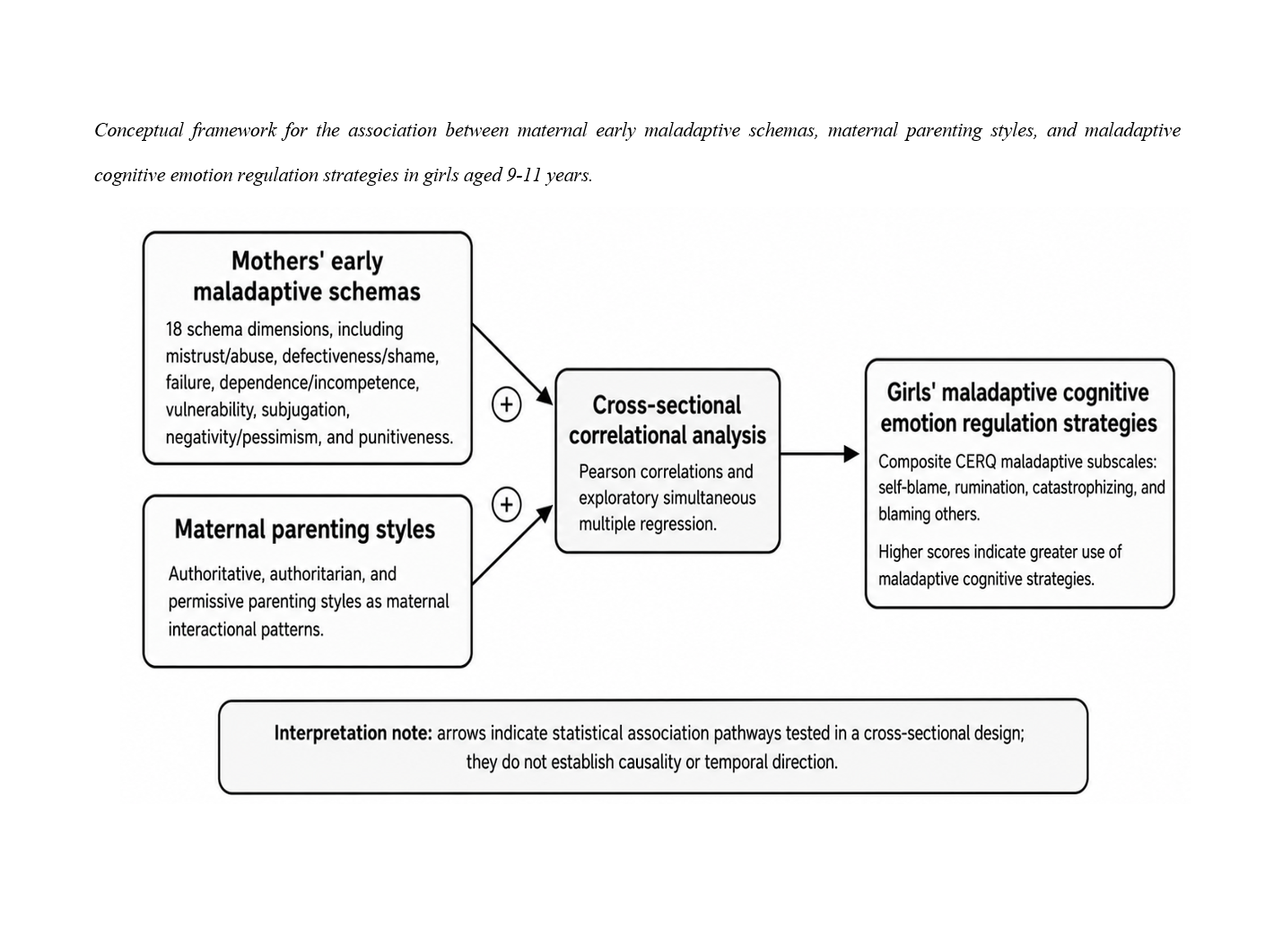
Maladaptive cognitive emotion regulation strategies, including self-blame, rumination, catastrophizing, and blaming others, may place children at increased risk for emotional and behavioral difficulties. Maternal early maladaptive schemas and parenting styles are family-related factors that may be associated with these strategies. This cross-sectional correlational study was conducted among 181 girls aged 9-11 years and their mothers in the second educational district of Kerman, Iran. Participants were recruited from five elementary schools using multistage cluster sampling. The girls completed the Cognitive Emotion Regulation Questionnaire, and mothers completed Young's Early Maladaptive Schema Questionnaire and Baumrind's Parenting Style Questionnaire. Maladaptive cognitive emotion regulation was calculated as the sum of the CERQ maladaptive subscales: self-blame, rumination, catastrophizing, and blaming others. Data were analyzed using Pearson correlation and exploratory simultaneous multiple regression in SPSS version 26. Maladaptive cognitive emotion regulation was positively correlated with all maternal early maladaptive schemas and with authoritarian and permissive parenting styles, and it was negatively correlated with authoritative parenting. The simultaneous regression model was statistically significant, F(21, 159) = 34.04, p < .001, R = .904, R2 = .818, adjusted R2 = .794. Variables with significant positive independent associations were mistrust / abuse, defectiveness / shame, failure, dependence / incompetence, vulnerability to harm or illness, subjugation, negativity / pessimism, punitiveness, authoritarian parenting, and permissive parenting. Authoritative parenting showed a significant negative independent association. The findings suggest that girls' maladaptive cognitive emotion regulation strategies are associated with both mothers' cognitive-emotional schema patterns and maternal parenting styles. Because of the cross-sectional design, school-clustered sampling, lack of covariate adjustment, and relatively large number of predictors, the findings should be interpreted as exploratory associations rather than causal or definitive predictive evidence.
Downloads
References
Awiszus, A., Koenig, M., & Vaisarova, J. (2022). Parenting styles and their effect on child development and outcome. Journal of Student Research, 11(3), 3-12. https://doi.org/10.47611/JSRHS.V11I3.3679
Baumrind, D. (1973). The development of instrumental competence through socialization. In A. D. Pick (Ed.), Minnesota symposia on child psychology (Vol. 7, pp. 3-46). University of Minnesota Press.
Caliskan, B. (2017). Relationship between early maladaptive schemas, perceived maternal parenting style, emotion regulation difficulties and psychological well-being [Master's thesis, Dogus University].
Emami, M., Moghadasin, M., Mastour, H., & Tayebi, A. (2024). Early maladaptive schema, attachment style, and parenting style in a clinical population with personality disorder and normal individuals: A discriminant analysis model. BMC Psychology, 12(1), 78. https://doi.org/10.1186/s40359-024-01564-5
Garnefski, N., Kraaij, V., & Spinhoven, P. (2001). Negative life events, cognitive emotion regulation and emotional problems. Personality and Individual Differences, 30(8), 1311-1327. https://doi.org/10.1016/S0191-8869(00)00113-6
Gratz, K. L., & Roemer, L. (2004). Multidimensional assessment of emotion regulation and dysregulation: Development, factor structure, and initial validation of the Difficulties in Emotion Regulation Scale. Journal of Psychopathology and Behavioral Assessment, 26(1), 41-54. https://doi.org/10.1023/B:JOBA.0000007455.08539.94
Hen, M., Shenaar-Golan, V., & Yatzker, U. (2022). Children and adolescents' mental health following COVID-19: The possible role of difficulty in emotional regulation. Frontiers in Psychiatry, 13, 865435. https://doi.org/10.3389/fpsyt.2022.865435
Kozubal, M., Szuster, A., & Wielgopolan, A. (2023). Emotional regulation strategies in daily life: The intensity of emotions and regulation choice. Frontiers in Psychology, 14, 1218694. https://doi.org/10.3389/fpsyg.2023.1218694
McCullen, J. R., Counts, C. J., & John-Henderson, N. A. (2023). Childhood adversity and emotion regulation strategies as predictors of psychological stress and mental health in American Indian adults during the COVID-19 pandemic. Emotion, 23(3), 805-817. https://doi.org/10.1037/emo0001106
Morris, A. S., Criss, M. M., Silk, J. S., & Houltberg, B. J. (2017). The impact of parenting on emotion regulation during childhood and adolescence. Child Development Perspectives, 11(4), 233-238. https://doi.org/10.1111/cdep.12238
Mortazavizadeh, Z., Gollner, L., & Forstmeier, S. (2022). Emotional competence, attachment, and parenting styles in children and parents. Psicologia: Reflexao e Critica, 35, 6. https://doi.org/10.1186/s41155-022-00208-0
Preece, D. A., Becerra, R., Robinson, K., Dandy, J., & Allan, A. (2018). Measuring emotion regulation ability across negative and positive emotions: The Perth Emotion Regulation Competency Inventory (PERCI). Personality and Individual Differences, 135, 229-241. https://doi.org/10.1016/j.paid.2018.07.025
Ravens-Sieberer, U., Kaman, A., Erhart, M., Otto, C., Devine, J., Loffler, C., Hurrelmann, K., Bullinger, M., Barkmann, C., & Siegel, N. A. (2023). Quality of life and mental health in children and adolescents during the first year of the COVID-19 pandemic: Results of a two-wave nationwide population-based study. European Child & Adolescent Psychiatry, 32(4), 575-588. https://doi.org/10.1007/s00787-021-01889-1
Shi, Y., Chen, I. J., Yang, M., Wang, L., Song, Y., & Sun, Z. (2024). How does parental early maladaptive schema affect adolescents' social adaptation? Based on the perspective of intergenerational transmission. Behavioral Sciences, 14(10), 928. https://doi.org/10.3390/bs14100928
Sojta, K., & Strzelecki, D. (2023). Early maladaptive schemas and their impact on parenting: Do dysfunctional schemas pass generationally? A systematic review. Journal of Clinical Medicine, 12(4), 1263. https://doi.org/10.3390/jcm12041263
Thummler, R., Engel, E.-M., & Bartz, J. (2022). Strengthening emotional development and emotion regulation in childhood as a key task in early childhood education. International Journal of Environmental Research and Public Health, 19(7), 3978. https://doi.org/10.3390/ijerph19073978
Young, J. E., Klosko, J. S., & Weishaar, M. E. (2003). Schema therapy: A practitioner's guide. Guilford Press.
Zimmer-Gembeck, M. J., Rudolph, J., Kerin, J., & Bohadana-Brown, G. (2022). Parent emotional regulation: A meta-analytic review of its association with parenting and child adjustment. International Journal of Behavioral Development, 46(1), 63-82. https://doi.org/10.1177/01650254211051086
Zitzmann, J., Rombold-George, L., Rosenbach, C., & Renneberg, B. (2024). Emotion regulation, parenting, and psychopathology: A systematic review. Clinical Child and Family Psychology Review, 27(1), 1-22. https://doi.org/10.1007/s10567-023-00452-5
Zreik, G., Haimov, I., & Szepsenwol, O. (2025). Parental childhood adversity and emotional functioning: Associations with child's emotion regulation. Family Relations, 74(1), 144-162. https://doi.org/10.1111/fare.13120
Downloads
Additional Files
Publication Timeline
- Submitted
- Revised
- Accepted