The Effectiveness of the Floortime Method on Sensory Processing Sensitivity, Theory of Mind, and Social Skills in Children with High-Functioning Autism
DOI:
https://doi.org/10.61838/kman.hn.5594Keywords:
Floortime; DIR model; sensory processing; theory of mind; social skills; high-functioning autismAbstract
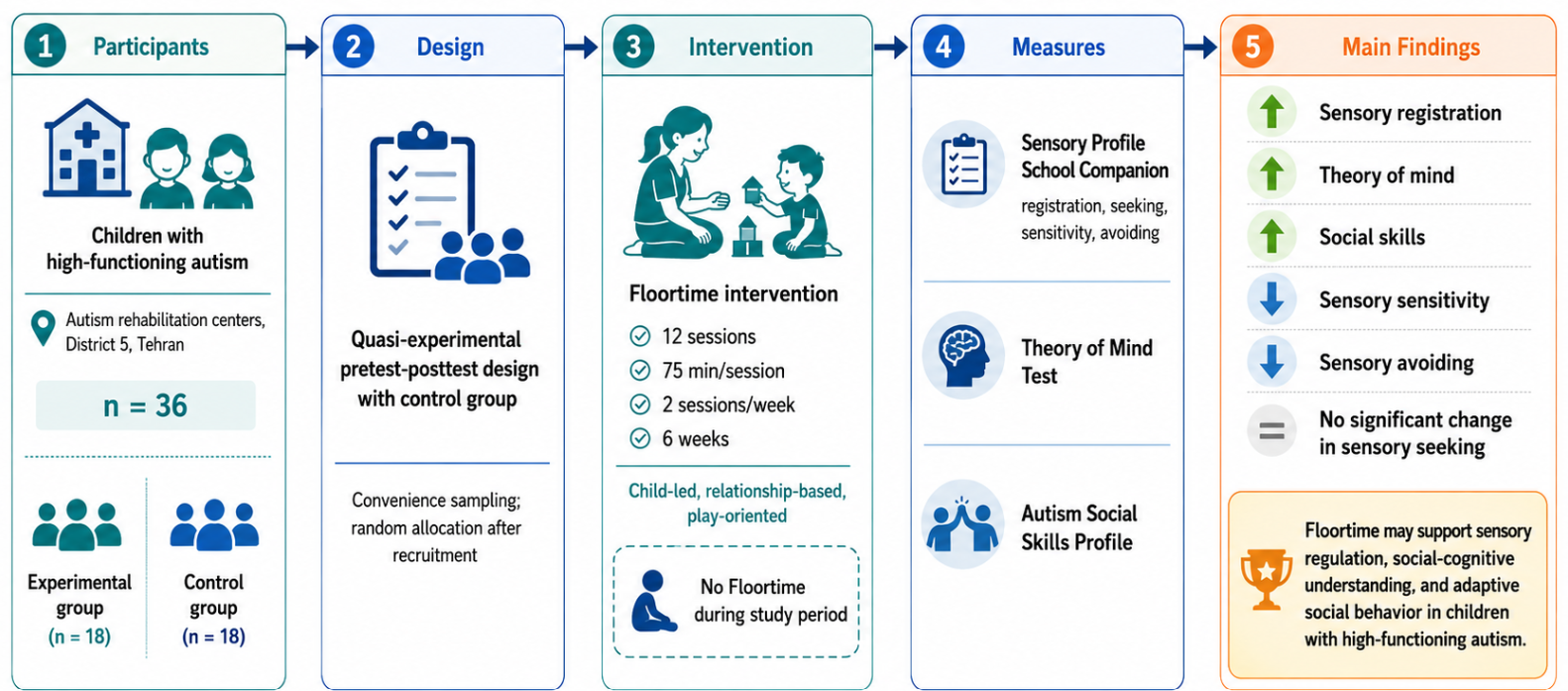
This study examined the effectiveness of the Floortime method on sensory processing sensitivity, theory of mind, and social skills in children with high-functioning autism. A quasi-experimental pretest-posttest design with a control group was used. The statistical population consisted of children with high-functioning autism who attended autism rehabilitation centers in District 5 of Tehran in spring 2025. Thirty-six children were selected by convenience sampling and then allocated to experimental and control groups, with 18 participants in each group. Data were collected using the Sensory Profile School Companion, the Theory of Mind Test, and the Autism Social Skills Profile. The experimental group received twelve 75-minute Floortime sessions over six weeks, whereas the control group received no Floortime intervention during the study period. Data were analyzed using multivariate analysis of covariance and analysis of covariance in SPSS version 23. After controlling for pretest scores, the Floortime method significantly increased sensory registration, theory of mind, and social skills and significantly decreased sensory sensitivity and sensory avoiding. The intervention did not produce a statistically significant change in sensory seeking. The findings suggest that Floortime can support sensory regulation, social-cognitive understanding, and adaptive social behavior in children with high-functioning autism when implemented in a structured and developmentally responsive format.
Downloads
References
American Psychiatric Association. (2022). Diagnostic and statistical manual of mental disorders (5th ed., text rev.). American Psychiatric Association.
Baron-Cohen, S., Wheelwright, S., Hill, J., Raste, Y., & Plumb, I. (2001). The Reading the Mind in the Eyes Test revised version: A study with normal adults, and adults with Asperger syndrome or high-functioning autism. Journal of Child Psychology and Psychiatry, 42(2), 241-251. https://doi.org/10.1111/1469-7610.00715
Barghi, F., Safarzadeh, S., Marashian, F., & Bakhtiarpour, S. (2022). Comparison of the effectiveness of ABA and Floortime on sensory processing in children with autism spectrum disorder. Arak Medical University Journal, 25(6), 17-26. [In Persian]
Begeer, S., Gevers, C., Clifford, P., Verhoeve, M., Kat, K., Hoddenbach, E., & Boer, F. (2011). Theory of mind training in children with autism: A randomized controlled trial. Journal of Autism and Developmental Disorders, 41, 997-1006. https://doi.org/10.1007/s10803-010-1121-9
Bellini, S., & Hopf, A. (2007). The development of the Autism Social Skills Profile: A preliminary analysis of psychometric properties. Focus on Autism and Other Developmental Disabilities, 22(2), 80-87. https://doi.org/10.1177/10883576070220020801
Casenhiser, D. M., Shanker, S. G., & Stieben, J. (2013). Learning through interaction in children with autism: Preliminary data from a social-communication-based intervention. Autism, 17(2), 220-241. https://doi.org/10.1177/1362361311422052
Cohen, J. (1988). Statistical power analysis for the behavioral sciences (2nd ed.). Lawrence Erlbaum Associates.
Dehvari, A., Arab, A., & Shirazi, M. (2022). The effectiveness of Floortime therapy on the behavioral activation system of children with autism disorder. Psychological Dynamics in Mood Disorders, 1(4), 1-10. [In Persian]
Dunn, W. (1997). The impact of sensory processing abilities on the daily lives of young children and their families: A conceptual model. Infants & Young Children, 9(4), 23-35. https://doi.org/10.1097/00001163-199704000-00005
Dunn, W. (2006). Sensory Profile School Companion: User's manual. Pearson Psychological Corporation.
Greenspan, S. I., & Wieder, S. (1997). Developmental patterns and outcomes in infants and children with disorders in relating and communicating: A chart review of 200 cases of children with autistic spectrum diagnoses. Journal of Developmental and Learning Disorders, 1(1), 87-141.
Jorquera-Cabrera, S., Romero-Ayuso, D., Rodriguez-Gil, G., & Trivino-Juarez, J. M. (2017). Assessment of sensory processing characteristics in children between 3 and 11 years old: A systematic review. Frontiers in Pediatrics, 5, 57. https://doi.org/10.3389/fped.2017.00057
Kars, S., Huri, M., Kayihan, H., & Ergul, C. (2020). Effect of DIR/Floortime intervention on adaptive behavior of a child with autism spectrum disorder. Ergoterapi ve Rehabilitasyon Dergisi, 8(2), 175-184.
Mercer, J. (2017). Examining DIR/Floortime as a treatment for children with autism spectrum disorders: A review of research and theory. Research on Social Work Practice, 27(5), 625-635. https://doi.org/10.1177/1049731515583062
Muris, P., Steerneman, P., Meesters, C., Merckelbach, H., Horselenberg, R., van den Hogen, T., & van Dongen, L. (1999). The TOM Test: A new instrument for assessing theory of mind in normal children and children with pervasive developmental disorders. Journal of Autism and Developmental Disorders, 29(1), 67-80. https://doi.org/10.1023/A:1025922717020
Pajareya, K., & Nopmaneejumruslers, K. (2011). A pilot randomized controlled trial of DIR/Floortime parent training intervention for pre-school children with autistic spectrum disorders. Autism, 15(5), 563-577. https://doi.org/10.1177/1362361310386502
Schoen, S. A., Miller, L. J., & Flanagan, J. (2018). A retrospective pre-post treatment study of occupational therapy intervention for children with sensory processing challenges. The Open Journal of Occupational Therapy, 6(1). https://doi.org/10.15453/2168-6408.1367
Solomon, R., Van Egeren, L. A., Mahoney, G., Quon Huber, M. S., & Zimmerman, P. (2014). PLAY Project Home Consultation intervention program for young children with autism spectrum disorders: A randomized controlled trial. Journal of Developmental and Behavioral Pediatrics, 35(8), 475-485. https://doi.org/10.1097/DBP.0000000000000096
Tabachnick, B. G., & Fidell, L. S. (2007). Using multivariate statistics (5th ed.). Pearson Education.
Downloads
Additional Files
Publication Timeline
- Submitted
- Revised
- Accepted