Effects of a 12-Week School-Based Physical Education and Nutrition Education Intervention on Obesity Indices and Cardiorespiratory Fitness in Upper Elementary School Boys: A Quasi-Experimental Study
DOI:
https://doi.org/10.61838/Keywords:
nutrition education; energy-intake management; body composition; cardiorespiratory fitness; childhood obesity; elementary school boysAbstract
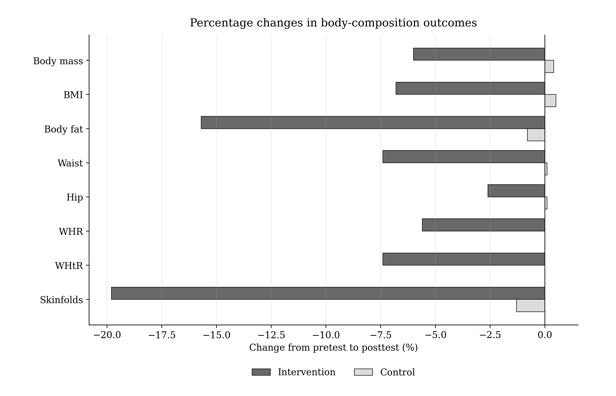
Childhood overweight, obesity, and declining physical activity are major public-health concerns, and schools provide a practical setting for preventive interventions. This quasi-experimental study examined the effects of a 12-week integrated school-based physical education, nutrition education, and energy-intake management program on body-composition indices and cardiorespiratory fitness in upper elementary school boys in District 5 of Tehran, Iran. One hundred eligible boys were selected by multistage cluster sampling and allocated to an intervention group (n = 50) or a control group (n = 50). The intervention group participated in a structured physical education program twice weekly for 12 weeks (45 min/session) and received six nutrition-education sessions with guidance designed to reduce habitual energy intake by approximately 200-300 kcal/day without severe dietary restriction. The control group continued usual school activities. Body mass, body mass index (BMI), body-fat percentage, waist circumference, hip circumference, waist-to-hip ratio (WHR), waist-to-height ratio (WHtR), three-site skinfold thickness, 20-m shuttle-run performance, and estimated maximal oxygen uptake (VO₂max) were assessed before and after the intervention. Data were analyzed using paired-samples t tests, independent-samples t tests, and analysis of covariance controlling for pretest values. After 12 weeks, the intervention group showed meaningful reductions in body mass (-6.0%), BMI (-6.8%), body-fat percentage (-15.7%), waist circumference (-7.4%), WHR (-5.6%), WHtR (-7.4%), and total skinfold thickness (-19.8%). Cardiorespiratory-fitness outcomes also improved, with increases in 20-m shuttle-run stages (+40.3%), shuttle-run laps (+45.1%), and estimated VO₂max (+18.7%). ANCOVA confirmed significant between-group differences for all outcomes, with the largest effects for VO₂max (partial η² = .41), 20-m shuttle-run performance (partial η² = .39), total skinfold thickness (partial η² = .34), and body-fat percentage (partial η² = .31). The findings indicate that combining school-based physical education with nutrition education and moderate energy-intake management can improve obesity-related indices and cardiorespiratory fitness in upper elementary school boys. Such integrated programs may represent a feasible and low-cost strategy for child-obesity prevention and health promotion in school settings.
Downloads
References
Ashwell, M., & Hsieh, S. D. (2005). Six reasons why the waist-to-height ratio is a rapid and effective global indicator for health risks of obesity and how its use could simplify the international public health message on obesity. International Journal of Food Sciences and Nutrition, 56(5), 303-307. https://doi.org/10.1080/09637480500195066
Bull, F. C., Al-Ansari, S. S., Biddle, S., Borodulin, K., Buman, M. P., Cardon, G., Carty, C., Chaput, J. P., Chastin, S., Chou, R., Dempsey, P. C., DiPietro, L., Ekelund, U., Firth, J., Friedenreich, C. M., Garcia, L., Gichu, M., Jago, R., Katzmarzyk, P. T., ... Willumsen, J. F. (2020). World Health Organization 2020 guidelines on physical activity and sedentary behaviour. British Journal of Sports Medicine, 54(24), 1451-1462. https://doi.org/10.1136/bjsports-2020-102955
Cohen, J. (1988). Statistical power analysis for the behavioral sciences (2nd ed.). Lawrence Erlbaum Associates.
Dobbins, M., Husson, H., DeCorby, K., & LaRocca, R. L. (2013). School-based physical activity programs for promoting physical activity and fitness in children and adolescents aged 6 to 18. Cochrane Database of Systematic Reviews, 2013(2), CD007651. https://doi.org/10.1002/14651858.CD007651.pub2
García-Hermoso, A., Alonso-Martínez, A. M., Ramírez-Vélez, R., Pérez-Sousa, M. Á., Ramírez-Campillo, R., & Izquierdo, M. (2020). Association of physical education with improvement of health-related physical fitness outcomes and fundamental motor skills among youths: A systematic review and meta-analysis. JAMA Pediatrics, 174(6), e200223. https://doi.org/10.1001/jamapediatrics.2020.0223
Harris, K. C., Kuramoto, L. K., Schulzer, M., & Retallack, J. E. (2009). Effect of school-based physical activity interventions on body mass index in children: A meta-analysis. Canadian Medical Association Journal, 180(7), 719-726. https://doi.org/10.1503/cmaj.080966
Janssen, I., & LeBlanc, A. G. (2010). Systematic review of the health benefits of physical activity and fitness in school-aged children and youth. International Journal of Behavioral Nutrition and Physical Activity, 7, Article 40. https://doi.org/10.1186/1479-5868-7-40
Léger, L. A., Mercier, D., Gadoury, C., & Lambert, J. (1988). The multistage 20 metre shuttle run test for aerobic fitness. Journal of Sports Sciences, 6(2), 93-101. https://doi.org/10.1080/02640418808729800
Ortega, F. B., Ruiz, J. R., Castillo, M. J., & Sjöström, M. (2008). Physical fitness in childhood and adolescence: A powerful marker of health. International Journal of Obesity, 32(1), 1-11. https://doi.org/10.1038/sj.ijo.0803774
Poitras, V. J., Gray, C. E., Borghese, M. M., Carson, V., Chaput, J. P., Janssen, I., Katzmarzyk, P. T., Pate, R. R., Connor Gorber, S., Kho, M. E., Sampson, M., & Tremblay, M. S. (2016). Systematic review of the relationships between objectively measured physical activity and health indicators in school-aged children and youth. Applied Physiology, Nutrition, and Metabolism, 41(6 Suppl. 3), S197-S239. https://doi.org/10.1139/apnm-2015-0663
Ruiz, J. R., Castro-Piñero, J., Artero, E. G., Ortega, F. B., Sjöström, M., Suni, J., & Castillo, M. J. (2009). Predictive validity of health-related fitness in youth: A systematic review. British Journal of Sports Medicine, 43(12), 909-923. https://doi.org/10.1136/bjsm.2008.056499
Sallis, J. F., & McKenzie, T. L. (1991). Physical education's role in public health. Research Quarterly for Exercise and Sport, 62(2), 124-137. https://doi.org/10.1080/02701367.1991.10608701
World Health Organization. (2020). WHO guidelines on physical activity and sedentary behaviour. World Health Organization. https://www.who.int/publications/i/item/9789240015128
Downloads
Publication Timeline
- Submitted
- Revised
- Accepted