Analyzing Coaches' Behaviors in the Relationship Between Motivational Climate and Performance Satisfaction Among Table Tennis Athletes
DOI:
https://doi.org/10.61838/Keywords:
coaching behavior; motivational climate; performance satisfaction; table tennis; self-determination theory; qualitative researchAbstract
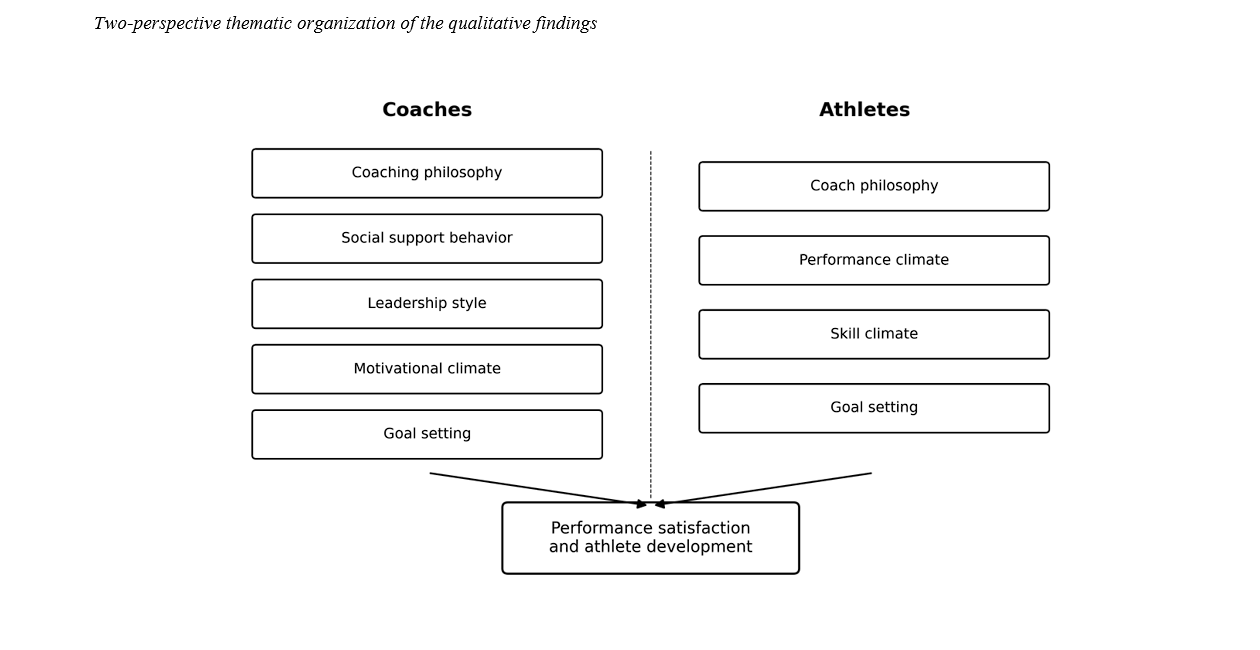
This qualitative phenomenological study analyzed coaches' behaviors in the relationship between motivational climate and performance satisfaction among developing table tennis athletes. Coaches are central social agents in youth sport, because their feedback, leadership style, goal-setting practices, and interpersonal behavior shape athletes' perceptions of competence, autonomy, relatedness, and achievement. Seven table tennis coaches and 25 developing athletes aged 14-18 years were recruited through snowball sampling. Data were collected through semi-structured interviews and analyzed using reflexive thematic analysis. The findings were organized into two complementary perspectives. From the coaches' accounts, five overarching themes were identified: coaching philosophy, social support behavior, leadership style, motivational climate, and goal setting. From the athletes' accounts, four overarching themes emerged: coaches' philosophy from the athletes' viewpoint, performance climate, skill climate, and goal setting. The integrated interpretation showed that supportive communication, positive feedback, emotional support, adaptive leadership, mastery-oriented climates, and individualized goal setting were perceived as facilitating athletes' motivation and satisfaction with performance. Conversely, excessive control, punishment for mistakes, rigid outcome emphasis, and social comparison were described as potentially reducing intrinsic motivation and psychological safety. The study contributes to coaching science by showing how coaching behaviors are experienced simultaneously as technical, ethical, relational, and motivational practices in table tennis. Practical implications are offered for coach education, particularly the need to train coaches in reflective self-regulation, autonomy-supportive communication, constructive feedback, and goal-setting methods that support both performance development and athlete well-being.
Downloads
References
Ames, C. (1992). Achievement goals, motivational climate, and motivational processes. In G. C. Roberts (Ed.), Motivation in sport and exercise (pp. 161-176). Human Kinetics.
Bartholomew, K. J., Ntoumanis, N., & Thogersen-Ntoumani, C. (2009). A review of controlling motivational strategies from a self-determination theory perspective: Implications for sports coaches. International Review of Sport and Exercise Psychology, 2(2), 215-233. https://doi.org/10.1080/17509840902740998
Braun, V., & Clarke, V. (2006). Using thematic analysis in psychology. Qualitative Research in Psychology, 3(2), 77-101. https://doi.org/10.1191/1478088706qp063oa
Braun, V., & Clarke, V. (2019). Reflecting on reflexive thematic analysis. Qualitative Research in Sport, Exercise and Health, 11(4), 589-597. https://doi.org/10.1080/2159676X.2019.1628806
Braun, V., & Clarke, V. (2021). Thematic analysis: A practical guide. SAGE.
Creswell, J. W., & Poth, C. N. (2018). Qualitative inquiry and research design: Choosing among five approaches (4th ed.). SAGE.
Deci, E. L., & Ryan, R. M. (2000). The 'what' and 'why' of goal pursuits: Human needs and the self-determination of behavior. Psychological Inquiry, 11(4), 227-268. https://doi.org/10.1207/S15327965PLI1104_01
Duda, J. L., & Balaguer, I. (2007). Coach-created motivational climate. In S. Jowett & D. Lavallee (Eds.), Social psychology in sport (pp. 117-130). Human Kinetics.
Horn, T. S. (Ed.). (2008). Advances in sport psychology (3rd ed.). Human Kinetics.
Jowett, S. (2007). Interdependence analysis and the 3+1Cs in the coach-athlete relationship. In S. Jowett & D. Lavallee (Eds.), Social psychology in sport (pp. 15-27). Human Kinetics.
Jowett, S., & Cockerill, I. M. (2003). Olympic medallists' perspective of the athlete-coach relationship. Psychology of Sport and Exercise, 4(4), 313-331. https://doi.org/10.1016/S1469-0292(02)00011-0
Keegan, R. J., Harwood, C. G., Spray, C. M., & Lavallee, D. E. (2009). A qualitative investigation exploring the motivational climate in early career sports participants: Coach, parent and peer influences on sport motivation. Psychology of Sport and Exercise, 10(3), 361-372. https://doi.org/10.1016/j.psychsport.2008.12.003
Lincoln, Y. S., & Guba, E. G. (1985). Naturalistic inquiry. SAGE.
Locke, E. A., & Latham, G. P. (2002). Building a practically useful theory of goal setting and task motivation: A 35-year odyssey. American Psychologist, 57(9), 705-717. https://doi.org/10.1037/0003-066X.57.9.705
Mageau, G. A., & Vallerand, R. J. (2003). The coach-athlete relationship: A motivational model. Journal of Sports Sciences, 21(11), 883-904. https://doi.org/10.1080/0264041031000140374
Newton, M., Duda, J. L., & Yin, Z. (2000). Examination of the psychometric properties of the Perceived Motivational Climate in Sport Questionnaire-2 in a sample of female athletes. Journal of Sports Sciences, 18(4), 275-290. https://doi.org/10.1080/026404100365018
Nicholls, J. G. (1984). Achievement motivation: Conceptions of ability, subjective experience, task choice, and performance. Psychological Review, 91(3), 328-346. https://doi.org/10.1037/0033-295X.91.3.328
Nicholls, J. G. (1989). The competitive ethos and democratic education. Harvard University Press.
Ntoumanis, N. (2001). A self-determination approach to the understanding of motivation in physical education. British Journal of Educational Psychology, 71(2), 225-242. https://doi.org/10.1348/000709901158497
Roberts, G. C. (Ed.). (2012). Advances in motivation in sport and exercise (3rd ed.). Human Kinetics.
Ryan, R. M., & Deci, E. L. (2000). Self-determination theory and the facilitation of intrinsic motivation, social development, and well-being. American Psychologist, 55(1), 68-78. https://doi.org/10.1037/0003-066X.55.1.68
Ryan, R. M., & Deci, E. L. (2017). Self-determination theory: Basic psychological needs in motivation, development, and wellness. Guilford Press.
Smith, J. A., Flowers, P., & Larkin, M. (2009). Interpretative phenomenological analysis: Theory, method and research. SAGE.
Smith, R. E., Smoll, F. L., & Cumming, S. P. (2007). Effects of a motivational climate intervention for coaches on young athletes' sport performance anxiety. Journal of Sport and Exercise Psychology, 29(1), 39-59. https://doi.org/10.1123/jsep.29.1.39
Smith, R. E., Smoll, F. L., & Hunt, E. (1977). A system for the behavioral assessment of athletic coaches. Research Quarterly, 48(2), 401-407.
Sparkes, A. C., & Smith, B. (2014). Qualitative research methods in sport, exercise and health: From process to product. Routledge.
Tracy, S. J. (2010). Qualitative quality: Eight 'big-tent' criteria for excellent qualitative research. Qualitative Inquiry, 16(10), 837-851. https://doi.org/10.1177/1077800410383121
Downloads
Additional Files
Publication Timeline
- Submitted
- Revised
- Accepted