
Modeling Elementary Teachers' Work Engagement Based on Job Crafting and Emotional Creativity: The Mediating Role of Critical Thinking
DOI:
https://doi.org/10.61838/Keywords:
Work engagement; job crafting; emotional creativity; critical thinking; elementary teachers; structural equation modelingAbstract
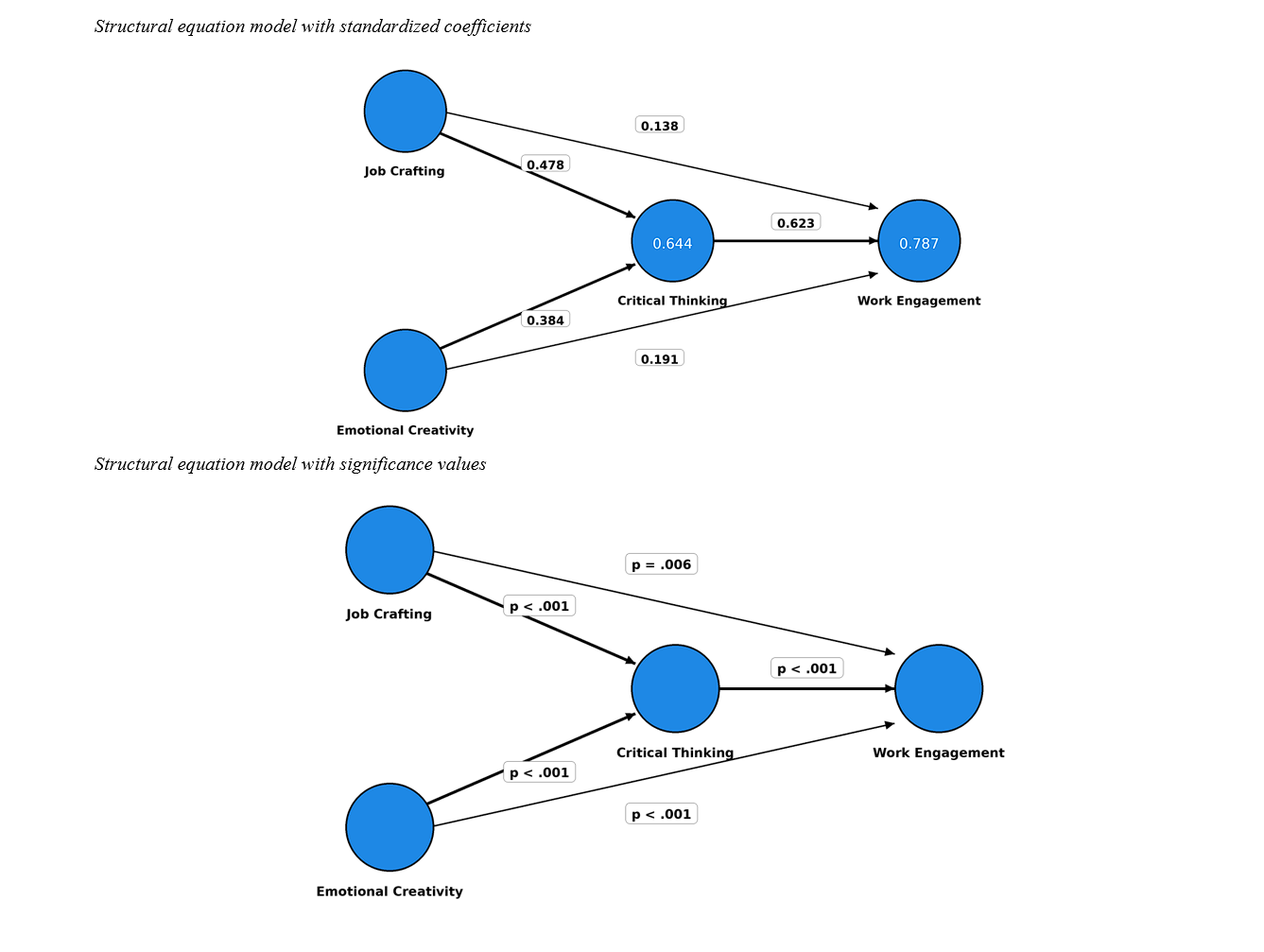
Teacher work engagement is a key psychological and occupational factor in educational quality. The present study examined a structural model in which job crafting and emotional creativity were associated with elementary teachers' work engagement, both directly and indirectly through critical thinking. This applied, descriptive-correlational survey used structural equation modeling. The population consisted of all elementary school teachers in Barkhar, Iran. Because the population was limited, census sampling was used, and 270 teachers were included. Data were collected using standardized self-report instruments measuring emotional creativity, job crafting, critical thinking, and work engagement. Data were analyzed using SPSS and SmartPLS 3. Descriptive statistics showed mean scores of 63.62 for emotional creativity, 55.38 for critical thinking, 42.87 for job crafting, and 22.79 for work engagement. All direct structural paths were positive and statistically significant. Job crafting was positively associated with work engagement (beta = 0.138, t = 2.762, p = .006) and critical thinking (beta = 0.478, t = 8.566, p < .001). Emotional creativity was positively associated with work engagement (beta = 0.191, t = 3.944, p < .001) and critical thinking (beta = 0.384, t = 6.601, p < .001). Critical thinking was the strongest direct predictor of work engagement (beta = 0.623, t = 14.366, p < .001). The indirect effects through critical thinking were also supported: emotional creativity -> critical thinking -> work engagement (indirect beta = 0.239) and job crafting -> critical thinking -> work engagement (indirect beta = 0.298). The findings suggest that job crafting and emotional creativity are relevant correlates of elementary teachers' work engagement and that critical thinking may partly explain these associations.
Downloads
References
Averill, J. R. (1999). Individual differences in emotional creativity: Structure and correlates. Journal of Personality, 67(2), 331-371. https://doi.org/10.1111/1467-6494.00058
Bakker, A. B., & Bal, P. M. (2010). Weekly work engagement and performance: A study among starting teachers. Journal of Occupational and Organizational Psychology, 83(1), 189-206. https://doi.org/10.1348/096317909X402596
Bakker, A. B., & Demerouti, E. (2007). The Job Demands-Resources model: State of the art. Journal of Managerial Psychology, 22(3), 309-328. https://doi.org/10.1108/02683940710733115
Facione, P. A. (1990). Critical thinking: A statement of expert consensus for purposes of educational assessment and instruction. Research findings and recommendations. American Philosophical Association.
Hair, J. F., Hult, G. T. M., Ringle, C. M., & Sarstedt, M. (2022). A primer on partial least squares structural equation modeling (PLS-SEM) (3rd ed.). Sage.
Hakanen, J. J., Bakker, A. B., & Schaufeli, W. B. (2006). Burnout and work engagement among teachers. Journal of School Psychology, 43(6), 495-513. https://doi.org/10.1016/j.jsp.2005.11.001
Kahn, W. A. (1990). Psychological conditions of personal engagement and disengagement at work. Academy of Management Journal, 33(4), 692-724. https://doi.org/10.5465/256287
Podsakoff, P. M., MacKenzie, S. B., Lee, J. Y., & Podsakoff, N. P. (2003). Common method biases in behavioral research: A critical review of the literature and recommended remedies. Journal of Applied Psychology, 88(5), 879-903. https://doi.org/10.1037/0021-9010.88.5.879
Rudolph, C. W., Katz, I. M., Lavigne, K. N., & Zacher, H. (2017). Job crafting: A meta-analysis of relationships with individual differences, job characteristics, and work outcomes. Journal of Vocational Behavior, 102, 112-138. https://doi.org/10.1016/j.jvb.2017.05.008
Schaufeli, W. B., Salanova, M., Gonzalez-Roma, V., & Bakker, A. B. (2002). The measurement of engagement and burnout: A two sample confirmatory factor analytic approach. Journal of Happiness Studies, 3, 71-92. https://doi.org/10.1023/A:1015630930326
Slemp, G. R., & Vella-Brodrick, D. A. (2013). The Job Crafting Questionnaire: A new scale to measure the extent to which employees engage in job crafting. International Journal of Wellbeing, 3(2), 126-146. https://doi.org/10.5502/ijw.v3i2.1
Tims, M., Bakker, A. B., & Derks, D. (2012). Development and validation of the job crafting scale. Journal of Vocational Behavior, 80(1), 173-186. https://doi.org/10.1016/j.jvb.2011.05.009
Wrzesniewski, A., & Dutton, J. E. (2001). Crafting a job: Revisioning employees as active crafters of their work. Academy of Management Review, 26(2), 179-201. https://doi.org/10.5465/amr.2001.4378011
Downloads
Additional Files
Publication Timeline
- Submitted
- Revised
- Accepted