Effectiveness of Combined Healthy Lifestyle Education and Yoga Therapy on Self-Reflection and Personal Insight in Overweight Adults at Risk of Type 2 Diabetes
DOI:
https://doi.org/10.61838/Keywords:
healthy lifestyle; yoga therapy; self-reflection; personal insight; overweight; diabetes riskAbstract
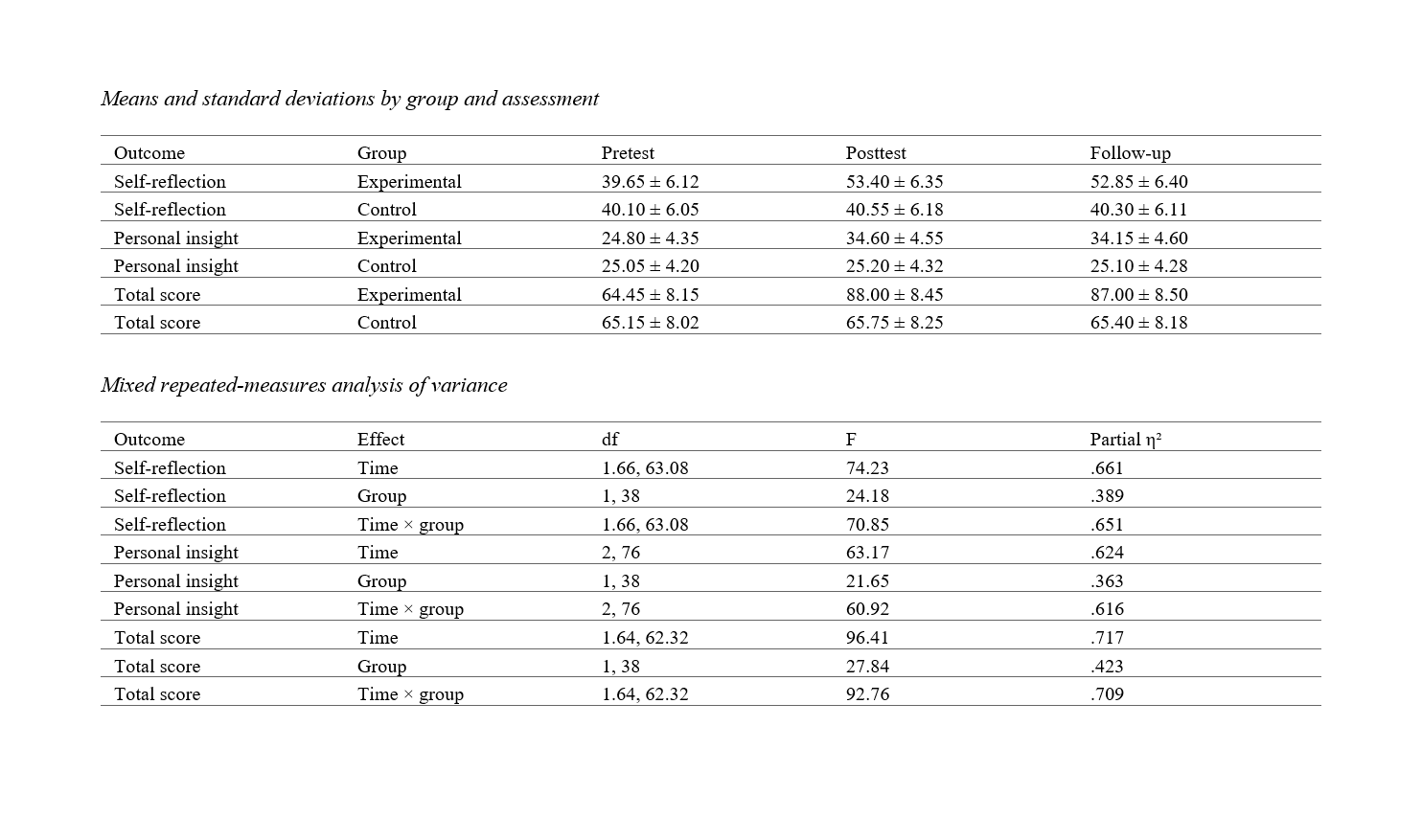
This study examined the effectiveness of a combined healthy lifestyle education and yoga therapy program in improving self-reflection and personal insight among overweight adults at risk of developing type 2 diabetes. A quasi-experimental pretest–posttest design with a follow-up assessment and a non-intervention control group was used. Forty eligible adults attending health-related services in Tehran were selected through purposive sampling and randomly allocated to an experimental group (n = 20) or a control group (n = 20). The experimental group participated in a structured 10-session weekly program integrating education on nutrition, physical activity, sleep, stress management, self-care, goal setting, and maintenance of healthy behavior with yoga postures, breathing exercises, relaxation, body awareness, mindfulness, and self-compassion practices. The control group received no intervention during the study period. Self-reflection and personal insight were measured with the Self-Reflection and Insight Scale. Data were analyzed using descriptive statistics and mixed repeated-measures analysis of variance. Significant time-by-group interactions were observed for self-reflection, personal insight, and the total score. In the experimental group, mean self-reflection increased from 39.65 at pretest to 53.40 at posttest, and mean personal insight increased from 24.80 to 34.60. These improvements remained largely stable at follow-up, whereas the control group showed no meaningful change. The interaction effect sizes were large for self-reflection (partial η² = .651), personal insight (partial η² = .616), and the total score (partial η² = .709). Pairwise comparisons confirmed significant improvements from pretest to posttest and from pretest to follow-up, with no significant decline between posttest and follow-up. The findings suggest that integrating lifestyle education with yoga-based mind–body practices may strengthen constructive self-observation and clearer understanding of health-related thoughts, emotions, and behaviors in overweight adults at elevated diabetes risk. Larger trials with active controls, longer follow-up periods, and objective metabolic outcomes are required.
Downloads
References
American Diabetes Association Professional Practice Committee for Diabetes. (2026). 3. Prevention or delay of diabetes and associated comorbidities: Standards of Care in Diabetes—2026. Diabetes Care, 49(Suppl. 1), S50–S60.
Anheyer, D., Koch, A. K., Thoms, M. S., Dobos, G., & Cramer, H. (2021). Yoga in women with abdominal obesity: Do lifestyle factors mediate the effect? Secondary analysis of a randomized controlled trial. Complementary Therapies in Medicine, 60, Article 102741.
Bucknell, K. J., Kangas, M., & Crane, M. F. (2022). Adaptive self-reflection and resilience: The moderating effects of rumination on insight as a mediator. Personality and Individual Differences, 185, Article 111234.
Cramer, H., Thoms, M. S., Anheyer, D., Lauche, R., & Dobos, G. (2016). Yoga in women with abdominal obesity: A randomized controlled trial. Deutsches Ärzteblatt International, 113(39), 645–652.
Critchley, C. R., Hardie, E. A., & Moore, S. M. (2012). Examining the psychological pathways to behavior change in a group-based lifestyle program to prevent type 2 diabetes. Diabetes Care, 35(4), 699–705.
Gard, T., Noggle, J. J., Park, C. L., Vago, D. R., & Wilson, A. (2014). Potential self-regulatory mechanisms of yoga for psychological health. Frontiers in Human Neuroscience, 8, Article 770.
Goldberg, S. B., Imhoff-Smith, T., Bolt, D. M., Wilson-Mendenhall, C. D., Dahl, C. J., Davidson, R. J., & Rosenkranz, M. A. (2020). Testing the efficacy of a multicomponent, self-guided, smartphone-based meditation app: Three-armed randomized controlled trial. JMIR Mental Health, 7(11), e23825.
Grant, A. M., Franklin, J., & Langford, P. (2002). The Self-Reflection and Insight Scale: A new measure of private self-consciousness. Social Behavior and Personality: An International Journal, 30(8), 821–836.
Haliwa, I., Ford, C. G., Wilson, J. M., & Shook, N. J. (2021). A mixed-method assessment of a 10-day mobile mindfulness intervention. Frontiers in Psychology, 12, Article 722995.
Hamasaki, H. (2023). The effects of mindfulness on glycemic control in people with diabetes: An overview of systematic reviews and meta-analyses. Medicines, 10(9), Article 53.
Heo, S., Kang, J. H., Umeakunne, E., Lee, S., Bertulfo, T. F., Barbé, T., Kim, J. S., Black, V., An, M., & Randolph, J. (2023). Effects of meditation intervention on self-management in adult patients with type 2 diabetes: A systematic literature review and meta-analysis. Journal of Cardiovascular Nursing, 38(6), 581–592.
Knowler, W. C., Barrett-Connor, E., Fowler, S. E., Hamman, R. F., Lachin, J. M., Walker, E. A., Nathan, D. M., & Diabetes Prevention Program Research Group. (2002). Reduction in the incidence of type 2 diabetes with lifestyle intervention or metformin. The New England Journal of Medicine, 346(6), 393–403.
Mehling, W. E., Chesney, M. A., Metzler, T. J., Goldstein, L. A., Maguen, S., Geronimo, C., Agcaoili, G., Barnes, D. E., Hlavin, J. A., & Neylan, T. C. (2018). A 12-week integrative exercise program improves self-reported mindfulness and interoceptive awareness in war veterans with posttraumatic stress symptoms. Journal of Clinical Psychology, 74(4), 554–565.
Ngan, H. Y., Chong, Y. Y., & Chien, W. T. (2021). Effects of mindfulness- and acceptance-based interventions on diabetes distress and glycaemic level in people with type 2 diabetes: A systematic review and meta-analysis. Diabetic Medicine, 38(4), e14525.
Nyklíček, I., Zonneveld, R., & Denollet, J. (2020). Introspective interest and insight in the context of mindfulness-based stress reduction: A randomized trial. Mindfulness, 11, 2176–2188.
Roberts, C., & Stark, P. (2008). Readiness for self-directed change in professional behaviours: Factorial validation of the Self-Reflection and Insight Scale. Medical Education, 42(11), 1054–1063.
Sanogo, F., Xu, K., Cortessis, V. K., Weigensberg, M. J., & Watanabe, R. M. (2023). Mind- and body-based interventions improve glycemic control in patients with type 2 diabetes: A systematic review and meta-analysis. Journal of Integrative and Complementary Medicine, 29(2), 69–79.
van Aalst, J., Jennen, L., Demyttenaere, K., Sunaert, S., Koole, M., Ceccarini, J., & Van Laere, K. (2021). Twelve-week yoga versus aerobic cycling initiation in sedentary healthy subjects: A behavioral and multiparametric interventional PET/MR study. Frontiers in Psychiatry, 12, Article 739356.
World Health Organization. (2024, November 14). Diabetes.
World Health Organization. (2025, December 8). Obesity and overweight.
Downloads
Additional Files
Publication Timeline
- Submitted
- Revised
- Accepted