
Healthcare Providers' Perspectives on the Implementation of Patient-Centered Care Models in Hospitals
DOI:
https://doi.org/10.61838/kman.hn.2.3.10Keywords:
Patient-centered care, healthcare providers, qualitative research, hospital care models, implementation challenges, benefits of PCC, thematic analysis, NVivo, holistic care, interdisciplinary collaborationAbstract
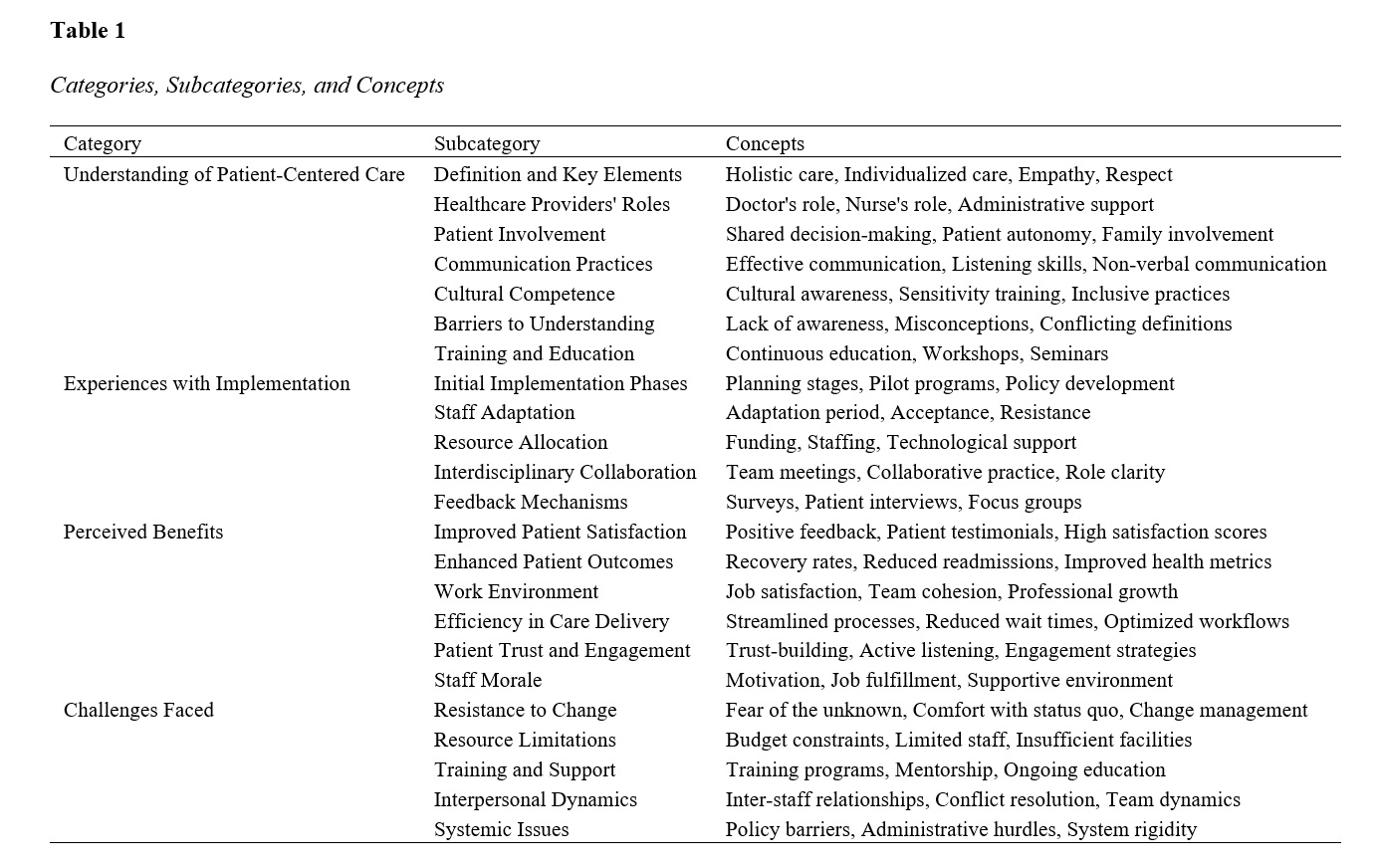
This study explores healthcare providers' perspectives on the implementation of patient-centered care (PCC) models in hospitals. It aims to identify key themes related to understanding, experiences, perceived benefits, and challenges associated with PCC to inform better practices and policies. A qualitative research design was employed, utilizing semi-structured interviews to collect data from 21 healthcare providers, including doctors, nurses, and administrative staff, in various hospitals. Participants were selected through purposive sampling to ensure diverse perspectives. Data collection continued until theoretical saturation was achieved. The interview data were transcribed and analyzed using NVivo software, following a thematic analysis approach to identify and refine key themes. The analysis revealed four main themes: understanding of PCC, experiences with implementation, perceived benefits, and challenges faced. Providers described PCC as holistic, individualized care requiring effective communication and cultural competence. Implementation experiences highlighted the importance of planning, resource allocation, interdisciplinary collaboration, and feedback mechanisms. Benefits of PCC included improved patient satisfaction and outcomes, better work environments, efficiency in care delivery, patient trust, and enhanced staff morale. Challenges encompassed resistance to change, resource limitations, training and support deficiencies, interpersonal dynamics, and systemic barriers. The study underscores the critical role of comprehensive training, effective communication, and adequate resources in implementing PCC. Despite significant challenges, the benefits of PCC for patients and providers are evident. Addressing implementation barriers through continuous education, supportive policies, and robust feedback mechanisms can enhance the adoption and sustainability of PCC models. Future research should focus on expanding sample diversity, quantitative measures, and the impact of technology on PCC.
Downloads
References
1. Clark KB. Smart Device-Driven Corticolimbic Plasticity in Cognitive-Emotional Restructuring of Space-Related Neuropsychiatric Disease and Injury. Life [Internet]. 2022; 12(2).
2. Hoseini M. Patient Experiences with AI in Healthcare Settings. AI and Tech in Behavioral and Social Sciences. 2023;1(3):12-8.
3. Qiu H, Piskorz-Ryń O. Understanding Patient Adherence to Hypertension Management Guidelines. KMAN Counseling & Psychology Nexus. 2024;2(1):70-6.
4. Yousefi Z, Saadati N, Saadati SA. AI in Elderly Care: Understanding the Implications for Independence and Social Interaction. AI and Tech in Behavioral and Social Sciences. 2023;1(4):26-32.
5. Liberati EG, Gorli M, Scaratti G. Reorganising Hospitals to Implement a Patient-Centered Model of Care. Journal of Health Organization and Management. 2015;29(7):848-73.
6. Orsolini L, Pompili S, Volpe U. Schizophrenia: A Narrative Review of Etiopathogenetic, Diagnostic and Treatment Aspects. Journal of Clinical Medicine [Internet]. 2022; 11(17).
7. Rosenberg CN, Peele PB, Keyser DJ, McAnallen S, Holder D. Results From a Patient-Centered Medical Home Pilot at UPMC Health Plan Hold Lessons for Broader Adoption of the Model. Health Affairs. 2012;31(11):2423-31.
8. Yano EM, Haskell SG, Hayes PM. Delivery of Gender-Sensitive Comprehensive Primary Care to Women Veterans: Implications for VA Patient Aligned Care Teams. Journal of General Internal Medicine. 2014;29(S2):703-7.
9. Zlateva I, Anderson D, Coman E, Khatri K, Tian T, Fifield J. Development and Validation of the Medical Home Care Coordination Survey for Assessing Care Coordination in the Primary Care Setting From the Patient and Provider Perspectives. BMC Health Services Research. 2015;15(1).
10. Stone S. A Retrospective Evaluation of the Impact of the Planetree Patient-Centered Model of Care on Inpatient Quality Outcomes. Herd Health Environments Research & Design Journal. 2008;1(4):55-69.
11. Anthony MK, Hudson-Barr D. A Patient-Centered Model of Care for Hospital Discharge. Clinical Nursing Research. 2004;13(2):117-36.
12. Jayadevappa R, Chhatre S. Patient Centered Care - A Conceptual Model and Review of the State of the Art. The Open Health Services and Policy Journal. 2011;4(1):15-25.
13. Finlay E, Newport K, Sivendran S, Kilpatrick L, Owens MD, Buss MK. Models of Outpatient Palliative Care Clinics for Patients With Cancer. Journal of Oncology Practice. 2019;15(4):187-93.
14. Collins M, O’Sullivan T, Harkins V, Perry IJ. Quality of Life and Quality of Care in Patients With Diabetes Experiencing Different Models of Care. Diabetes Care. 2009;32(4):603-5.
15. Ewunetu M, Temesgen W, Zewdu D, Andargie A, Kebede M, Lidetu T. Patients’ Perception of Patient-Centered Care and Associated Factors Among Patients Admitted in Private and Public Hospitals: A Comparative Cross-Sectional Study. Patient Preference and Adherence. 2023;Volume 17:1035-47.
16. Maatman SMO, Bohlin K, Lilliesköld S, Garberg HT, Uitewaal-Poslawky I, Kars MC, Hoogen Avd. Factors Influencing Implementation of Family-Centered Care in a Neonatal Intensive Care Unit. Frontiers in Pediatrics. 2020;8.
Downloads
Additional Files
Publication Timeline
License
Copyright (c) 2024 Oriana Piskorz-Ryń, Geoffrey Olsen (Author); Valerie Karstensen (Corresponding Author); Daniela Gottschlich (Author)

This work is licensed under a Creative Commons Attribution-NonCommercial 4.0 International License.