The Impact of Architectural Design on Reducing Anxiety in Schizophrenic Patients: Exploring Familiar Cognitive Patterns in Therapeutic Spaces
DOI:
https://doi.org/10.61838/kman.hn.2.3.14Keywords:
Architectural, Schizophrenia, Therapeutic Spaces, Psychological Well-being, HealingAbstract
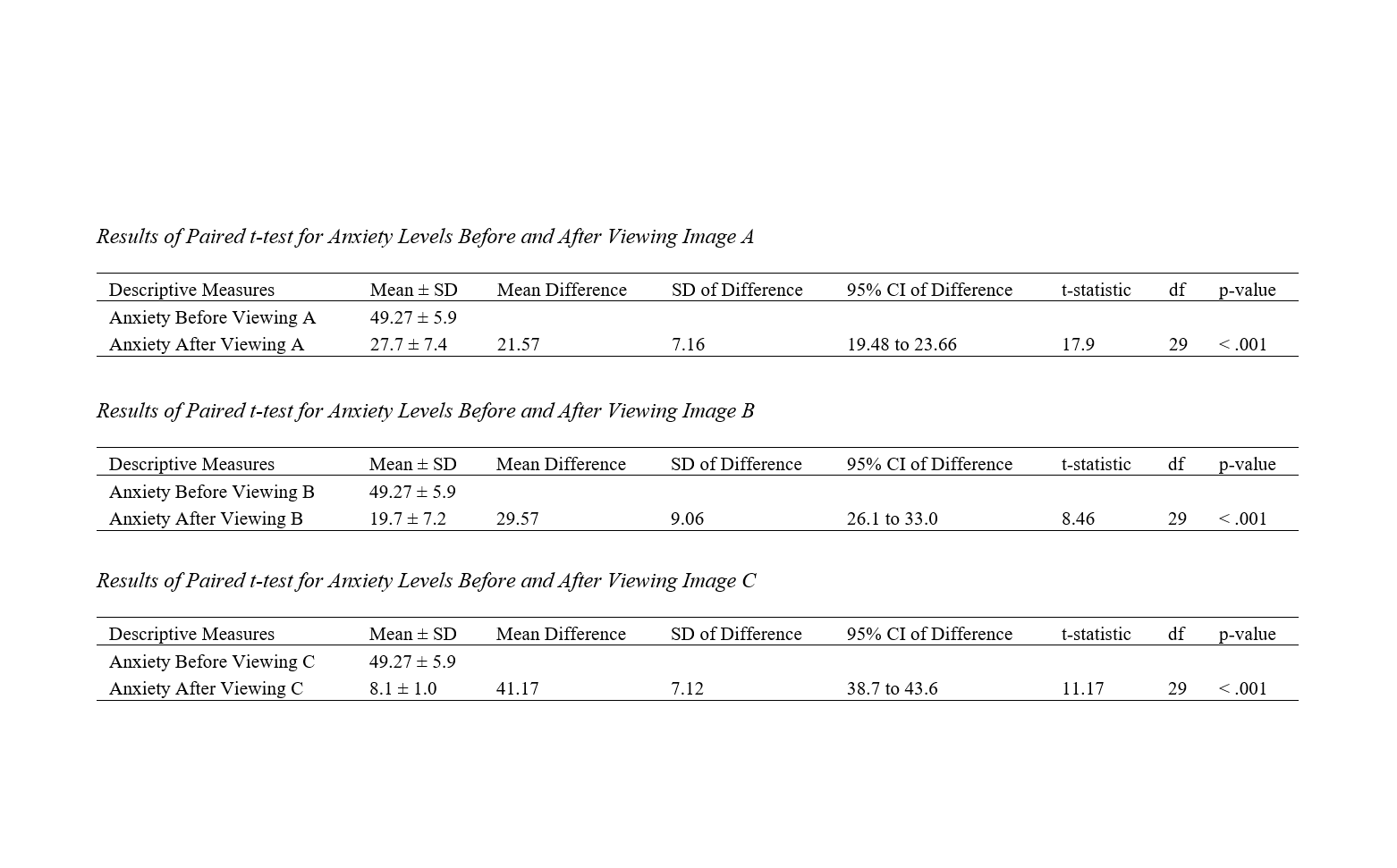
This study investigates the impact of architectural design, specifically incorporating familiar cognitive patterns, on reducing anxiety levels in schizophrenic patients. Utilizing a mixed-methods approach, 30 patients from the Omid-e-Farda Center were assessed using the Hamilton Anxiety Rating Scale (HAM-A) before and after exposure to images of designed spaces. The findings demonstrated significant reductions in anxiety levels across all stages of intervention. After viewing Image A, the mean difference in anxiety levels was 21.57 (t(29) = 17.9, p < .001). Viewing Image B resulted in a mean difference of 29.57 (t(29) = 8.46, p < .001), and Image C led to a mean difference of 41.17 (t(29) = 11.17, p < .001). These results suggest that integrating familiar elements in therapeutic environments can significantly enhance psychological well-being and reduce anxiety in patients with schizophrenia. The study underscores the potential for interdisciplinary approaches in architectural design to improve mental health outcomes in clinical settings.
Downloads
References
1. Lee JH, Nuechterlein KH, Knowlton BJ, Bearden CE, Cannon TD, Fiske AP, et al. Episodic Memory for Dynamic Social Interaction Across Phase of Illness in Schizophrenia. Schizophrenia Bulletin. 2017;44(3):620-30. [PMID: 30189096] [DOI]
2. Doss MK. Unique Effects of Sedatives, Dissociatives, Psychedelics, Stimulants, and Cannabinoids on Episodic Memory: A Review and Reanalysis of Acute Drug Effects on Recollection, Familiarity, and Metamemory. Psychological Review. 2024;131(2):523-62. [PMID: 38095937] [DOI]
3. Doss MK, Samaha J, Barrett FS, Griffiths RR, Wit Hd, Gallo DA, et al. Unique Effects of Sedatives, Dissociatives, Psychedelics, Stimulants, and Cannabinoids on Episodic Memory: A Review and Reanalysis of Acute Drug Effects on Recollection, Familiarity, and Metamemory. 2022. [DOI]
4. Kafkas A, Montaldi D. The Pupillary Response Discriminates Between Subjective and Objective Familiarity and Novelty. Psychophysiology. 2015;52(10):1305-16. [PMID: 26174940] [PMCID: PMC4737255] [DOI]
5. Keinath AT, Rechnitz O, Balasubramanian V, Epstein RA. Environmental Deformations Dynamically Shift Human Spatial Memory. Hippocampus. 2020;31(1):89-101. [PMID: 32941670] [PMCID: PMC8293620] [DOI]
6. Kraemer KR, Enam T, McDonough IM. Cognitive Reserve Moderates Older Adults’ Memory Errors in an Autobiographical Reality Monitoring Task. Psychology & Neuroscience. 2019;12(2):247-56. [PMID: 31178983] [PMCID: PMC6553653] [DOI]
7. Alvernhe A, Save É, Poucet B. Local Remapping of Place Cell Firing in the Tolman Detour Task. European Journal of Neuroscience. 2011;33(9):1696-705. [PMID: 21395871] [DOI]
8. Patrick SD, Rapport LJ, Kanser RJ, Hanks RA, Bashem JR. Detecting Simulated Versus Bona Fide Traumatic Brain Injury Using Pupillometry. Neuropsychology. 2021;35(5):472-85. [PMID: 34014751] [PMCID: PMC8380510] [DOI]
9. Donix M, Petrowski K, Jurjanz L, Huebner T, Herold U, Baeumler D, et al. Age and the Neural Network of Personal Familiarity. Plos One. 2010;5(12):e15790. [PMID: 21203474] [PMCID: PMC3008748] [DOI]
10. Boz TE, Demirkan H, Ürgen BA. Visual Perception of the Built Environment in Virtual Reality: A Systematic Characterization of Human Aesthetic Experience in Spaces With Curved Boundaries. Psychology of Aesthetics Creativity and the Arts. 2022. [DOI]
11. Hwang NK, Shim S-M, Cheon H-W. Use of Information and Communication Technology by South Korean Occupational Therapists Working in Hospitals: A Cross-Sectional Study. International Journal of Environmental Research and Public Health. 2022;19(10):6022. [PMID: 35627559] [PMCID: PMC9141427] [DOI]
12. Benjamin O. Changing Intimate Relationships: An Israel–UK Comparison. Community Work & Family. 2001;4(2):173-93. [DOI]
13. Galazka AM. Field, Place or Space? A Carnal Ethnography of a Therapeutic Space-Construct. Journal of Organizational Ethnography. 2023;12(2):209-22. [DOI]
14. Georgakopoulou I. Psychodynamic-Cognitive Therapy: Working From the Framework of a Multimodal Matrix of Contributors to Personality Development and Behavior. Journal of Psychotherapy Integration. 2013;23(4):359-72. [DOI]
15. Stanescu I, Gabriela D. Cognitive Rehabilitation: An Important Tool in Disability Improvement After Brain Injuries. Balneo Research Journal. 2016;7(3):89-96. [DOI]
16. Robitsek RJ, Fortin NJ, Koh MT, Gallagher M, Eichenbaum H. Cognitive Aging: A Common Decline of Episodic Recollection and Spatial Memory in Rats. Journal of Neuroscience. 2008;28(36):8945-54. [PMID: 18768688] [PMCID: PMC2585597] [DOI]
17. Shu H, Gu L, Yang P, Lucas MV, Gao L, Zhang H, et al. Disturbed Temporal Dynamics of Episodic Retrieval Activity With Preserved Spatial Activity Pattern in Amnestic Mild Cognitive Impairment: A Simultaneous EEG-fMRI Study. 2020. [DOI]
18. Brunyé TT, Burte H, Houck L, Taylor HA. The Map in Our Head Is Not Oriented North: Evidence From a Real-World Environment. Plos One. 2015;10(9):e0135803. [PMID: 26353119] [PMCID: PMC4564159] [DOI]
19. Chang B-L, Chang H-T, Lin B, Hsiao GL, Lin Y-J. Factors Affecting Emergency Evacuation: Floor Plan Cognition and Distance. Sustainability. 2023;15(10):8028. [DOI]
20. Doborjeh ZG, Kasabov N, Doborjeh MG, Sumich A. Modelling Peri-Perceptual Brain Processes in a Deep Learning Spiking Neural Network Architecture. Scientific Reports. 2018;8(1). [PMID: 29892002] [PMCID: PMC5995966] [DOI]
21. Cui J, Li M, Hao Y. Research on Face Recognition Method Based on Cognitive Mechanism. 2008. [DOI]
22. Sun Y, He Z, Li J. Cognitive Space-Time Transmit Pattern Design. International Journal of Antennas and Propagation. 2014;2014:1-6. [DOI]
23. Etienne AS, Séguinot V. Navigation by Dead Reckoning and Local Cues. Journal of Navigation. 1993;46(3):364-70. [DOI]
24. Neupane S, Fiete I, Jazayeri M. Vector Production via Mental Navigation in the Entorhinal Cortex. 2022. [DOI]
25. Orvati Aziz M. The Effectiveness of Integrative Therapy Short-Term Psychodynamic Psychotherapy and Cognitive-Behavioral Therapy in Increasing Ego Strength and Reducing Generalized Anxiety Disorder. Journal of Applied Psychological Research. 2021;12(3):353-69. [DOI]
26. Rahmatinia M, Gorji Y. The effectiveness of cognitive analytical therapy on improving generalized anxiety disorder and reducing anxiety symptoms in women of Isfahan city. Psychology of Woman Journal. 2023;4(3):28-40. [DOI]
Downloads
Additional Files
Publication Timeline
- Submitted
- Revised
- Accepted
License
Copyright (c) 2024 Mohammad Kaveh Baghbahadorani (Author); Hamidreza Ameri Siyahoyi (Corresponding Author); Vahdaneh Fooladi (Author)

This work is licensed under a Creative Commons Attribution-NonCommercial 4.0 International License.